
Newborn Sensory Activities: A Developmental Guide (0-2 Months)
Newborn sensory activities help develop your baby’s brain, strengthen bonding, and support early motor and language skills through touch, sound, sight, and movement.
The newborn stage honestly feels like survival mode. Sleep , endless diapers, round the clock feeds. But even in those hazy first weeks, your baby’s little brain is firing like crazy.
What surprised me most was you don’t need fancy toys or Pinterest perfect setups. YOU are your baby’s favorite sensory activity. Your face, your voice, your touch that’s the magic combo.
And it’s not just us saying this. Research backs it up too. Pediatric experts (including the American Academy of Pediatrics) note that early play and sensory experiences support brain growth, motor skills, and emotional bonding. It’s not about doing more, it’s about tuning in and doing it gently.
What Is Sensory Stimulation for Newborns?
From day one, babies explore the world through their senses:
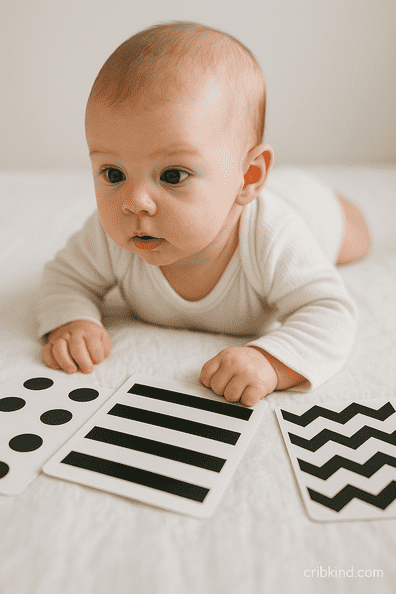
- Sight: Everything’s blurry at first, except bold, high-contrast patterns think black and white stripes about 8 to 12 inches from their face.
- Hearing: Your voice is their favorite sound, even when you’re just mumbling about how tired you are. Lullabies, humming, or even talking through your to-do list it all works.
- Touch: Skin-to-skin contact, gentle stroking, those tiny cuddles that make everything else disappear.
- Movement: Rocking, swaying, chest-to-chest tummy time. Sometimes just walking in circles around the living room at 2 AM.
- Smell: Your scent is comforting and familiar.
Newborn sensory activities are simply little moments that engage one or more of these senses.You’re already doing them every time you sing, cuddle, or smile.
Everyday Newborn Sensory Activities (0 to 2 Months)
Here are safe, simple, and fun newborn sensory activities you can do at home no gadgets required.
Sight
- High contrast cards: I printed some black and white geometric patterns from Google and stuck them near Vihaan’s changing table with painter’s tape. He’d lock onto them like they were the most riveting thing he’d ever seen.
- Face time: This is the original toy. With Eeshaan, I’d hold him about 8-10 inches away and just… make faces. Big smiles, exaggerated expressions, slow blinks. He’d study me like I was a puzzle he was trying to solve
- Different views: Walk around the house slowly, show them lights, windows, or ceiling fans.
Hearing
- Sing and hum: Off key is fine, your voice is their favorite.
- Nursery rhymes: Bonus points for ones with touch (“Round and Round the Garden”).
- Respond to coos: Treat it like a conversation. Pause, smile, answer back.
Touch
- Gentle stroking: During late-night diaper changes with Vihaan, I’d take a soft muslin cloth and slowly trace his tiny hands and feet. It kept him calm when he was fighting sleep and honestly, it kept me grounded when I was running on pure fumes
- Skin-to-skin: Calms babies and regulates heartbeat & temperature.
- Massage: Slow, firm strokes with baby safe oil before bedtime.
Movement
- Tummy time: With both kids, I started with chest to chest tummy time them on my chest while I was semi reclined on the couch. Vihaan tolerated maybe 2 minutes before protesting. Eeshaan was more chill and would just rest his cheek against my shirt and make little grunting sounds. Either way, it counts
- Gentle rocking: In your arms, or slow swaying to soft music.
- Lap time: Lay baby across your lap and gently pat their back.
Real moment: One night, I read out my grocery list while rocking my son. He cooed back like we were having the most important meeting ever. Honestly? Best duet of my life.
Why Sensory Activities Help Development
According to early childhood specialists, newborn play and stimulation:
- Build brain connections for learning.
- Strengthen muscles during tummy time.
- Improve language development (every word you say counts).
- Build trust and bonding (play teaches your baby you’ll respond to them).
- Spotting Sensory Overload
Here’s where Baby Sensory’s guidance is crucial: more isn’t always better. Babies can get overwhelmed.
Signs your baby might be overstimulated
- They turn their head away like you suddenly became boring
- The fussing kicks up a notch higher pitched, more urgent
- Their little body gets squirmy and tense, or they start flailing their arms
If you observe any of these cues, you can pause these activities
How to Calm an Overstimulated Baby
If your newborn has had enough, here’s what helps:
Dim the lights or move to a quieter space.
- Hold them chest-to-chest: Your heartbeat is literally the soundtrack they’ve been hearing for months. With Eeshaan, this was my go to reset button works almost every time.
- Swaddle (for babies under 3 months) or wrap snugly in a soft blanket.
- White noise: shushing, fan, or a soft hum mimics womb sounds.
- Slow rocking or gentle pats: predictable movement feels safe.
Remember, your calm is their calm. Babies pick up on your state, so breathe, slow down, and keep it simple.
I have learned this the hard way. One evening, Eeshaan was fussy and overstimulated, and I was getting frustrated trying to fix it. My wife gently took him, dimmed the lights, and just swayed slowly without saying anything. He calmed down in under a minute. Lesson learned: sometimes your baby doesn’t need solutions they need your steady heartbeat and nothing else
How Long Should Newborn Sensory Play Last?
Newborns run on a play – rest – play cycle. Their tolerance for stimulation is short think minutes, not hours.
- Start with 5 to 10 minutes tops. Newborns have tiny attention spans. With Vihaan, even 3 minutes of tummy time felt like an eternity (for both of us).
- Watch for their I’m done signals turning away, fussing, that particular whine that means enough. When you see it, stop. You’re not giving up, you’re listening.
- Build up gradually as your baby grows
- Quality matters more than quantity. Always.
Newborn Sensory Play Ideas by Daily Routine
The best part? You can fit sensory play into everyday tasks.
- Diaper changes: This is prime face-to-face time. I’d make ridiculous expressions at Vihaan big eyes, silly sounds, the works. Sometimes I’d narrate what I was doing like a sports announcer: And now… the wipes!
- Bath time: Gentle splashes, letting warm water run over their little hands, talking them through it. Some babies love it. Others (like Eeshaan at first) scream like you’re torturing them. Both are normal.
- Feeding breaks : Soft eye contact
- Bedtime routine: Lullabies, massage, quiet rocking.
Sensitive Babies: Extra Tips
Some babies are extra sensitive to light, sound, or touch. They might cry more during bath time, or squirm when dressed. For them:
- Use low lighting and calm spaces.
- Stick to predictable routines.
- Offer gentle, slow touch.
Others may seem less responsive and need extra encouragement soft songs, gentle play, or face-to-face time to draw them in. If you notice persistent hypersensitivity or under-responsiveness, check with your pediatrician for guidance.
Why Newborn Sensory Stimulation Really Works
Here’s what blew my mind when I researched this: those tiny moments humming during diaper changes, making silly faces, chest to chest time they’re literally building your baby’s brain. Not in some abstract way, but actually creating neural pathways for:
- Memory
- Movement
- Emotional control
- Early words
So when you’re exhausted at 3 AM and you’re just talking nonsense to your baby? You’re doing brain development work
So when you talk, sing, or smile at your baby, you’re not “just passing time.”
You’re shaping their brain in the most natural, loving way possible.
Your face really is their favorite science experiment.
Newborn Activities at Home (0-8 weeks)
You don’t need extra time or special planning. Sensory play already fits into what you’re doing.
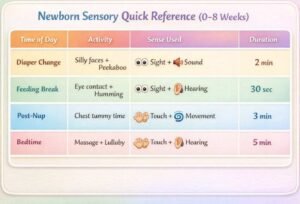
- During diaper changes (2 minutes): Play Where’s baby? by gently lifting and lowering their head. It turns a routine task into a little bonding game.
- During feeding breaks (30 seconds): Hold their gaze and hum softly. Your voice is calming and deeply familiar.
- While folding laundry (1 minute): I’d prop Vihaan in his bouncer next to the couch and narrate everything like a cooking show. ‘Okay, so this is Daddy’s shirt… we’re folding the arms… and now it goes in the pile.’ He’d watch my hands like I was performing surgery. Sometimes he’d coo back. Most times he’d just stare, unimpressed.
- After naps (3 minutes): Chest tummy time and a little conversation with coos and smiles.
These tiny moments add up in a big way
FAQs Parents Actually Ask
What are fun sensory activities for newborns?
Simple is best: singing, tummy time, gentle massage, black-and-white cards, and talking face to face. Everyday routines are full of opportunities.
When should I start sensory activities with my baby?
From day one. Newborns are already processing the world. Start with gentle activities like touch and singing, then slowly add more as they grow.
Which item is developmentally appropriate for newborn sensory stimulation?
Think safe, soft, and large: cloth books, rattles, scarves, your face, your voice. Avoid small items (choking hazard) or overly bright/noisy toys.
How do I know if my baby is overstimulated?
Watch for cues: turning away, fussiness, jerky movements, color changes, or high-pitched cries. That’s your baby saying “too much.”
Can I overstimulate my newborn by playing too much?
Yes.it happens easily. Short sessions, calm settings, and reading cues will keep things balanced.
4 Comments