DIY Busy Board Ideas for Toddlers
The week Eeshaan figured out how to open our kitchen drawers.. I knew I was in trouble.
Not because he was naughty. Because he was curious. Very curious.
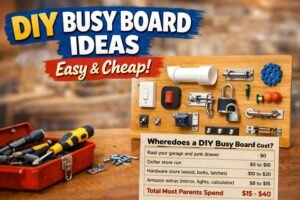
He wanted to twist knobs. Pull handles. Open things. Close things. Repeat 47 times.
So I built him a DIY busy board.
And honestly? It redirected so much of that chaos into something productive.
What Is a Busy Board?
A busy board (also called a sensory board or activity board) is a wooden board filled with real-life objects toddlers can safely explore.
Things like:
- Door latches
- Locks and keys
- Zippers
- Light switches
- Knobs
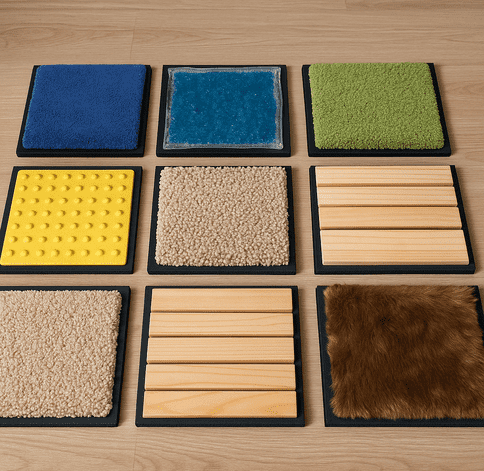
- Textures
Instead of constantly pulling your cabinet handles, they get their own safe version.
And here’s the important part.
Toddlers touch everything because their brain is wiring through their hands. According to the American Academy of Pediatrics, hands-on sensory play supports fine motor skills and early problem solving.
So this isn’t just distraction. It’s development.
25+ Best Things to Put on a Busy Board (Toddler-Tested)
Before buying anything, check your house first. I found half my items in our storage drawer.
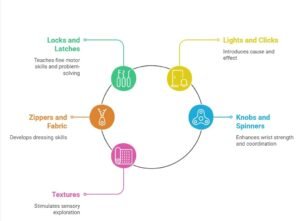
Locks and Latches
- Sliding bolt latch
- Padlock with key
- Hook-and-eye latch
- Chain lock
The first time Eeshaan unlocked the padlock, he looked at me like he solved world hunger.
Lights and Clicks
- Puck light
- Doorbell chime
- Small bell
Cause and effect is magic at this age.
Zippers and Fabric
- Old jacket zipper
- Large sewn buttons
- Velcro strip
These are the exact movements they’ll need later for dressing themselves.
Knobs and Spinners
- Cabinet handles
- Drawer pulls
- Fidget spinner
Rotational wrist movement builds strength in ways we don’t notice.
Textures
- Felt
- Sandpaper
- Burlap
- Foam sheet
- Bubble wrap
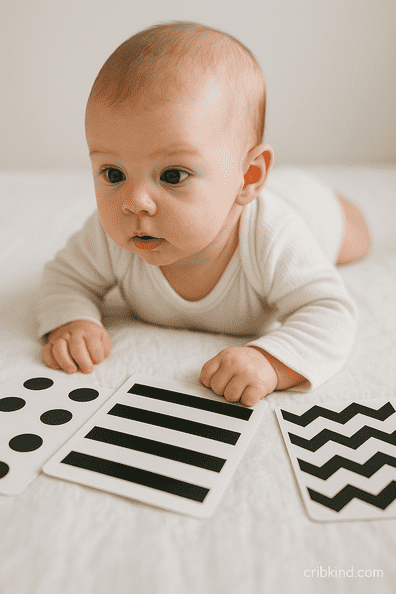
If your baby is between 6 to 12 months, textures matter even more. I wrote more about early sensory play here:
Simple Sensory Play Ideas for Babies
Mirror
An unbreakable baby mirror is always a hit. Face recognition is a real developmental milestone.
Ball Drop
I added a small PVC pipe at an angle. Drop a pom pom in. Watch it fall. Repeat. Repeat again.
Cheap. Effective.
What You Need to Build It
- 3/4 inch plywood (18×24 inches is perfect)
- 120 grit sandpaper
- Screws and washers
- Drill or screwdriver
- Hot glue gun
- Non-toxic paint (optional)
Total cost for me was around ₹1,500. Most of that was the wood.
Step-by-Step Build Guide
- Sand everything first. Every edge. Every corner. Do not skip this.
- Lay out items before attaching anything.
- Take a photo of the layout.
- Use screws for heavy items.
- Hot glue lighter materials.
- Pull hard on every attachment before giving it to your child.
I almost skipped the second safety check. One latch came loose when I pulled hard. That could have been dangerous.
What NOT to Put on a DIY Busy Board
This part matters just as much as what you include.
I’ve seen some Pinterest builds that honestly made me nervous.
- Anything smaller than a toilet paper roll tube: if it fits fully inside, it’s a choking risk.
- Real electrical outlets or live wires : please don’t. Even if “it’s disconnected.” Toddlers copy what they see.
- Loose decorative beads or buttons : fine on day one, dangerous three months later.
- Toxic paint or oil-based stain: toddlers mouth everything. Use non-toxic, water-based finishes only.
- Heavy items attached only with glue : glue fails. Screws don’t.
Do the tug test.
Pull on every piece harder than your toddler would. If it shifts even slightly, fix it.
Where to Set Up Your Busy Board
Parents ask this more than you’d think.
- Flat on the floor: best for 6 to 12 months. Easy reach. No tipping risk.
- Propped at a slight angle against a wall : good for 1 to 3 years. Lean it in a corner for stability.
- Wall-mounted : most permanent option. Use proper anchors and make sure screws go into studs.
- Freestanding easel frame: attach with zip ties to a sturdy wooden easel.
If you mount it, double-check height. Your toddler’s elbows should bend naturally while playing.
Safety Rules (Read This Twice)
- No small detachable pieces for kids under 3.
- Supervision is required, especially under 18 months.
- Check weekly for loose screws.
- No sharp edges.
- No toxic paint.
If your child still mouths everything aggressively, wait a little before introducing metal pieces.
Busy boards are tools. Not babysitters.
Age Guide
| Age | Best Additions |
|---|---|
| 6 to 12 months | Textures, mirror, soft bell |
| 12 to 24 months | Lights, zippers, simple latches |
| 2 to 3 years | Padlocks, ball drop, knobs |
| 3 to 4 years | Shoelace threading, harder locks |
Are DIY Busy Boards Actually Worth It?
Yes.
But not because they keep your toddler quiet.
They’re worth it because they let your child practice real-life skills in a controlled space.
And there’s something different about giving your child something you built yourself.
When Eeshaan unlocked that padlock on his own and turned around smiling… I didn’t see a toy.
I saw problem-solving happening in real time.
FAQs
What are the best DIY busy board ideas for toddlers?
Latches, locks, zippers, light switches, mirrors, textures, and anything that turns or clicks.
Are busy boards safe for 1-year-olds?
Yes, if supervised and built properly. Avoid small detachable parts.
How much does it cost to build one?
Usually between ₹800 and ₹3,000 depending on materials.
Do I need power tools?
No. A screwdriver works. A drill just makes it faster.
Is it better than buying one online?
Store-bought boards are fine. But building one lets you customize it for your child’s stage.