Ultimate Guide to Montessori Sensorial Activities
Walk into a Montessori classroom and you’ll probably see a kid completely absorbed stacking wooden cubes, or slowly running tiny fingers along a strip of sandpaper.
To most of us, it looks almost too simple. Honestly, my first thought was: that’s it?
But Dr. Maria Montessori had a very different idea about how children learn. She believed kids don’t just need their senses entertained. They need them trained. Quietly, intentionally, one sense at a time. And that’s why sensorial activities sit at the heart of her whole method.
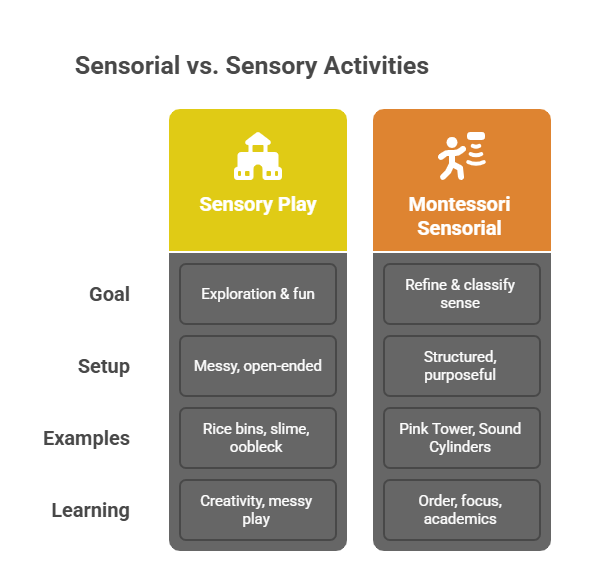
Here’s the short version: sensory play entertains the senses. Montessori sensorial activities train them.
- Sensory play is the messy, open-ended stuff shaving cream, water tables, a bin full of rice where kids just dive in and do their thing.
- Montessori sensorial activities are different. More intentional. Each one focuses on a single sense and uses simple materials to help a child notice, compare, and classify what they’re experiencing.
- A simple way to think about it: sensory play is joyful chaos. Sensorial work is calm, focused discovery. Both have real value but Montessori’s version quietly lays the groundwork for math, language, and logical thinking down the road.
With that, let’s start with what most people actually mean when they say sensory play.
We started with just an Oball. That was it. Over time we layered in more activities, and what genuinely caught me off guard is that Eeshaan almost always preferred everyday home objects over proper toys. A wooden spoon over a rattle. A scarf over a sensory cube. A cardboard box over basically anything we actually bought him. That tells you something real about how kids learn.
Sensorial vs Sensory Activities: What’s the Difference?
You’re probably reading this in a stolen five minutes maybe even hiding in the bathroom so here’s the quick version:
| Feature | Sensory Play (General) | Montessori Sensorial Activities |
|---|---|---|
| Goal | Exploration and fun | Refine and classify one sense |
| Setup | Messy, open-ended | Structured, purposeful |
| Examples | Rice bins, slime, oobleck | Pink Tower, Sound Cylinders, Color Tablets |
| Learning | Creativity, free play | Order, focus, foundation for academics |
My son loved shaving cream play. Messy, loud, completely hilarious. But one afternoon I swapped it for a DIY sound cylinder two spice jars, one filled with beans, one with rice and he went completely quiet. Just sat there, shaking and comparing. Different kid entirely.
Why Sensorial Activities Matter in Montessori
Dr. Montessori wasn’t just designing pretty wooden blocks for fun. Every material has a real purpose behind it:
- Refining the senses: Sight, touch, hearing, smell, taste, temperature, weight and even the stereognostic sense, which means identifying objects purely by touch without looking. One sense at a time. No sensory overload, no rushing.
- Building order and logic: Kids practice sorting, sequencing, and comparing. The Pink Tower looks like a stacking toy. It’s actually early math in disguise.
- Independence through self-correction: The materials are built so kids spot their own mistakes. No hovering from you. No constant fixing. They figure it out and that matters more than getting it right the first time.
- Preparing for academics: Sensorial work quietly builds the thinking patterns behind math, language, and science. No pressure. No worksheets. Just hands and objects and time.
- Emotional regulation: Deep focus leads to calm confidence. You’ll notice it small wins, real pride, and a kid who isn’t constantly looking to you for validation.
If I had to sum it up in one line: sensorial work turns raw curiosity into something focused and lasting.
Montessori Sensorial Materials (The Full List + Home Alternatives)
You don’t need a $500 Montessori material set. The Pink Tower is iconic I get it but most families honestly don’t need the full kit to see results. Everyday items work just as well when you use them with some intention behind it.
| Sense | Montessori Material | DIY / Home Alternative |
|---|---|---|
| Visual | Pink Tower, Color Tablets, Red Rods | Blocks, stacking cups, paint swatches |
| Tactile | Fabric Boxes, Touch Boards | Texture swatches sandpaper, velvet, bubble wrap |
| Baric (Weight) | Baric Tablets | Small bags filled with rice or beans at different weights |
| Thermic (Temperature) | Thermic Bottles | Sealed jars one warm, one cool |
| Auditory | Sound Cylinders, Bells | Spice jars with rice, beans, or coins inside |
| Olfactory | Smelling Bottles | Cotton balls with cinnamon, coffee, or vanilla |
| Gustatory | Tasting Bottles | A simple tasting tray sweet, sour, salty |
| Stereognostic | Mystery Bag | A cloth bag with small safe objects from around the house |
Sensorial Activities by Age
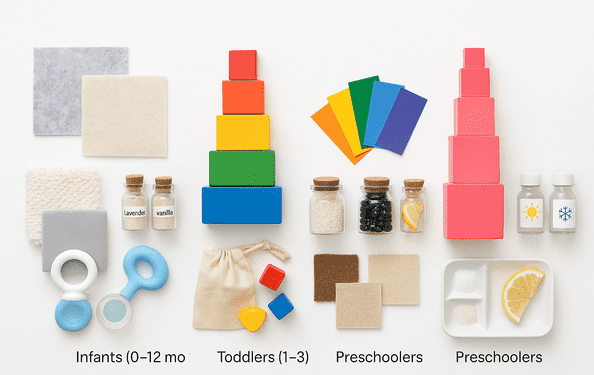
Infants (0 to 12 months)
Slow is the whole strategy here. Watch their face. The moment they lose interest, you stop not five minutes later.
- Texture mats with soft and rough cloths laid underneath them
- Fabric swatches of different materials for their hands to explore
- Rattles simple auditory cause and effect
- Scent jars with lavender or vanilla, held gently nearby
Toddlers (1 to 3 years)
Ten minutes of real focus beats an hour of scattered play. Keep sessions short and let them come back for more.
- Stacking blocks visual discrimination and a satisfying sense of order
- Mystery bags with chunky, safe household objects
- Sound jars rice in one, beans in another, shake and match
- Smelling jars with lemon on one side, cinnamon on the other
Preschoolers (3 to 5 years)
This is the age where repetition becomes everything. They’ll do the same activity fifteen times in a row and it will drive you slightly mad but that repetition is exactly how mastery happens. Let it go.
- Pink Tower or DIY nesting boxes for visual size discrimination
- Color sorting using paint swatches from a hardware store
- Fabric matching rough versus smooth, thick versus thin
- Thermic jars one warm, one cool, feel the difference
- Taste trays with sweet, salty, and sour options laid out simply
DIY Sensorial Activities at Home
No classroom needed. These work on any ordinary afternoon with things already in your kitchen:
- Mystery Bag: Drop in a spoon, a small block, a toy car. No looking just feel and guess. Takes thirty seconds to set up and kids take it seriously.
- DIY Sound Cylinders: Fill spice jars with rice, beans, coins, or pasta. Shake. Match by sound. Eeshaan spent twenty minutes on this the first time.
- Texture Walk: Tape bubble wrap, sandpaper, and a soft cloth strip to the floor. Step back. Let them walk barefoot across it and figure out the rest themselves.
- Smelling Jars: Cotton balls with coffee, vanilla, or lemon in small jars. One at a time. See if they can name it without looking at what’s inside.
- Weight Bags: Same size bags, different fillings beans, rice, coins. Let little hands pick them up and compare. Simple concept, genuinely absorbing for toddlers.
Always supervise, seal containers properly, and skip anything small for babies who are still putting everything in their mouths.
FAQ: Parents Actually Ask
What are sensorial activities in Montessori?
Structured exercises that train one sense at a time using intentional, simple materials. The goal is focused attention and classification not entertainment.
How are sensorial activities different from sensory play?
Sensory play is messy, open-ended, and throws all the senses in at once. Sensorial activities are structured, isolate a single sense, and are specifically designed to build the thinking patterns that support academic learning later.
Why are sensorial activities important in Montessori?
They build order, independence, and deep focus and quietly lay the foundation for math, language, and science long before any formal learning begins.
Can I do sensorial activities at home without buying materials?
Yes, completely. Rice, fabric scraps, sealed jars, stacking cups that is genuinely all you need. Keep the setup simple, focus on one sense at a time, and it works just as well as any classroom material.