Sensorial vs Sensory activities
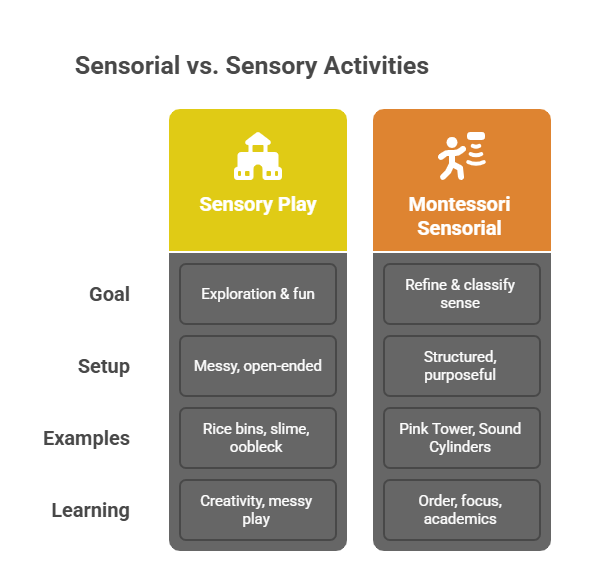
Many parents use sensory and sensorial interchangeably but in Montessori, they are not the same. Sensory play is about free, messy exploration, while Montessori sensorial activities are structured exercises designed to refine one sense at a time
If you’ve ever Googled sensory play, you’ve seen it: rice bins, oobleck, water tables, slime. Now scroll a Montessori blog, and suddenly you see sensorial activities kids carefully stacking wooden blocks or matching sound jars.
They may look similar, but they’re actually different.
This article clearly explains the difference between sensory play and Montessori sensorial activities, with examples parents can actually use.
This mixup happens all the time, even among early childhood bloggers. The words sound alike, but in Montessori, sensorial has a very specific meaning. And if you’re a U.S. parent trying to figure out what’s best for your child, the difference matters.
What is Sensory Play?
Sensory play is a common early childhood term you’ll see everywhere in daycares, parenting blogs, playgroups, and therapy rooms. In simple words, it means any activity that lets a child explore through their senses.
And that includes what they see, touch, taste, smell, hear, and even how their body moves. So when your child is squishing playdough, splashing in water, digging in sand, or letting rice slip through their fingers, they are doing sensory play. It’s messy, playful, and very child-led and honestly, that’s the beauty of it.
At home, for example, I’ve seen this so clearly with Eeshaan. After a long or overstimulating day, he usually settles much faster when he’s slowly pouring water between cups or simply letting rice slip through his fingers in a tray. And in those moments, he isn’t really “learning” in a structured way he’s just unwinding, exploring at his own pace, and being his curious little self.
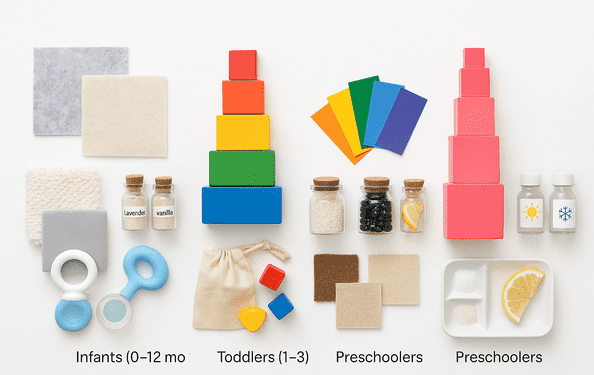
If you’re looking for specific age-appropriate ideas from infant play to preschool activities I’ve put together a full guide on sensory activities for infants, toddlers, and preschoolers that you can browse by your child’s age
What are Montessori Sensorial Activities?
Sensorial activities are a Montessori-specific idea. Dr. Maria Montessori didn’t just add a few sensory games to her classroom instead, she designed an entire Sensorial area based on her scientifically observed method of child development.
Here, the goal is a little different from regular sensory play. Instead of letting children engage all their senses at once, Montessori sensorial activities help them refine one sense at a time using structured, graded, and self-correcting materials.
In Montessori classrooms, these are often referred to as Montessori sensorial materials things like the Pink Tower, Sound Cylinders, and Color Tablets each designed with a clear purpose and a logical sequence.
With Eeshaan, I’ve noticed something interesting. On quiet mornings, when we use simple versions of materials like sound jars or texture cards, he naturally slows down, focuses, and moves more deliberately. As a result, it feels calmer, more thoughtful, and oddly satisfying for him almost like gentle, meaningful “work” that still feels playful.
Key Differences: Sensory vs Sensorial
Here’s a clear side-by-side comparison of sensory vs sensorial activities:
| Feature | Sensory Play (General) | Montessori Sensorial Activities |
|---|---|---|
| Origin | General early childhood education | Maria Montessori’s curriculum (1907 onwards) |
| Goal | Engage & explore all senses for fun + curiosity | Refine one sense at a time, build order & logic |
| Setup | Messy, open-ended, multi-sensory | Structured, graded, self-correcting |
| Examples | Rice bins, slime, shaving cream, water tables | Pink Tower, Sound Cylinders, Color Tablets |
| Learning | Creativity, exploration, sensory regulation | Order, classification, academic foundations |
As a parent who uses both play-based and Montessori-inspired activities at home, I’ve seen how differently these two approaches feel in practice
What Do Sensorial Activities Actually Mean?
The word sensorial isn’t just Montessori jargon. It’s her way of saying: kids don’t just need exposure, they need refinement.
Core principles of Montessori sensorial activities:
- Isolate one sense (e.g., only sound or only touch)
- Follow a graded sequence (big → small, loud → soft, rough → smooth)
- Use control of error (child can self correct)
- Develop classification skills (matching, sorting, comparing)
Examples of Sensory Play
Common examples of sensory play you’ll see in homes and preschools include:
- Rice or bean bins with scoops and funnels
- Shaving cream or foam painting
- Water tables with cups, boats, sponges
- Playdough with cookie cutters
- Finger painting
- Mud kitchens and nature exploration (leaves, pinecones, sand, dirt)
Examples of Montessori Sensorial Activities
The best part about Montessori sensorial activities. Most of them look like play. Your child has no idea they’re building the foundation for reading, math, and focus. They just think they’re having fun.
Here are some of the most common ones:
- Pink Tower: Ten pink cubes, stacked from largest to smallest. Sounds simple. But your toddler is learning to compare sizes visually, control their hand movements, and self-correct when it falls. It’s also quietly preparing their brain for early math concepts
- Sound Cylinders: It’s one of those activities where you realize how much a child’s ears can do when given the chance and that kind of auditory attention is quietly building the foundation for language.
If you’ve been wondering whether your child is on track with their words, this guide on how many words your child should say by age breaks it down clearly.
- Color Tablets: Starting with the three primary colors, then gradually moving to subtle shades. Children learn to sort and grade colors from light to dark. It’s one of those activities where you watch your toddler focus harder than you’ve ever seen them focus before.
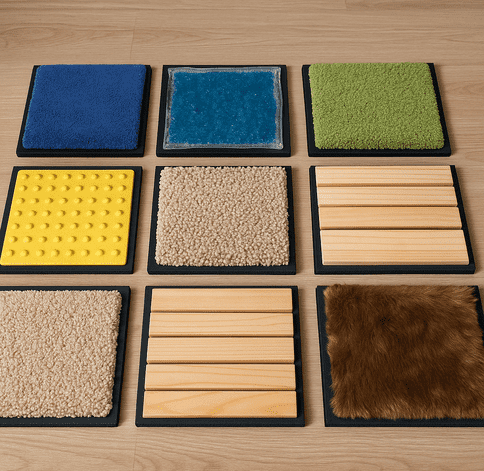
- Fabric Matching: identify textures (rough vs smooth).
- Thermic Bottles: Small jars at different temperatures, from cool to warm. Your child arranges them in order. It sounds almost too simple until you realize most children have never been asked to pay attention to temperature as a sensation
- Baric Tablets: compare weights of wooden tablets.
- Mystery Bag: Take a cloth bag and fill with everyday objects. Your child reaches in, feels around, and names what they find without looking. It’s called the stereognostic sense the brain’s ability to recognize objects through touch alone. And watching a two-year-old figure it out is genuinely one of the best things.
When to Use Each (Practical Parenting Guide)
Here’s how I use both with my own child:
- Sensory play after a long day, for fun and regulation. Messy play helps get the wiggles and big feelings out.
- Sensorial activities quiet mornings or focused playtime. Perfect when I want him calm, concentrating, and building independence.
- Think of sensory play as the “playground” and sensorial work as the “classroom” but both are still playful
Montessori Sensorial Activities at Home (Easy DIY Ideas)
You don’t need expensive Montessori materials to do this at home. Most of what you need is already in your kitchen or junk drawer.
- DIY Sound Jars: Take a few small containers old spice jars, dabba lids, film canisters, even small plastic bottles. Fill pairs of them with rice, pasta, coins, or lentils. Your child shakes and matches the ones that sound the same. Eeshaan loved this at around 18 months. He’d shake each one so seriously, like he was doing very important work.
- Texture Walk: Tape different materials to the floor in a line bubble wrap, sandpaper, a piece of soft cloth, a jute mat, a smooth plastic folder. Let your toddler walk barefoot across them. You’ll hear very strong opinions about the bubble wrap.
- Color Sorting: Grab a few paint swatches from any hardware store even local ones carry them. Sort them by color family, then try arranging them from lightest to darkest. It works even better if you let your child lead and just watch what they do with them.
- Scent Jars: Small cotton balls soaked in things with a strong scent coffee, vanilla, lemon, haldi, tulsi. Cover each jar with a cloth held by a rubber band so they can smell but not see. Your child learns to name and match scents. It’s surprisingly hard, even for adults.
- Mystery Bag : Any cloth bag works an old cloth bag, a dupatta folded over, even a pillowcase. Drop in five or six everyday objects: a spoon, a small bottle, a toy car, a key, a pencil. Your child reaches in, feels around, and tries to name what they’re touching. No peeking. The concentration on their face is worth everything.
Why the Difference Matters
Understanding the difference helps parents choose the right activity for the right moment
- Sensory play is for the messy, loud, joyful afternoons when your child just needs to feel things and be free.
- Sensorial activities are for the quieter moments when you notice your toddler is focused, curious, and ready to really pay attention.
Neither is better. They serve different parts of your child’s development.
- If you want creativity, freedom, and pure fun sensory play.
- If you want concentration, order, and early academic foundations: sensorial activities.
- If you want both which, honestly, is what most days look like blend them naturally and follow your child’s lead.
FAQs Parents Ask
What are sensorial activities in Montessori?
Sensorial activities in Montessori are structured learning exercises designed by Dr. Maria Montessori are structured learning exercises designed help children refine one sense at a time such as sight, touch, or hearing using carefully graded, self-correcting materials like the Pink Tower or Sound Cylinders.
Is sensorial the same as sensory?
No. Sensory refers to general, open-ended sensory play that engages multiple senses at once (like water play or slime). Sensorial is a Montessori-specific approach that focuses on structured activities to refine individual senses in a logical and ordered way.
Can parents do Montessori sensorial activities at home?
Yes. You don’t need expensive Montessori materials. You can use everyday items like spice jars for sound matching, fabric scraps for texture sorting, paint swatches for color grading, or a simple mystery bag for touch-based guessing.
Do children need both sensory and sensorial activities?
Yes both are important. Sensory play supports creativity, emotional regulation, and free exploration, while sensorial activities build focus, concentration, classification skills, and early academic foundations.