Average age for baby’s first words list
That Magical First Word: When Babies Start Talking
Every parent remembers their baby’s first word. For us, it was one of those small moments that stays in your heart forever. It could be mama, tata, or dada. Sometimes it’s not even a clear word just a sound or a name the baby hears often.
In our case, we have a Pomeranian dog named Chitti, and Chitti slowly became one of our baby’s favorite words. Hearing it for the first time made us smile instantly.
Eeshans first word is thatha and we are waiting for vihaans first word.
Moments like these remind us how closely babies observe and connect with their everyday world, and it’s something we know we’ll always cherish.
Whatever it is, that first word hits different. It’s the moment your baby crosses from sound making into real conversation.

When Do Babies Say Their First Words?
Most babies say their first real word between 10 and 14 months.
Many babies say their first word before their first birthday. That word doesn’t need to be clear or perfect.
Ba for ball or da for dog counts if your baby uses it again and again with meaning.
Babies usually begin with simple sounds and gradually turn them into fuller words over time.
By:
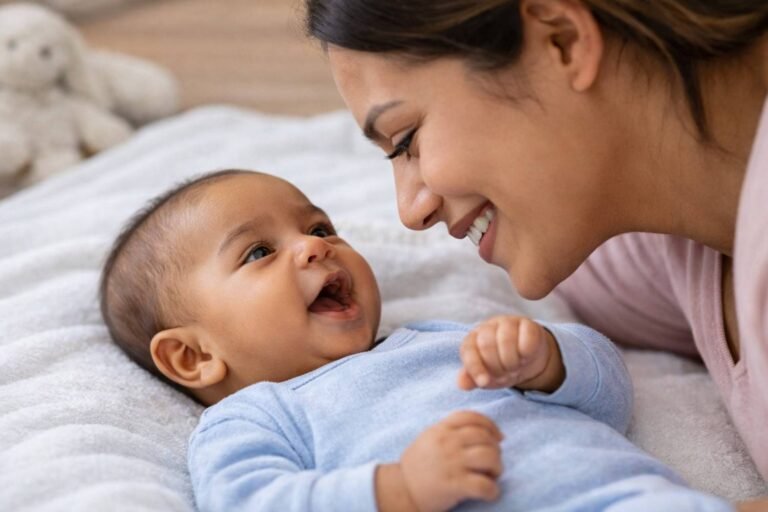
- 0 to 6 months : cooing, laughing, and experimenting with basic sounds
- 12 months: 1 to 3 words (simple, familiar)
If you’re wondering how many words your baby should be saying at different ages, you might find this helpful:
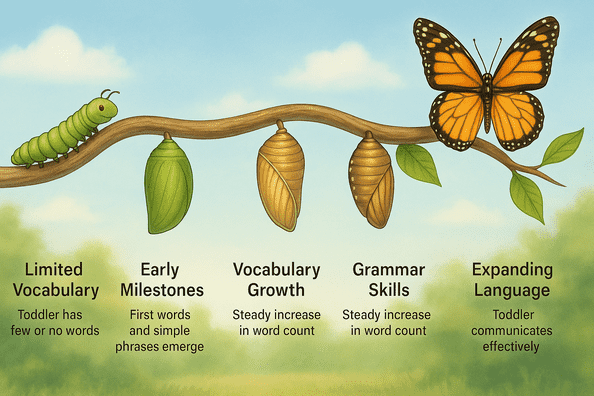
How Many Words Should a toddler say by age?
Most Common Baby’s First Words List (With Examples)
Based on research and parent reports, here are the early favorites (this is just for your reference, your baby words might be completely different )
Words 1 Year Olds (toddlers) Should Know
By around 12 months, many babies can say a few meaningful words. These don’t have to be clear or perfect what matters is consistent use with meaning.
Common words many 1-year-olds know
People
- Mama
- Dada
- Papa
- Amma / Nana (or other family names)
Social words
- Hi
- Bye
- No
Everyday objects
- Ball
- Milk
- Bottle
- Book
- Car
Animals
- Dog
- Cat
- Cow
(Sometimes as sounds like ba for ball or da for dog)
Action / request words
- More
- Up
Expressions
- Uh-oh
Why Do Babies Say These Words First?
Babies tend to say the words they hear most and the ones that are easiest to pronounce. That’s why early words often include social phrases (hi), familiar people (mama), and fun, exciting objects (ball).
How to Encourage Baby’s First Words
No drills needed. Daily life is the best classroom.
- Repeat often: Say ball every time you roll it
- Use gestures: Wave when you say bye bye
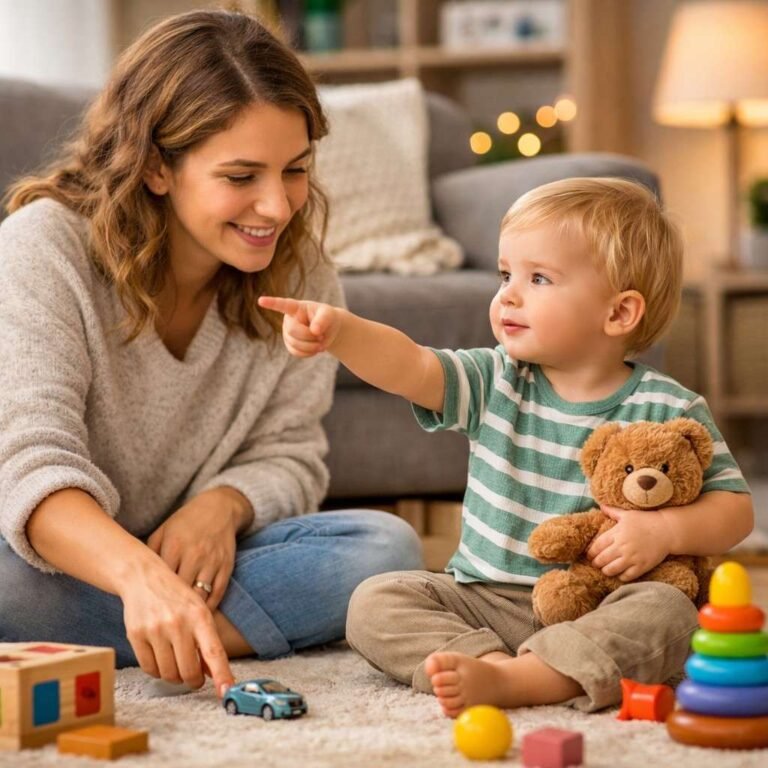
- Label interests: Dog when they point
- Pause and wait: Start a phrase and let them fill it in
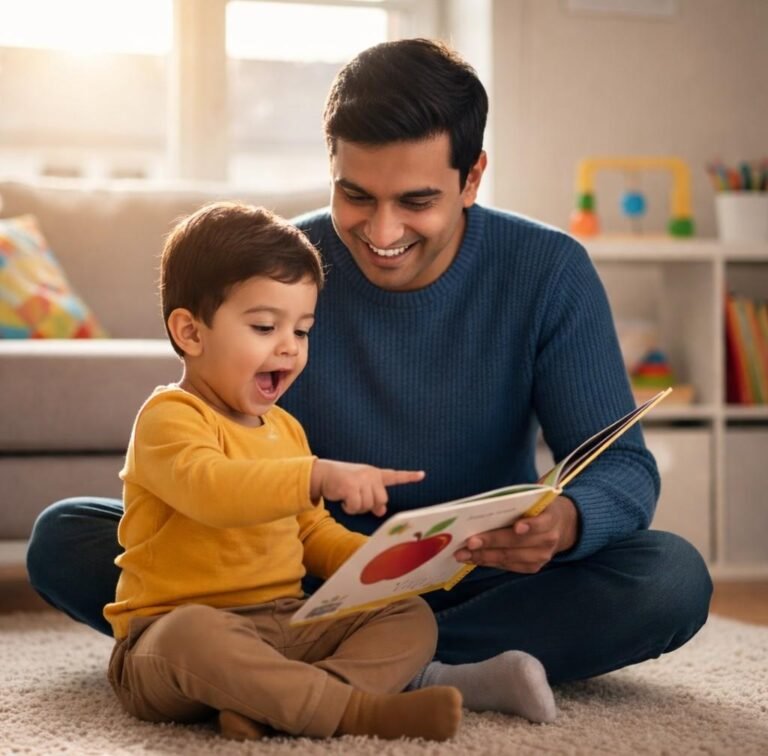
- Read again and again: Repetition helps words stick
- Board books / flash cards: Based on your comfort, you can introduce them gradually and keep it playful
Read and reread. Babies love repetition.
When Eeshaan under one year old, we spent at least 10 minutes daily reading storybooks with expression either before sleep or during the day.
What we noticed was that whatever we spoke to them didn’t show up immediately, but it became visible after a few months.
And that’s the surprising part. One day, it just clicks.
So don’t force your baby to recognize, repeat, or answer. Just do your part. talk, read, play and enjoy the time with your baby. The learning will come in its own time.
As a father, those storytelling moments became a simple but powerful way to connect and encourage language.
Average age for baby’s first word
- 12-15 months
Important Reassurance for Parents About First Words
- Some babies talk early.
- Some babies talk later.
- Both can be perfectly healthy.
Understanding, responding, and attempting to communicate matter more than hitting an exact number of words.
This article shares personal parenting experience and general developmental guidance and is not a substitute for professional medical advice always consult your pediatrician with concerns.
When to Talk to Your Pediatrician
Every child is different, but you might want to bring it up with your pediatrician if you see any one of below
- No babbling or gestures by 12 months
- No words by 18 months
- Fewer than 50 words by age 2
At the same time, don’t underestimate everyday moments. Talking, reading, playing, and simply being present matter more than rushing or pushing just enjoy the journey and let your baby grow at their own pace.
– Written by a father of two, sharing real life parenting experiences.
FAQ: Baby’s First Words & Speech Development
1. Does it count as a first word if it’s just a sound?
Yes. If your baby uses the same sound consistently for the same thing, they’ve made a meaningful connection and that absolutely counts as a first word.
2. My baby is growing up in a bilingual home. Will they talk later?
Not necessarily. From both research and our own experience, bilingual babies may take a little longer to sort words, but they usually develop within the normal range.
3. Does screen time affect when my baby says their first word?
Language grows through interaction, so babies learn best from your voice, facial expressions, and responses not from screens.
4. My baby understands everything but isn’t talking yet. Is that normal?
Yes, this is very common. Understanding comes before speaking, and following simple directions is a great sign of healthy development.
5.Can a baby say their first word at 6 months?
Yes, it can happen, but it’s not very common. Some babies use meaningful sounds around 6 months, but most first clear words usually appear between 10 and 18 months and both timelines can be perfectly normal.
6. how many words should 9 month old say
At 9 months, there’s no fixed word count most babies are just babbling and maybe trying “mama” or “dada,” and it’s still normal if they aren’t saying clear words yet.
One Comment