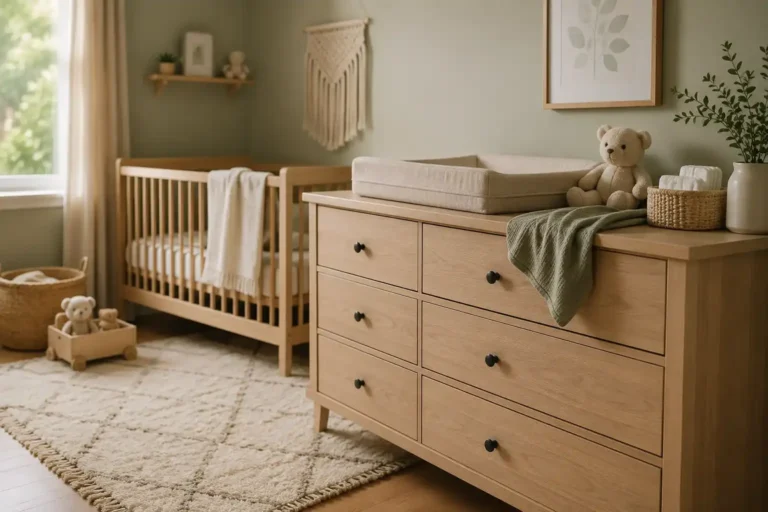
8 Toy Storage Ideas for Living Room That Actually Work
The night Vihaan turned 14 months, I counted the toys on our living room floor at 7pm. Eleven. In a two-foot radius of the couch. A shape sorter, three board books, a xylophone mallet without the xylophone, two rubber ducks (we do not have a bath nearby), and four things I could not immediately identify. I took a photo, sent it to Spandana, and wrote “we need a system.” That began a long education in which toy storage ideas actually work with babies and toddlers, and which just look good on Pinterest while quietly failing in real life.
Living room toy storage ideas: the rules that make any system work
Before specific ideas, two rules that changed everything for us. Both come from watching Eeshan and Vihaan actually interact with storage rather than just looking at it.
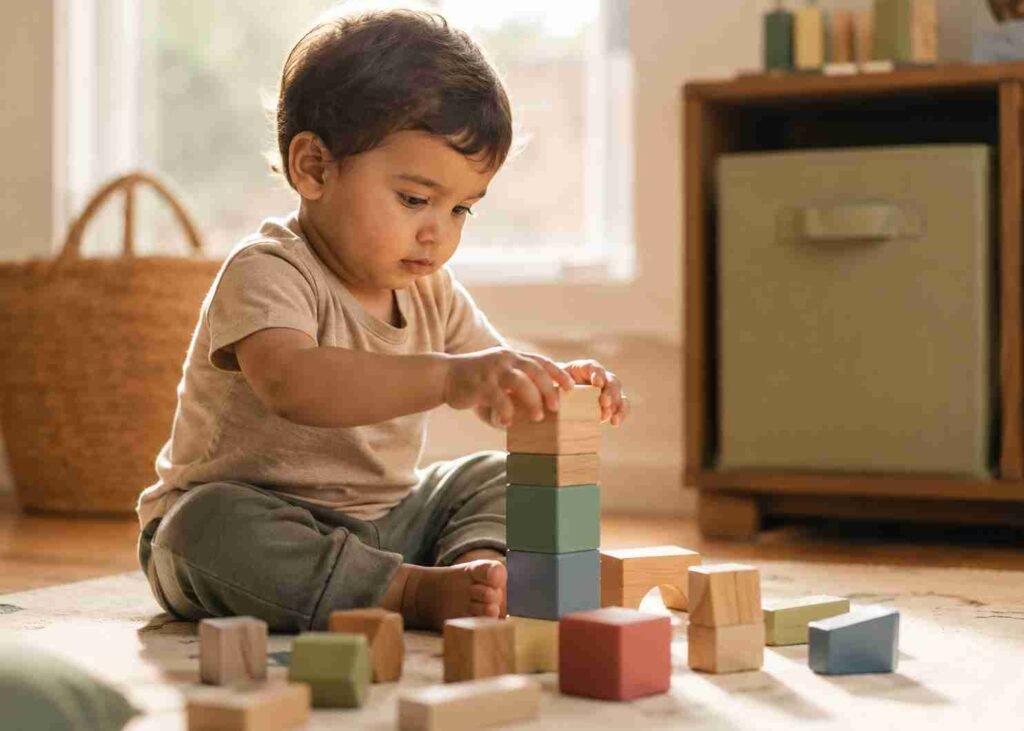
Rule 1: Everything must be reachable and returnable by the child. Storage your toddler cannot access independently is storage you maintain entirely yourself. Open-front bins at floor or low shelf height mean a 14-month-old can get the blocks out and, eventually, put them back. A lidded box requires adult help every single time. We kept one decorative lidded basket for about three months. It became a hole into which things disappeared and were never sorted again. Donated it.
Rule 2: Fewer toys visible at once means more actual playing. This one surprised me. When we had everything out , every toy accessible in every bin , Eeshan would pull things out and abandon them constantly, cycling through a dozen toys in twenty minutes without engaging with any of them. When we rotated to six items at a time, he played with each one longer and with more focus. The storage system is also a curation system. Less out does not mean less available , it means the toys that are visible actually get used.
With both rules in mind, here are the childrens toy storage ideas and general toy storage ideas that held up at our house, sorted by room, toy type, and situation.
Toy storage ideas in living room: 8 setups that hold up with toddlers
1. The cube organizer with fabric bins
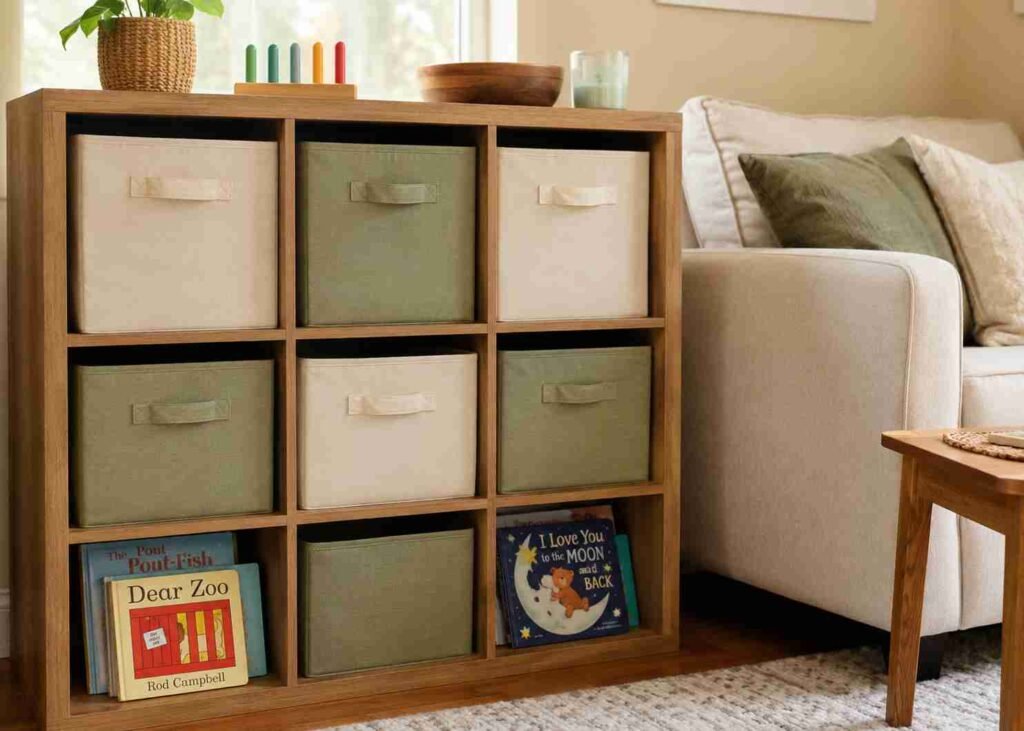
A 4-cube or 6-cube organizer with open fabric bins is the workhorse of living room toy storage. Low enough for toddlers to reach. Open-front so children can see and grab what they want. The fabric bins are soft , no sharp edges when a baby grabs the edge. And the whole unit looks like furniture, not a toy dump. Eeshan has had one since he was 18 months. The bins now hold blocks (left), cars (right), books (centre), and art supplies (top). He has been sorting them himself, roughly accurately, for four months.
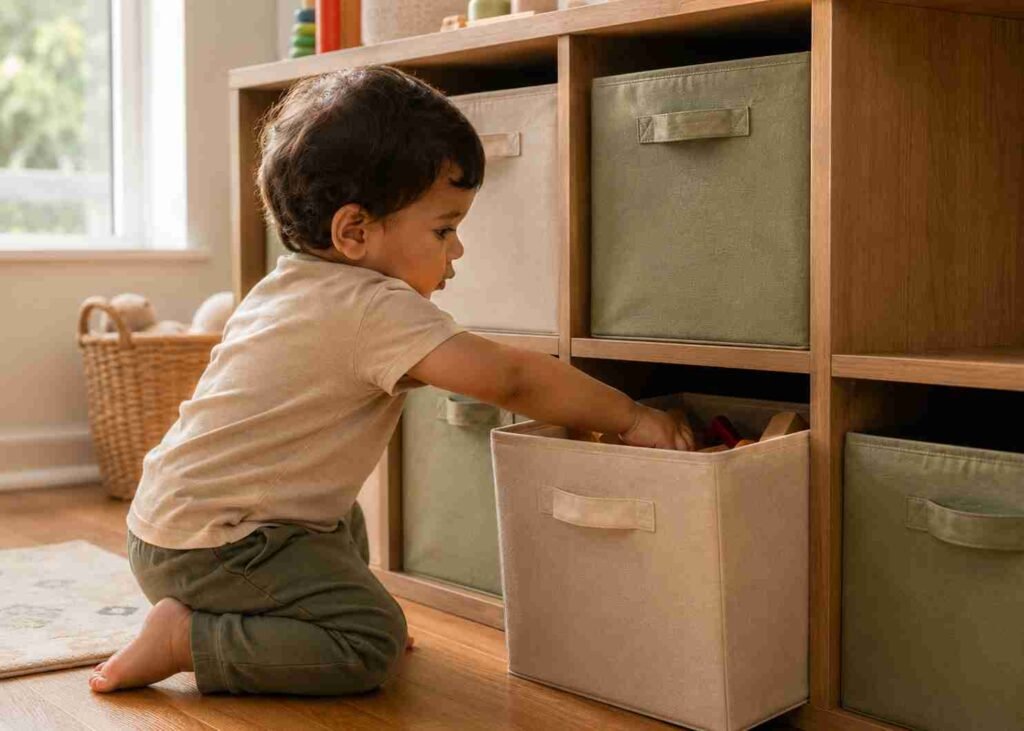
What we use: a 6-cube unit from Target, fabric bins from IKEA KALLAX inserts. The bins are the same size so they are interchangeable. Total cost around $65. The honest downside: the fabric bins accumulate crumbs and small pieces at the bottom that are annoying to clean. Worth it anyway.
2. Open wicker baskets (with a sorting system, not without one)
A large wicker or seagrass basket looks beautiful in a living room and survives long past the toddler years , use it for throw blankets later. The mistake is using one big basket as the only system. One basket becomes a dumping ground immediately; nothing gets sorted, nothing gets found, and the whole thing gets tipped over when the child is looking for the one thing at the bottom.
What works: three medium baskets instead of one large one, each with a clear visual label (a photo or a simple drawn picture for pre-readers). Seagrass baskets at around $20-35 each. One for stuffed animals and plush toys, one for building toys, one for vehicles. With sorting labels, children can actually put things away correctly, which means you do not do it yourself every night.
3. The KALLAX unit (IKEA’s best accidental toy storage solution)
IKEA’s KALLAX shelving unit was not designed for toy storage, but it is close to perfect for it. The square cubbies are exactly the right size for fabric bins, small baskets, or loose display of favourite toys. Low configuration (2×2 or 2×4 on its side) sits at toddler height. The open cubbies mean nothing is hidden and everything is accessible.
What to avoid: combining the KALLAX with those inserts that have doors. The doors get pulled off. Ask any parent of a toddler. Open cubbies only at this stage , add doors later when the children are old enough to open and close them properly.
4. A low bookshelf for board books
Board books are a specific problem. They are small, they fall over when mixed with toys, and children never find the one they want when books are stored spine-out. A low angled bookshelf or magazine rack lets books face-out at toddler level , cover visible, independently chooseable, easy to return. Children’s front-facing bookshelves start around $40 and take books from a pile on the floor to something a 12-month-old can independently choose from.
Spandana found ours at a consignment sale for $15. It is the single most used piece of furniture we own per square foot. Vihaan goes to it 6-8 times a day.
5. Hidden toy storage ideas: the ottoman with storage
An ottoman with a removable lid is the best hidden toy storage idea for living rooms because it doubles as seating and a surface , three functions in one piece of furniture. We use ours for larger soft toys, puzzle pieces in a ziplock bag, and anything that needs to be invisible before guests arrive.
The real use case: the 10-second tidy. When someone is coming over and the floor is covered, everything goes in the ottoman in one sweep. Nobody knows. The ottoman looks like an ottoman. Storage ottomans run from $45 for a basic version to $200+ for upholstered. Basic versions work just as well for this purpose.
The honest downside: toddlers figure out how to open the lid and remove every single thing within about one week of installation. The ottoman is for your storage system, not theirs.
6. Under-sofa rolling bins
Flat rolling storage bins that slide under a sofa are one of the most underused toy storage ideas for living rooms with limited floor space. The space under most sofas is wasted. A flat rolling bin (the kind made for under-bed storage) pulls out for play and disappears completely when pushed back. Ideal for flat toys: puzzles, stacking rings, shape sorters.
Eeshan loved pulling this out at about 20 months , the rolling mechanism itself was entertainment for two weeks before he realised toys were inside.
7. Wall-mounted storage for the “looks adult” test
Not every toy storage solution in a living room needs to be at floor level. Some of the best living room toy storage ideas use wall-mounted shelves for display items , favourite books, a few decorative toys, puzzles the child is not currently using. This solves the “looks adult enough” problem: most parents do not mind having some toys visible in the living room as long as the overall room still reads like a home rather than a playroom.
A floating shelf at adult height holds the items the parents want accessible but not constantly grabbed. A lower wall-mounted rail with hooks holds backpacks, dress-up items, or art supply bags at toddler height. Between the two, the room has zones rather than chaos.
8. The toy rotation system (the setup competitors never mention)
This is not a specific product , it is the method that makes every storage solution above work better. Pull half the toys out of rotation. Store them in a lidded bin in a closet. Every 2-3 weeks, swap one category: bring out the stored blocks, put away the vehicles. To the child, the blocks feel new. Engagement goes up. Total toys owned stays the same.
We started this with Vihaan at 15 months out of desperation , we had too many toys and not enough storage. The rotation meant the living room stayed manageable and Vihaan actually played with what was out rather than cycling through everything. The research backs this up too: according to AAP guidance on play, focused engagement with fewer objects supports better developmental outcomes than access to many simultaneous options.
Children’s toy storage ideas by toy type (sorted by what’s actually hardest)
Plush toys storage ideas and cuddly toy storage ideas
Stuffed animals are the hardest category. There are always more of them than you planned for, they come from grandparents, and nobody wants to throw them away. Three options that work:
- A hammock net in the corner of a room. Stuffed animal hammocks ($10-20) mount in a corner and hold an implausible number of soft toys off the floor. Looks intentional. Toddlers can pull things down independently. The downside: whatever is at the back is invisible and forgotten.
- A large seagrass basket dedicated to soft toys only. No sorting required , it is a single-category bin. Everything that goes in is the same type. Toddlers can dump it and refill it, which they will do regardless.
- A bean bag cover stuffed with the stuffed animals. The animals become the stuffing. It looks like a giant pouf. This is either brilliant or alarming depending on your perspective. Works extremely well for the child’s room.
Toy car storage ideas and large toy truck storage
Toy cars and trucks need something they can roll in and out of. A simple low-sided open bin or tray , not a basket with high sides , means children can push cars in and take them out without tipping the whole container. A shallow plastic bin at floor level works better than a deep bucket. For large toy truck storage ideas, a milk crate or open wooden crate at floor level is the simplest answer , trucks are large enough to sit in an open crate without getting lost.
Toy storage ideas for small spaces
When the living room is small and storage space is limited, the priority is vertical space and furniture that multitasks:
- A storage bench along a wall gives seating, a surface, and hidden storage in a single piece. Works for entry areas and small living rooms equally.
- A narrow bookshelf or media unit repurposed with bins takes up less floor space than a wide cube organizer while holding similar volume.
- The back of a sofa , a simple fabric caddy that hooks over the back of the couch holds small toys, board books, and remotes without using any floor space.
- Stackable square bins , stacking storage cubes allow vertical organisation in a small footprint. Use the top for less-accessed items, lower for everyday toys.
For more ideas on setting up a space that works for both babies and adults, our nursery essentials guide covers the storage decisions that matter most in the first year, and our sensory activities for infants post covers what toys are actually worth storing in the first place for 0-12 month olds.
Frequently asked questions
What is the best toy storage for a living room?
A low cube organizer with open fabric bins is the most consistently effective living room toy storage for families with toddlers. It is toddler-accessible, visually organized, and looks like furniture rather than a toy bin. Add a storage ottoman for hidden overflow and a dedicated basket for plush toys and the living room has three tiers of storage that handle 90% of what most families accumulate.
How do you store toys in a living room without it looking messy?
The “looks adult enough” test: use storage pieces that would fit in the room without toys in them. A KALLAX unit, a wicker basket, a storage ottoman , all are legitimate living room furniture independent of their toy function. The visual mess comes from open piles and floor-level clutter, not from the storage pieces themselves. Keep the storage contained to one zone of the room rather than distributed across every wall.
What are good hidden toy storage ideas for living rooms?
Storage ottomans are the strongest hidden toy storage option for living rooms because they double as seating and surface space. A console table with drawers or a media unit with closed lower cabinets also hides toys while looking intentional. The honest limitation: hidden storage requires adult maintenance, since toddlers cannot independently put things away in closed containers. Balance hidden storage with open-access bins the child can use alone.
How do I store plush toys and stuffed animals?
A stuffed animal hammock net in a corner is the most space-efficient solution , holds a large number of animals off the floor and looks intentional. A dedicated large basket (single category, no sorting required) works for families who prefer floor-level accessible storage. The bean bag cover approach , stuffing the animals inside a bean bag cover , works well in children’s rooms where floor space is the primary constraint.
What toy storage works for small living rooms?
Small spaces need furniture that multitasks: a storage bench for seating plus containment, a narrow shelf unit instead of a wide one, and the back-of-sofa caddy for what gets used constantly. The most important rule in small spaces is the toy rotation system , only a subset of toys is out at any time, the rest stored in a closet. Less visible volume is the single biggest impact on how large or small a room feels.
from our experience
The KALLAX unit Spandana found has been the best $80 we spent on the house. Eeshan, now 3 and a half, puts blocks in the left bin and cars in the right bin without being asked. Has been doing this for four months. He does not always put the right toys in the right bins , the art supplies ended up with the cars last Tuesday , but the principle is there. The storage system taught him there is a place for things.
Vihaan is 14 months and still mostly interested in pulling everything out of whichever bin is nearest. That is fine. The low open bins mean he can do that independently, refill at least one of them independently, and not be trapped waiting for an adult to get him what he wants. The eleven toys in a two-foot radius are down to a manageable six. Progress.
For what toys are worth storing at each age, our guide to sensory toys for infants covers 0-12 months, and our sensory toys for toddlers covers what to buy once they hit the 12-24 month window when the toy volume really starts accumulating.