8 Best Sensory Toys for Infants 0 to 12 Months
I started keeping a small rotating basket of toys by the changing table around Vihaan’s third month, because I kept reaching for whatever was closest and half of it wasn’t doing much for him. Eight months and a lot of trial and error later, this is the list I’d hand a new parent on day one. Not the high contrast black and white stuff, we’ve got a separate guide for that. This is everything else: texture, sound, mouthing, the things that actually held his attention once his eyes could see in color.
What actually counts as a sensory toy at this age
Quick scope note before the list, because “sensory toy” gets used loosely. If you’re looking specifically for black and white visual toys for a newborn under 3 months, we’ve got a full breakdown of those here. That’s its own category, and a newborn’s eyes genuinely need that specific kind of input before anything else.
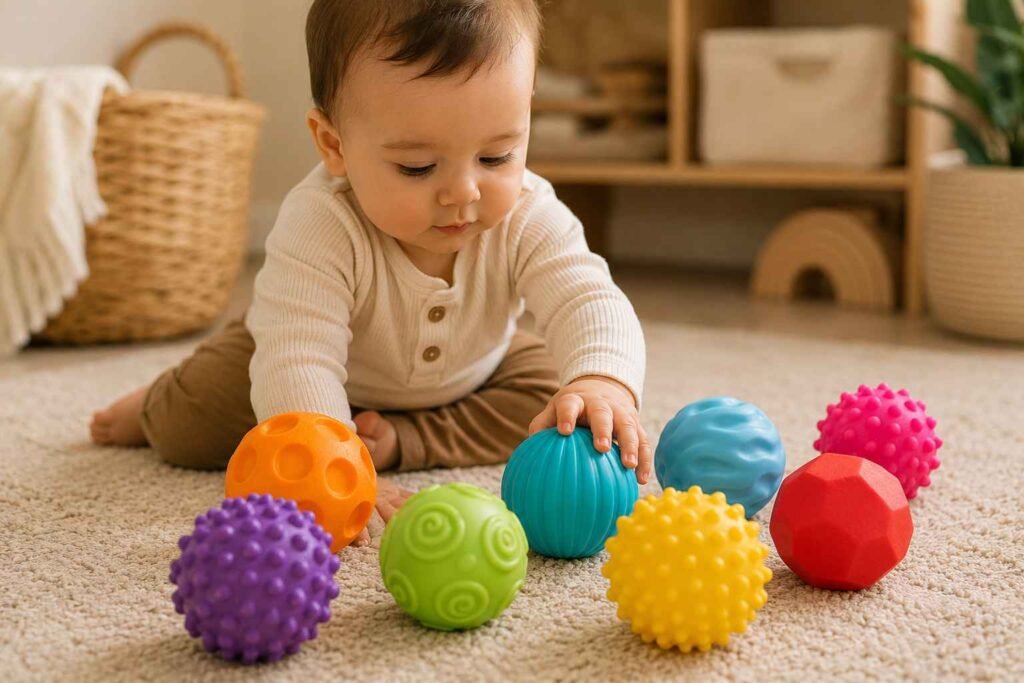
- This list picks up everywhere else. Texture is the big one. By 3 to 4 months most babies are reaching and grabbing on purpose, and what they grab matters. A crinkle texture against soft cotton teaches something different than smooth silicone, which teaches something different than a wooden ring. Sound matters too, not music exactly, but cause and effect: shake this, hear that. And a fair number of the best picks do two or three of these at once, which ends up mattering more than any single feature.
- If you want broader activity ideas beyond store-bought toys, our age by age guide to sensory activities for infants covers things like textured play and water exploration you can do without buying anything new.
How many sensory toys for infants does a baby actually need
Honestly, fewer than the registry checklist suggests. We rotate three or four at a time, not the whole bin. New isn’t always better either; pulling something out of storage after two weeks off can get the same reaction as buying something new, and it costs nothing.
Auditory and grasping toys
Manhattan Toy Winkel Rattle and Sensory Teether
This is the toy I’d buy first if I were starting from zero. It’s been around since the late 1970s for a reason: a maze of soft tubes, lightweight, with a quiet rattle inside that gives a baby their first real taste of cause and effect. Shake it, hear something, do it again on purpose.
- What surprised me with Vihaan was how early he could actually use it. By six weeks he was batting at it reflexively, and by ten weeks the batting had turned into actual grabbing. It doubles as a teether too, the loops are soft enough to gum without resistance, and you can refrigerate it for sore gums later.
- The rattle is genuinely quiet, which is a plus for parents but means it’s not the toy for a baby who needs loud feedback to stay interested.
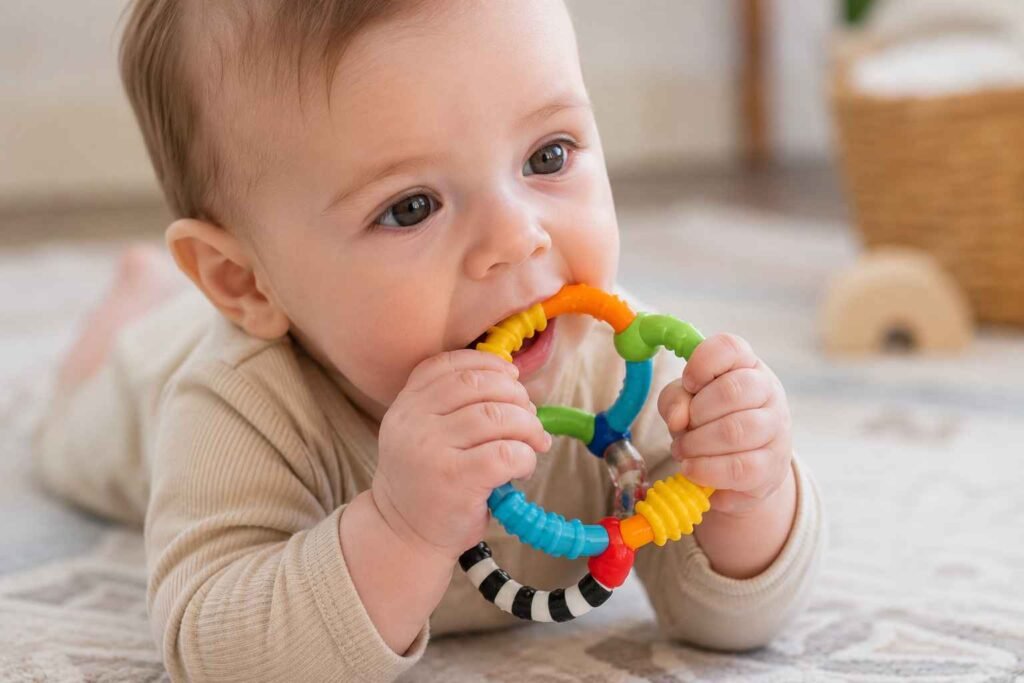
Hape Rattling Rings Teether
A simpler, sturdier cousin to the Winkel. Three or four soft rubber rings move along a central handle and rattle gently when shaken, and the bottom ring doubles as a chew-safe teether made from a rice-based material instead of standard plastic.
- We picked this one up specifically because Vihaan started teething earlier than Eeshan did, closer to four months instead of six, and we wanted something he could genuinely chew on hard without it feeling flimsy. It held up better than I expected to that kind of abuse.
- It’s a one-trick toy in the sense that there’s no visual complexity to it, just texture, motion, and sound. For some babies that’s exactly enough. For others used to busier toys, it might not hold attention as long.
Tactile and texture toys
Real texture variety is the thing most baby registries underbuy. A bag of differently-textured small objects sounds boring on paper and ends up being one of the highest-engagement categories at this age.
Itzy Ritzy Bitzy Crinkle Sensory Toy
A soft cotton plush with a crinkle layer inside, textured ribbons hanging off the side, and a braided teething ring built into the bottom. Rated from birth, and it genuinely earns that rating; even before Vihaan could grab on purpose, the crinkle sound alone would get him to turn his head.
- The textured ribbons are the underrated part. He’d run his fingers along them well before he had the coordination to do anything more deliberate, which made this one of the few toys that worked across a longer stretch of weeks than I expected from something this simple.
- The braided teething ring softens over time with heavy chewing, which is fine, it’s meant to, but don’t expect the crisp texture of week one to last past month three or four of regular use.
Itzy Ritzy Itzy Pop Sensory Popper
This is the toy that finally made me understand the appeal of those push-popper fidget toys adults buy themselves. Silicone bubbles you push through from one side, with raised texture for teething relief built into the same piece. Rated from 3 months, small enough to clip to a diaper bag or stroller strap.
- We didn’t expect much from this one going in, it felt almost too simple, but it’s become the thing we hand Vihaan in the car seat when he’s getting fussy. The repetitive popping motion seems to actually calm him down rather than just distract him, which isn’t true of most of the toys on this list.
- It’s small. We’ve lost track of it under a car seat more than once.
Multi-sensory toys
A few products genuinely do more than one job, and according to the American Academy of Pediatrics, play that combines multiple types of sensory input supports more of a baby’s developing brain at once than single-purpose toys do. We saw that play out almost exactly as described with the next two picks.
Itzy Ritzy Sensory Tummy Time Mirror
A small plush animal (ours is the cow) with an unbreakable mirror at the center, textured ribbons, and a crinkle-and-jingle combination built into the body. Rated from birth, and designed specifically to make tummy time less miserable for everyone involved.
- Babies are drawn to faces almost reflexively, including their own reflection once their vision develops enough to register it, which made this the single most reliable tummy time motivator we found. Vihaan would lift his head longer for this than for anything else, somewhere around the 7 to 8 week mark when tummy time stamina was still genuinely rough.
- It also clips to a car seat or stroller, which sounds like a minor feature until you’re three months in and realize half your sensory toy budget should go toward things that survive being dropped on a sidewalk.
Lamaze Fun with Colors Soft Baby Book
A cloth book with a discovery mirror, crinkle pages, a built-in squeaker, and textured corners designed for chewing. Rated from 6 months, which lines up with when most babies have the hand strength to actually flip a page on purpose instead of just grabbing at it.
- This is the toy Eeshan would not put down around 5 to 6 months, the one I mentioned earlier that beat out a much more expensive musical toy without trying. Every page does something slightly different, which seems to matter more than any single feature being impressive on its own.
- The squeaker is loud enough that you will hear it constantly for a while. Worth knowing before it ends up as a car toy.
Cause and effect for the older end of the range
Somewhere around 8 to 9 months, mouthing and grabbing start turning into actual problem-solving. Object permanence shows up. Stacking, dropping, and pouring all become genuinely interesting in a way they weren’t a few months earlier.
Skip Hop ABC & Me Nesting Blocks
Ten sturdy boxes that stack into a tower or nest inside each other, each printed with a letter and a small illustration. Rated from 6 months but genuinely most interesting closer to 9 to 12 months, once a baby has the coordination to actually stack rather than just knock things over.
We held off introducing this until closer to 9 months with Vihaan, mostly because earlier attempts with similar toys for Eeshan went nowhere until he had the grip strength to manage it. Once it clicked, it clicked fast. Within a couple weeks he went from swatting the tower over to deliberately placing one box on top of another.
If a corner gets chewed enough, the cardboard-reinforced edges start to soften and peel slightly. Not a safety issue, just a durability note.
Skip Hop Zoo Stack and Pour Buckets
Five nesting buckets with different drainage patterns, technically a bath toy, but it earns a spot here because pouring and dumping water is genuinely one of the better sensory and cause-and-effect activities available once a baby is steady enough to sit in a bath seat, usually around 9 months and up.
This became part of our actual bath routine rather than a toy that sits in a bin unused. Vihaan fills, dumps, refills, repeats, for longer stretches than I expected from something this simple. It also stacks for storage when bath time is done, which matters more than it sounds like it should once your bathroom shelf is already full of other baby gear.
It only really works in water. As a dry toy it’s fine but unremarkable, so don’t expect it to double as a living room toy the way some of the other picks on this list do.
| Toy | Age Rating | Primary Sense |
|---|---|---|
| Manhattan Toy Winkel | 0m+ | Auditory, grasping, what we’d buy first |
| Hape Rattling Rings Teether | 3m+ | Tactile, teething, sturdier for hard chewers |
| Itzy Ritzy Bitzy Crinkle | 0m+ | Tactile, auditory, textured ribbons hold interest longest |
| Itzy Ritzy Itzy Pop | 3m+ | Tactile, teething, our go-to fussy-moment toy |
| Itzy Ritzy Tummy Time Mirror | 0m+ | Multi-sensory, best tummy time motivator we found |
| Lamaze Soft Book | 6m+ | Multi-sensory, the one Eeshan wouldn’t put down |
| Skip Hop Nesting Blocks | 6m+, best 9-12m | Cause and effect, fine motor, stacking |
| Skip Hop Stack and Pour Buckets | 9m+ | Water sensory, cause and effect, doubles as bath toy |
Frequently Asked Questions
What age should babies start using sensory toys?
Most of the toys on this list are rated from birth and stay useful well past 12 months. What changes is how the baby uses them. A newborn might just turn toward a crinkle sound, while a 9 month old is deliberately stacking and pouring. The toy doesn’t always need to change, the baby’s relationship to it does.
Are sensory toys different from high contrast toys?
Yes, and the distinction matters more than it sounds like it should. High contrast toys use black and white visual patterns specifically for newborn vision, which can’t process color or detail well yet. Sensory toys in the broader sense, the kind on this list, lean on touch, sound, and grip instead, and stay relevant well past the newborn window where high contrast toys matter most.
How many sensory toys does a baby actually need?
Fewer than most registries suggest. Rotating three or four toys at a time tends to hold attention better than leaving a large pile out, and pulling something out of storage after a few weeks off can feel new again without buying anything.
Can sensory toys help if I’m worried about a speech delay?
Sensory toys support general developmental engagement, but they’re not a stand-in for evaluation if you have specific speech concerns. If that’s what’s actually on your mind, our guide on what’s normal at 14 months and not talking covers that territory directly.
What sensory toys work best for a baby who’s teething?
Anything with a built-in teether and varied texture tends to work better than a single-purpose teething ring, since it keeps a baby’s attention even between bouts of gum discomfort. The Itzy Pop and the Hape Rattling Rings on this list both double as teethers for that reason.
Do sensory toys actually make babies smarter?
They support the kind of brain development that underlies later skills like coordination, language, and focus, but no toy is a shortcut to intelligence on its own. What sensory play does is give a developing brain the right kind of input at the right stage, which is a real and useful thing without being a magic guarantee of anything.
What I’d actually buy first
If you’re starting from nothing, get the Winkel and the crinkle toy first. Those two cover sound, texture, and teething in a way that holds up from birth through about 6 months, and almost everything else on this list is something you can add once you see what your baby actually responds to.
What I didn’t expect going into this with Vihaan was how much the simple, repetitive toys outlasted the complicated ones. The popper and the crinkle toy have been in steady weekly rotation for months. A couple of flashier toys we tried along the way got maybe two good weeks before he lost interest entirely.
What’s worked for your baby? Drop it in the comments.
Saidesh is a dad of two, Eeshan and Vihaan, writing about what he actually tried, tested, and learned the hard way. CribKind covers baby development, sensory play, and real parenting for the first two years.