35 Back to School Bulletin Board Ideas
I taught second grade for two years before Eeshan was born, and the bulletin board was always the last thing I set up and somehow the thing parents commented on first.
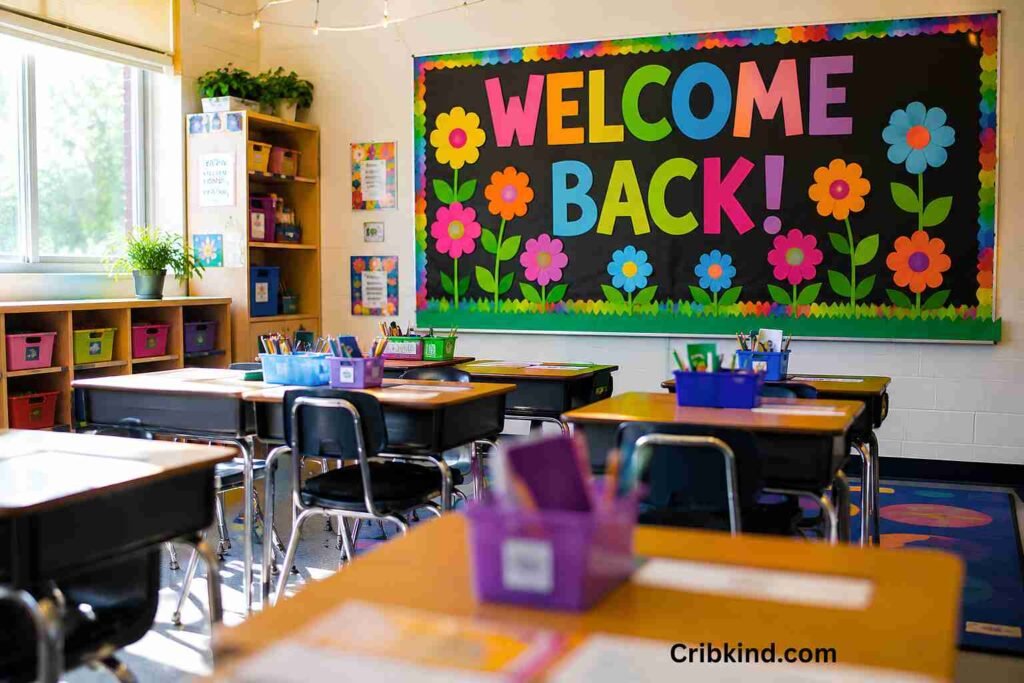
Most bulletin board idea lists online are really product pages in disguise, pretty photos leading to a paywalled TPT bundle at the bottom. This isn’t that. Every idea here is something I either actually put up in my own classroom or would have, using construction paper, a stapler, and a regular printer. No $6 download required.
What are good back to school bulletin board ideas for teachers?
The strongest back to school bulletin boards combine a welcoming visual theme (a pun, a pattern, a color scheme) with an interactive element students personally contribute to, like a name tag, a self-portrait, or a written response. Boards that are purely decorative tend to get less classroom engagement than ones kids add to.
Below: 35 ideas organized by board type, a materials list, setup tips, and answers to the questions teachers ask most before the first day.
Why the Board Matters More Than You’d Think
My first year, I spent almost no time on my bulletin board. I figured the lesson plans mattered more, and they did, but I underestimated how much that blank board said to the kids walking in on day one. A parent told me at meet-the-teacher night that her daughter had already decided she liked my room before I’d said a word to her, just from the board.
That’s not really a controlled study, obviously. But research backs up the instinct. According to the National Association for the Education of Young Children, a classroom’s visual environment plays a measurable role in how welcome and safe young students feel in the first weeks of a new setting. I didn’t need a citation to believe that by year two. I just needed one bad first impression to learn it.
What I’d actually recommend: pick one welcome-themed board and one interactive board as your two priorities before the first day. Everything else on this list can wait. I promise nobody remembers the third board.
Welcome Boards (First Thing Students See)
These go up before day one and stay up through the first week or two.
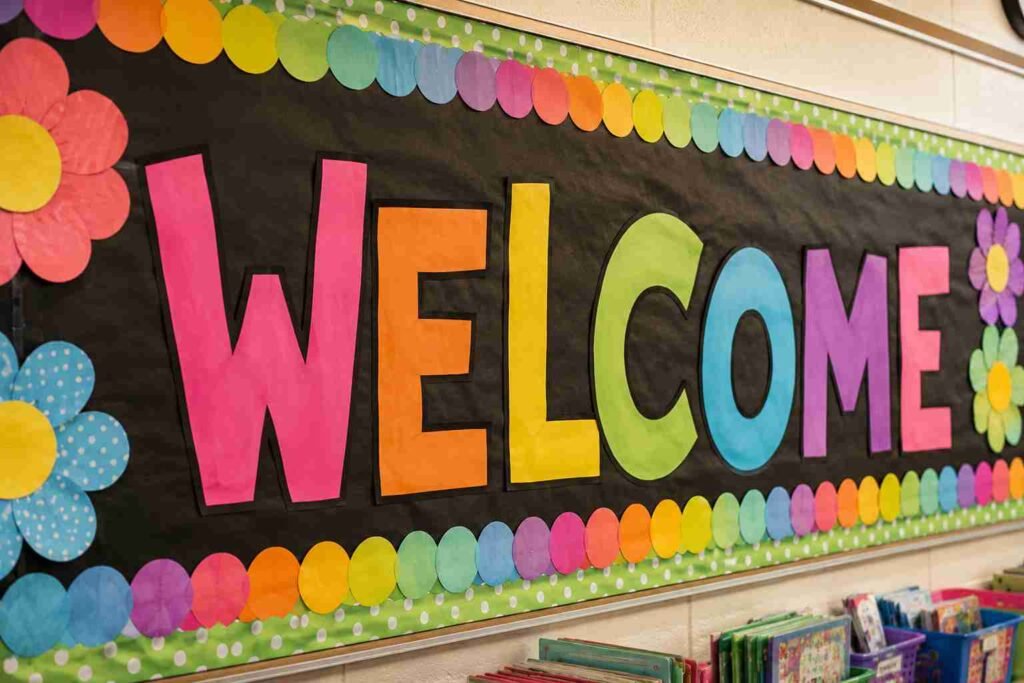
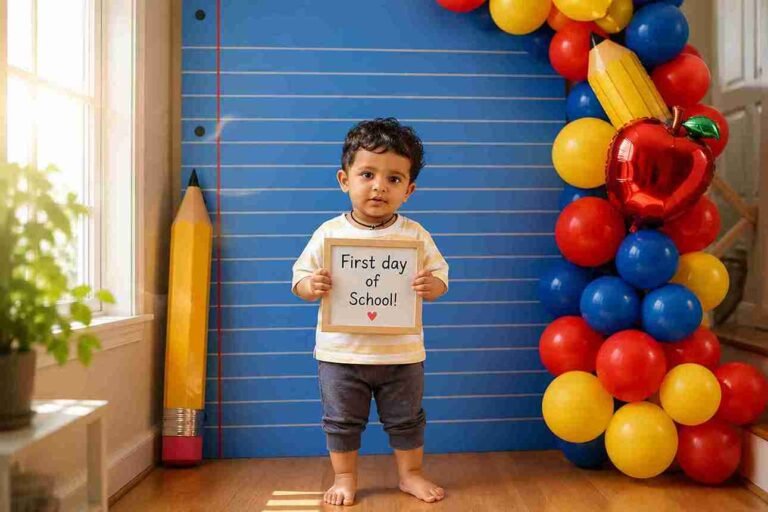
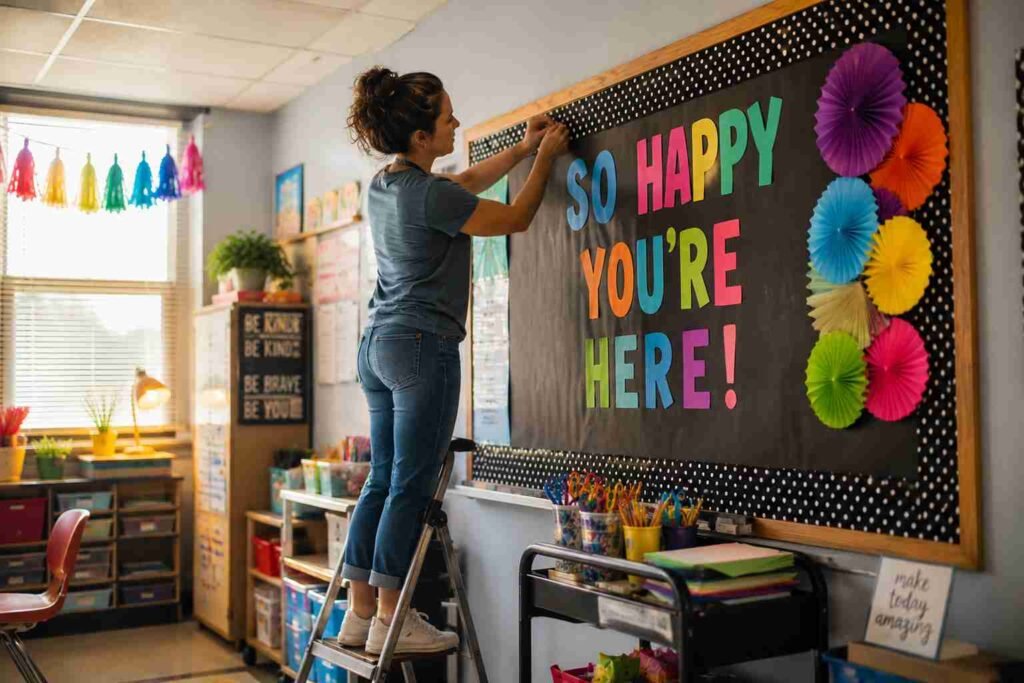
- “So Happy You’re Here” banner board. Large bubble letters, bright background paper, optional bow or border trim. I used a version of this my first year because it was the only thing I had time for, and it still worked.
- Pun-based welcome board (“Bee-utiful Year Ahead”). Bee or honeycomb visuals with a wordplay headline. Yellow and black construction paper, nothing fancier needed.
- “You Belong Here” inclusion board. A message-forward board, sometimes paired with diverse student silhouettes or hand cutouts, signaling every student is welcome regardless of background.
- Color-block welcome wall. No theme, just bold geometric color blocks and a large “Welcome” headline. This was my actual go-to. Fast, hard to mess up, looked intentional even when it wasn’t.
- String-light reading nook sign. A soft, warm welcome board built around a reading corner instead of the whole room.
- Photo-strip welcome collage. Headshots of every student, printed in black and white to save ink, arranged around an “Our Class” headline.
- Door + board combo welcome set. Matching welcome message split between the classroom door and the adjacent board for a unified entrance.
A board doesn’t need a clever pun to land. The color-block one, the plainest option here, was the one I actually finished on time more years than not.
Getting to Know You Boards (Built With Student Input)
These ask students to contribute something personal in the first week, which is what makes them stick.
- All About Me self-portrait board. Students draw themselves and answer a few prompts (favorite color, summer highlight, one fact). I did this every single year. Reliable, and the self-portraits alone are worth framing.
- Superhero pose photo board. Students pose like a superhero, the photo gets printed, and each student writes their personal “superpower” underneath.
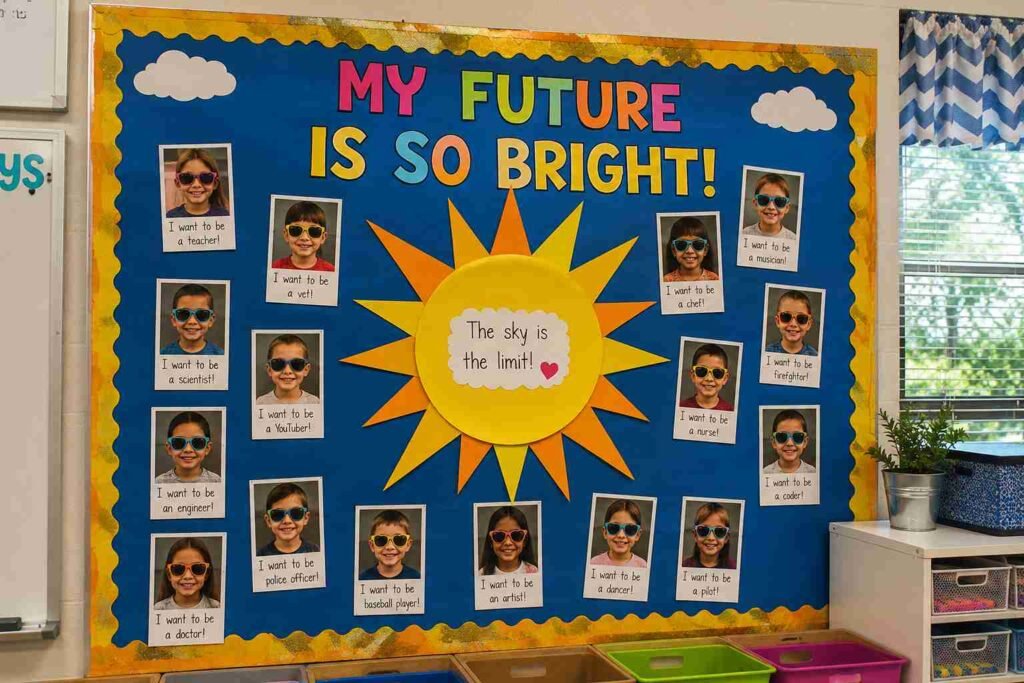
- Sunglasses “Future So Bright” board. Student photos in sunglasses arranged around a sun cutout, paired with a future-focused headline.
- Fingerprint or handprint tree. Each student adds a handprint or thumbprint “leaf” to a bare tree outline, built collaboratively over the first week.
- “Graph of Me” math board. True or false statements about each student get plotted as coordinates, producing a unique shape per student. Worth it specifically for upper-elementary math classrooms.
- Postcard from summer board. Students design a postcard about something from their summer and pin it to a map or world outline.
- Interest inventory cards. Index-card-sized profiles (favorite book, hobby, pet) pinned in a grid. I genuinely used these to learn 24 names faster than I would have otherwise.
The fingerprint tree is worth calling out specifically. It’s not finished on day one. It grows over the first week as more kids add to it, which gave me a built-in reason to talk about the board out loud every morning instead of just having it sit there.
Subject Specific Boards
These work for a specific classroom rather than a general homeroom, and they double as a visual cue for what the room teaches.
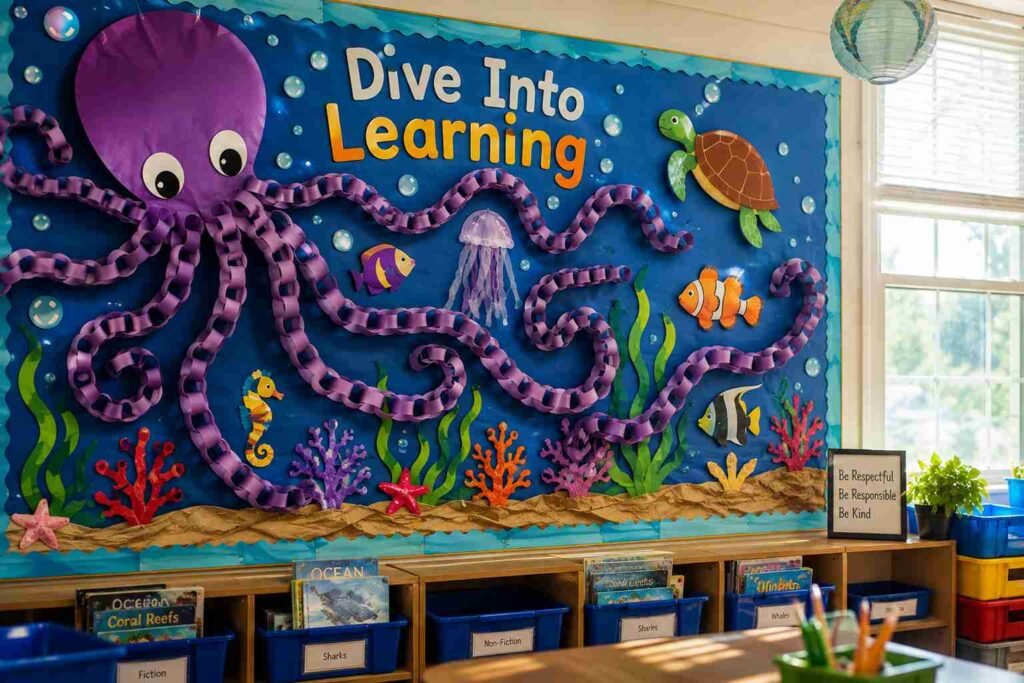
- Underwater science board. Ocean creatures, paper-chain octopus, a “Dive Into Learning” headline. Strong for elementary science rooms.
- Space and astronomy board. Planets, constellations, a rocket cutout. Works for science specifically but reads well in any room.
- Growth garden board. A bare trellis or vine that gains a paper leaf or flower every time the class completes a unit, ending the year visibly full.
- History mistakes-into-inventions board. A social studies or history-specific board pairing famous “failures” with the inventions they led to.
- Reading challenge board. A book-themed board (open book cutouts, character silhouettes) tracking a class reading goal.
- Current events corner. A rotating board for middle and high school classrooms that displays clippings or summaries of one current event per week.
- Activism and awareness board. For older students, a board built around a single issue (often climate, equity, or local civics) the class is studying that term.
- Bilingual or language-class board. A bright, vocabulary-forward board for a Spanish or other language classroom, often built around a single recurring character or mascot.
I never had the garden board going long enough to see it fill in. Two years wasn’t enough runway. If your school year is long, it’s worth the extra setup time. If it’s short, skip it.
Interactive Boards (Kids Touch These All Year)
These aren’t “set it and forget it.” They’re meant to be added to or used throughout the term.
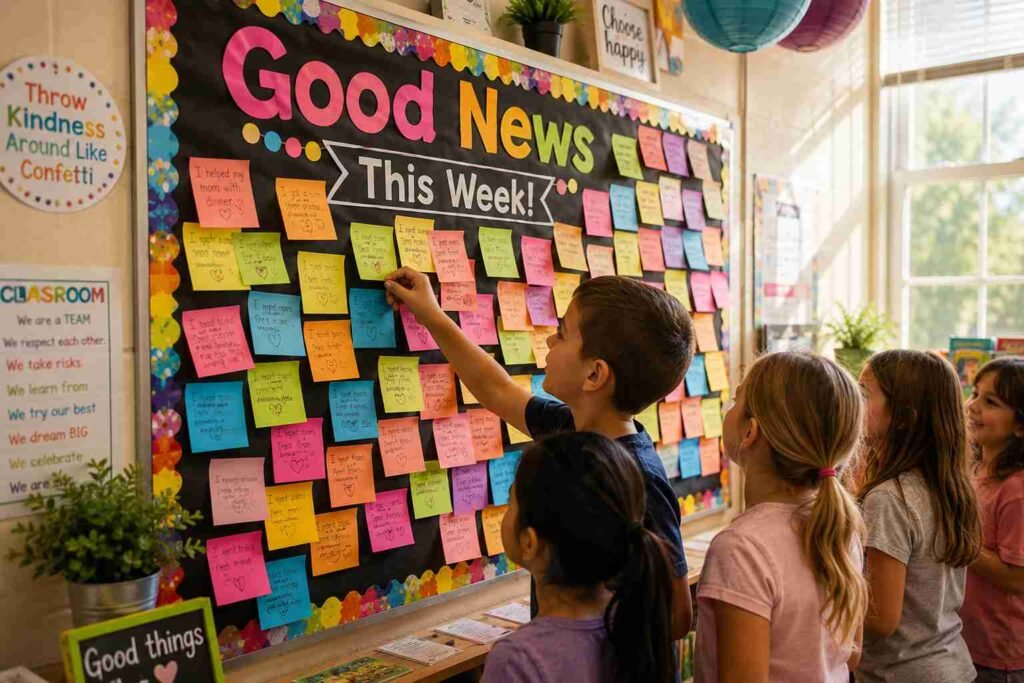
- Weekly good-news board. Students pin a small note each Friday about something good from their week. I read a few aloud before dismissal, and it became the thing kids asked about on Mondays if I’d forgotten.
- Affirmation station. A small interactive corner where students can take or leave an encouraging note card.
- Behavior or rewards tracker board. A visual progress system, often gamified, tied to a classroom management app or point system.
- Goal-setting board. Students write a personal goal for the term and revisit it at a midpoint check-in.
- Countdown board. A visual countdown to a specific event (winter break, a field trip, the end of the term) that updates weekly.
- Kindness chain board. Every act of kindness observed gets added as a new link to a growing paper chain across the room.
- “Ask Me About” rotating board. Each week, a different student’s interest or achievement gets featured front and center.
The good-news board was the smallest effort of anything on this list and did the most quiet work. Kids genuinely looked forward to Fridays because of it, which I didn’t expect from a stack of sticky notes.
Door and Hallway Extensions
A bulletin board doesn’t have to stop at the board itself.
- Matching classroom door. Carry the bulletin board’s color scheme or pun onto the door for a unified entrance.
- Hallway-facing inclusion message. A board or sign visible from the hallway, useful for school-wide visibility beyond just your own students.
- Reusable seasonal frame. A board frame (borders, headline letters) designed to swap center content by season without redoing the whole setup, saving prep time across the year.
- Locker-adjacent mini displays. Small individual displays near lockers or cubbies rather than one large central board, useful in schools without much wall space.
- Library or shared-space board. A board specifically for a school library or shared reading room, often book- or character-themed.
- Office or front-entrance welcome board. The same welcome-board principles applied to a school’s main office, which sets tone before a single student reaches a classroom.
What You Actually Need (Materials Checklist)
| Material | Used in how many board types above | Worth buying ahead? |
|---|---|---|
| Construction paper (assorted colors) | 30 of 35 | Yes, buy a large multi-pack before the year starts |
| Bulletin board border trim | 22 of 35 | Yes, reusable across multiple boards if kept neat |
| Bubble letter sets (printed or store-bought) | 18 of 35 | Worth it, saves significant setup time |
| Push pins or staples | 35 of 35 | Yes, you will run out faster than expected |
A lesson I learned the slow way: pin the background paper up the day before stapling it down. It hangs flatter, and the actual install goes twice as fast.
Frequently Asked Questions
How do I choose a back to school bulletin board theme?
Start with what the board needs to do, not what looks cutest. A welcome board needs to read fast and feel warm. A getting-to-know-you board needs a clear, simple prompt every student can answer. I learned to pick the function first and let the visual theme follow, not the other way around.
Do back to school bulletin boards need to be replaced every year?
Not entirely. Reusable border trim and letter sets carry across multiple years if you store them flat. The center content, like student photos or self-portraits, is what actually changes annually.
What’s the cheapest way to make a back to school bulletin board?
Construction paper, a stapler, and a printer cover almost everything here. I hand-cut my bubble letters from folded paper my first year because I didn’t have a budget for store-bought ones, and honestly nobody noticed the difference.
How long should a back to school bulletin board take to set up?
A simple welcome board, like the color-block or basic banner styles, takes under an hour. Interactive or photo-based boards take longer since they depend on collecting student contributions first.
Are back to school bulletin boards required by most schools?
Most schools don’t formally require them, but a welcoming visual entrance is a common expectation, especially in elementary classrooms and during meet-the-teacher events.
What if I don’t have a bulletin board in my classroom at all?
Several ideas here adapt to a door, a window, or a hallway-facing wall with poster putty instead of staples. The welcome message and the interactive concept matter more than the literal cork board.
Start With One Board, Not Five
If the full list feels like too much before the first bell, start with one welcome board and one interactive board. That’s genuinely what I did most years, and nobody ever seemed to notice I hadn’t filled every wall.
What’s on your classroom wall this year? Tell me in the comments. I’m always adding to this list myself.
– Written by Spandana