Sight Words Flash Cards: The Complete Guide
If you’re just starting out with sight words flash cards or wondering whether they actually work, you’re in the right place. Here’s everything I wish I’d known from the beginning.
My son Eeshaan had been in kindergarten for exactly three weeks when his teacher sent home a small ziplock bag. Inside: a stack of index cards with words like the, was, said, and where written in black marker.
There was a little note attached. Practice these every night if you can.
I remember thinking: that’s it? Just flash cards? He already knows the alphabet. Shouldn’t we be doing something more advanced?
Three months later, I completely understood. Those little cards were the thing. Once he could recognize those words instantly, without sounding anything out, everything clicked. Reading stopped being a struggle and started being something he actually wanted to do.
What Are Sight Words Flash Cards?
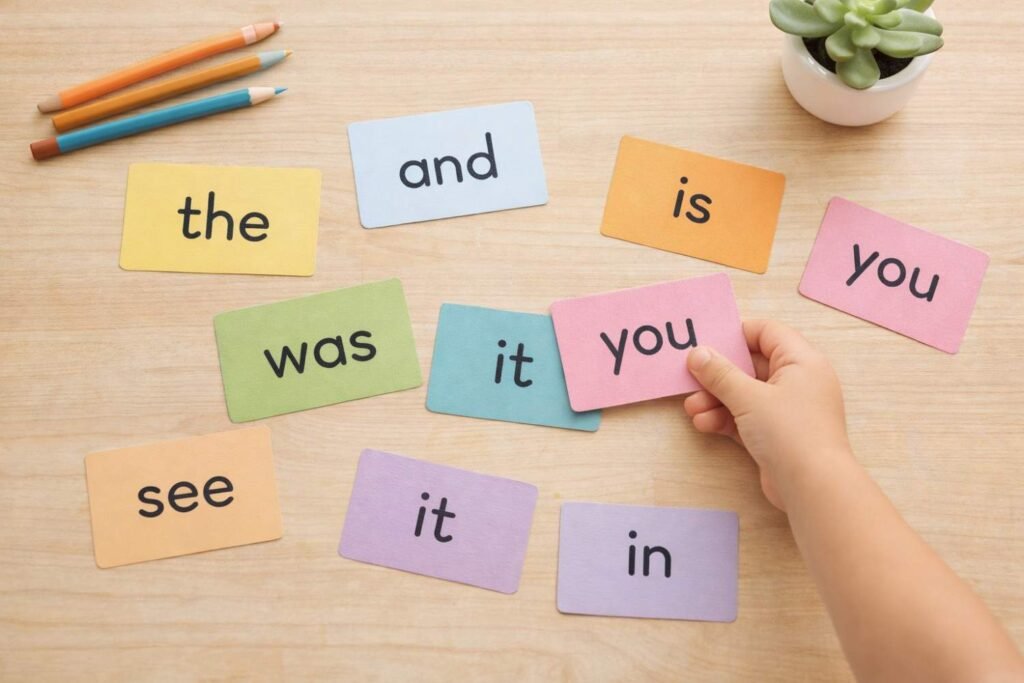
Sight words are the words that appear most frequently in written English. Words like the, and, is, you, they. Many of them don’t follow standard phonics rules, which means kids can’t easily sound them out. They just have to recognize them.
Sight words flash cards are exactly what they sound like: simple cards with one sight word on each, used to build fast, automatic word recognition. You show the card, your child says the word. Over time, with repetition, those words move from something they have to decode to something they just know.
There are two main lists most schools and programs pull from:
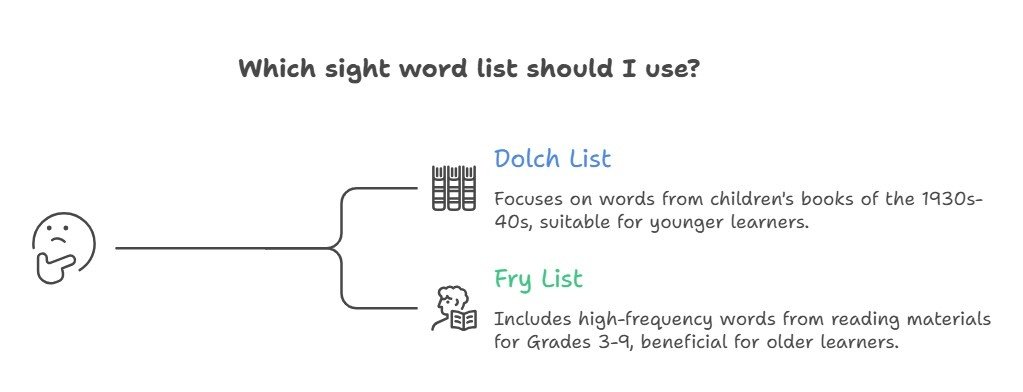
- Dolch sight words. A list of 220 words (plus 95 nouns) compiled by educator Edward William Dolch in the 1930s. Still widely used in schools today. Grouped by grade level from Pre-K through third grade.
- Fry sight words. The Fry word list, developed by Dr. Edward Fry, includes 1,000 words organized by reading frequency. Remarkably, the first 100 words alone account for nearly half of everything children read making them a powerful starting point for early literacy.
Most kindergarten programs use the Dolch list or a school-specific variation of it. If your child’s teacher sends home a word list, it almost certainly pulls from one of these two.
Do Sight Words Flash Cards Actually Work?
It’s not just something parents pass around in Facebook groups. There’s actual research behind it.
The Reading Rockets program at WETA, backed by the U.S. Department of Education, identifies automatic sight word recognition as one of the core building blocks of reading fluency. When your child already knows the word they, they don’t have to stop and puzzle over it. That freed-up brain space goes straight to understanding what they’re reading.
Flash cards work because of repetition plain and simple. Every time your child sees a word again, their brain gets a little faster at recognizing it. Eventually it stops being something they read and starts being something they just know.
The catch: they only work with consistent, short practice. Ten minutes a night beats one forty-minute session on the weekend every single time.
Here’s the part I didn’t lead with. I started flash cards with Eeshaan when he was one. Not because I had some master plan honestly, I’d read about it somewhere, made a stack of cards during nap time, and just started flashing them during our little sitting-together moments. No drilling, no expectations. Just the words, over and over, casually.
I don’t know exactly what stuck from those early sessions. But when kindergarten sight words showed up, something in him already recognized them. I can’t prove it was the early flashing. But I’m pretty sure it was.
What Age Should Kids Start Sight Words Flash Cards?
This is the question I get asked most often by other parents. Here’s the honest breakdown by age:
| Age / Grade | Where to Start | Goal |
|---|---|---|
| Pre-K (ages 3–4) | Dolch Pre-Primer list (40 words) | Recognize 10–20 words by end of year |
| Kindergarten (age 5) | Dolch Primer list (52 words) | Recognize 50+ words by end of year |
| 1st Grade (age 6) | Dolch 1st Grade list (41 words) | Read first 100 Fry words automatically |
| 2nd Grade (age 7) | Dolch 2nd Grade list (46 words) | Read first 200 Fry words automatically |
| 3rd Grade (age 8) | Dolch 3rd Grade list (41 words) | Solid fluency foundation established |
If your child is in Pre-K and interested in letters and words, go ahead and introduce a few cards. Keep it playful. If they’re in kindergarten, this is the sweet spot. Don’t wait.
How to Use Sight Words Flash Cards (The Way That Actually Works)
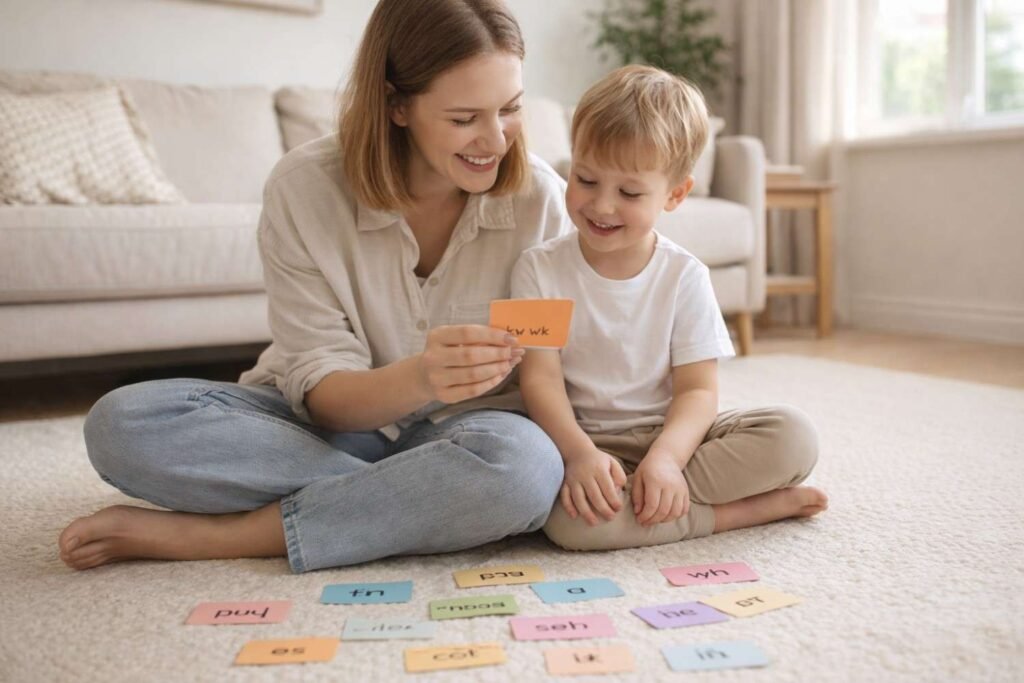
Most parents start with the right idea and then accidentally make it feel like a test. Here’s how to use sight words flash cards in a way that builds confidence instead of dread.
Keep sessions short
Five to ten minutes is plenty, especially for kids under 6. Their attention and working memory aren’t built for longer. A quick focused session before bath time beats a longer frustrated one at the kitchen table.
Start with a small stack
Don’t hand your child a deck of 52 words on day one. Pull out 5 cards. Once they know all 5 without hesitation, add 2 more. Keep the cards they know in a separate “mastered” pile. Watching that pile grow is genuinely motivating for little kids.
Say the word with them, not just after
When you show a card and they’re not sure, don’t just wait in silence. Say the word together. The goal isn’t to quiz them, it’s to build recognition through repetition. Pressure slows that process down.
Mix in the ones they already know
Every session, throw in a few mastered words alongside the new ones. It feels like winning. Kids need that, especially when they’re working on something hard.
Make it a game when you can
Lay 5 cards face up and ask them to find a specific word. Race to slap the card. Sort words into silly categories. Turn it into something other than school and you’ll get a lot less resistance.
Practice out in the world
When you’re reading a book together and hit a word from their stack, stop. “Hey, do you know that one?” That moment of recognition in a real sentence is more powerful than ten flash card drills.
Be consistent, not perfect
Four nights a week of five-minute sessions is far better than sporadic longer ones. Build it into a routine you can actually keep, not one that requires perfect conditions.
Sight Words Flash Cards by Grade Level
Here’s exactly what to focus on at each stage, whether you’re buying a set or printing one yourself.
Pre-K Sight Words Flash Cards
Focus on the Dolch Pre-Primer list. Words like: a, and, away, big, blue, can, come, down, find, for, funny, go, help, here, I, in, is, it, jump, little, look, make, me, my, not, one, play, red, run, said, see, the, three, to, two, up, we, where, who, you.
At this age, keep cards big, keep text clear, and add pictures if your child is very young. Colorful cards beat plain white every time.
Kindergarten Sight Words Flash Cards
The most searched and most important level. Move on to the Dolch Primer list once Pre-Primer words are solid. Primer words include: all, am, are, at, ate, be, black, brown, but, came, did, do, eat, four, get, good, have, he, into, like, must, new, no, now, on, our, out, please, pretty, ran, ride, saw, say, she, so, soon, that, there, they, this, too, under, want, was, well, went, what, white, who, will, with, yes.
By the end of kindergarten, the goal is reading these automatically without a second’s hesitation.
1st Grade Sight Words Flash Cards
First grade is where fluency starts to compound. Kids who have Pre-Primer and Primer words locked in pick up the Dolch 1st Grade list quickly. Words include: after, again, an, any, ask, by, could, every, fly, from, give, going, had, has, her, him, his, how, just, know, let, live, may, of, old, once, open, over, put, round, some, stop, take, thank, them, think, walk, were, when.
2nd Grade Sight Words Flash Cards
By second grade, you’re building toward the first 200 Fry words alongside the Dolch 2nd Grade list. The shift from learning to read to reading to learn happens around here. Keep sight word practice going even as phonics and decoding skills grow. They work together, not against each other.
Dolch vs. Fry Sight Words Flash Cards: Which List Should You Use?
Honestly? Either works. Here’s the only practical difference that actually matters:
- Dolch is what most US elementary schools use. If your child’s teacher is sending home a word list, it’s almost certainly Dolch. Start here if you want to stay in sync with school.
- Fry covers more ground 1,000 words total, organized purely by how often they appear in real reading. The first 100 Fry words overlap heavily with Dolch. Good for families who want to go deeper or whose school uses a different system.
If you’re not sure which your school uses, just ask the teacher. They’ll tell you in 30 seconds and it saves a lot of guessing.
How to Make Sight Words Flash Cards at Home
Store-bought sets are convenient, but homemade cards work just as well and kids often engage more with them because they helped make them.
Here’s what works:
- Use index cards. 3×5 is the standard. Thick ones so they don’t flop. You can buy a pack of 100 for under two dollars.
- Write large and clear. Use a thick black marker. Lowercase letters, except for proper words like “I”. Match whatever your child’s school uses for letter formation if you can.
- Add a picture on the back (optional). For younger kids especially, a simple drawing on the back gives them a clue to check themselves. A small sun for “yellow,” a stick figure running for “run.”
- Color-code by list. Blue cards for Pre-Primer, green for Primer, yellow for 1st Grade. Makes sorting and tracking easy.
- Punch a hole and put them on a ring. A binder ring through the corner keeps them together and lets kids flip through independently.
- Print and laminate if you want cards that last for years, or just print on cardstock for short term use. We tried both laminated ones held up through two kids.
Making the cards together counts as learning too. Eeshaan and I would write the word, draw something silly on the back, talk about it and that was already three rounds of exposure before we even started flashing.
Sight Words Flash Cards Online and Apps
If your child is more engaged by screens than paper (no judgment, same), there are solid digital options too.
Physical cards pull ahead for one simple reason: no notifications, no autoplay, no next video. Just the word and your kid. But if the choice is a screen-based session or no session, pick the screen.
FAQ: Sight Words Flash Cards
How many sight words should my kindergartner know?
Most kindergarten programs aim for 20 to 50 sight words by the end of the year. Some kids hit 100. Some hit 15. Both are within normal range. Consistent practice matters more than hitting a specific number.
How long does it take to learn sight words with flash cards?
With daily 5 to 10 minute sessions, most kids can recognize a new word within 5 to 10 exposures. Full mastery of a list like the Dolch Primer (52 words) usually takes 2 to 4 months of consistent practice. Every kid is different and that’s completely okay.
My child keeps forgetting words they knew last week. Is that normal?
Kids’ memory doesn’t work in a straight line. They’ll know a word Monday and blank on it Friday. That’s just how it goes. This is exactly why mixing mastered words back into practice sessions helps keep cycling old words in, and they’ll stick more permanently over time.
Should I correct my child when they get a word wrong?
Yes, but gently. Don’t let a wrong answer sit uncorrected because that can reinforce the mistake. Just say the word calmly: “This one is where. Let’s find it again in a minute.” Then bring it back a few cards later. Low pressure, high repetition.
Are sight words flash cards still relevant, or is phonics the better approach?
I get this question a lot and honestly it’s the wrong question. It’s not phonics OR sight words. Phonics teaches kids how to decode unfamiliar words. Sight word recognition builds the fluency and speed that makes reading feel natural. Most reading specialists, including those at the National Institute of Child Health and Human Development, support a balanced approach that includes both.
Sight words flash cards are not complicated. They’re not exciting. There’s no app, no subscription, no special method. They’re also genuinely one of the highest-return things you can do for your early reader and you can do it in less time than a TV episode.
Start with the list your child’s school uses. Keep sessions short. Keep it warm. Watch the mastered pile grow.
That little stack of index cards in the ziplock bag? It turned out to be one of the best things my son’s teacher ever sent home.
This post is for informational purposes and reflects general early literacy guidance. Every child develops at their own pace. If you have concerns about your child’s reading development, consult their teacher or a reading specialist.

3 Comments