
What Is Telegraphic Speech? A Dad’s Real Examples + Age Guide
I thought Vihaan was just being lazy with his words. Daddy go. More milk. Short, choppy, nothing like a full sentence. Then our pediatrician explained what was actually happening in his brain when those two words came out together, and I completely changed how I thought about this stage.
What sounds like incomplete speech is one of the clearest signs that real language is forming. That stage has a name: telegraphic speech. Here is exactly what it means, when it shows up, and what to do when it does.
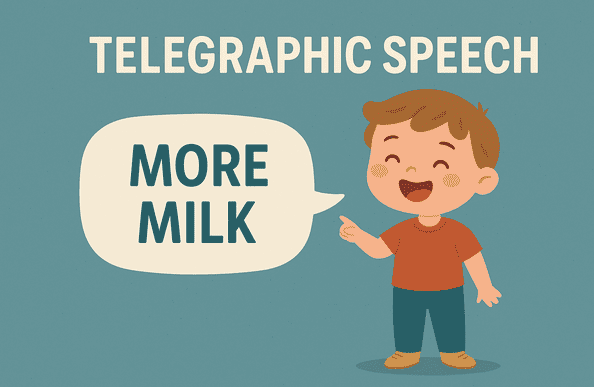
Telegraphic Speech Definition
Telegraphic speech is a stage of language development where toddlers start putting two or more meaningful words together but leave out the smaller connecting words. Instead of saying, I want more milk, they might simply say, More milk.
The name comes from old telegrams, where people paid for every word and only included the most important information. Young children do something very similar. They focus on the words that carry meaning while leaving out smaller connecting words such as “the,” “is,” and “and.”
Even though these phrases sound incomplete to adults, they are actually a positive sign that a child’s language skills are developing normally.
Where Telegraphic Speech Fits in the Language Timeline
Before telegraphic speech shows up, your toddler is in the single word stage. Roughly 12 to 18 months. One word carries everything. Ball means throw it. Ball means I see one. Ball means the dog just stole it and I need you to fix this immediately. Context does all the work because vocabulary is not there yet.
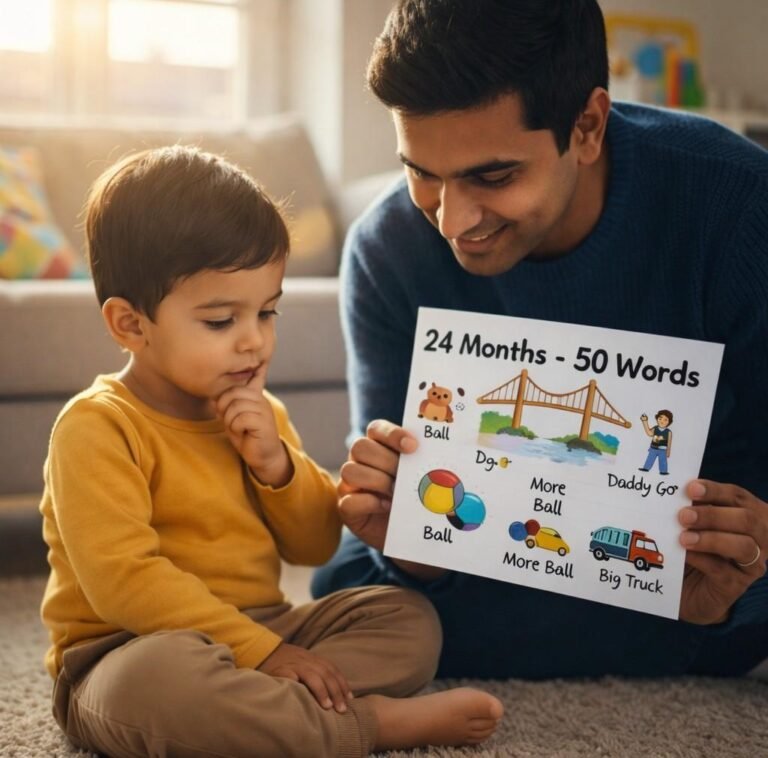
Then somewhere around 18 to 24 months, something shifts. With Vihaan it happened on a random Tuesday. He pointed at the front door and said daddy go. Two words, no article, no verb tense, zero grammar. But the meaning was completely clear and it stopped me mid-diaper-change. That is telegraphic speech. It is not sloppy talking. It is not a sign something is behind. It is exactly the stage language development needs before full sentences are possible.
By 30 to 36 months most toddlers start layering in the connecting words: “the,” “is,” “I want.” The two-word phrases stretch out, the gaps fill in, and telegraphic speech fades without you realizing it is gone. If your toddler just strung two words together for the first time, you are not watching a delay. You are watching the bridge get built.
What is Telegraphic Speech ?
At its simplest, it’s your toddler stringing together two (sometimes three) words no extras, just the core meaning. Think throw ball instead of Throw the ball, or mama hug instead of Mommy give me a hug. This stage typically kicks off between 18 and 24 months or right after single words burst into being.
You can picture it like a telegram: short, to the point, no the or is, just what matters most.
When Telegraphic Speech Happens (CDC Timeline)
According to the CDC and AAP standards, language development follows a predictable path. Here is when you can expect those telegrams to arrive:
| Age | Milestone | Normal Range / Examples |
|---|---|---|
| 18 months | 10–20 words + first 2-word combinations | More milk, Mommy up |
| 24 months | 2-word phrases used regularly | Daddy go, Want cookie |
| 30 months | 3–4 word phrases start to emerge | Me want more juice |
| Red Flag | No 2-word combinations by 30 months | Consult a pediatrician or speech therapist |
- If you’re wondering how many words are normal at each age, you can refer to our post: How Many Words Should a Toddler Say by Age?
- See the CDC’s developmental milestones for toddlers, including when most children begin saying two words together
Why It’s Such a Big Deal :
- They’re communicating more than before. Suddenly, “more milk” is not just babble it’s a thought with purpose.
- They’re building sentence structures. Even without grammar words, using subjects and verbs shows grammar is forming.
- It paves the way for full sentences. Over months, those “ball throw” phrases grow into “Throw the ball for me,” then “Can you throw the ball?” Pretty neat.
Common Examples of Telegraphic Speech
| Stage | What It Looks Like | Why It Matters |
|---|---|---|
| One-word utterances | Ball or Mama | Budding naming power |
| Telegraphic speech (2–3 words) | More juice or Dog bark | Intent plus rudimentary sentence logic |
| Transition phrases | I want cookie, No more milk | Combines grammar plus vocabulary |
What Are Telegraphic Sentences?
A telegraphic sentence is basically a sentence made up of only the most important words no little grammar fillers.
- Want cookie
- Doggy sleep
- Daddy go work
They sound short and choppy, almost like an old telegram (which is where the name comes from). But here’s the thing telegraphic sentences show your toddler’s language is growing. They’re starting to combine words with real meaning, even if grammar isn’t polished yet
Telegraphic Speech Examples in Toddlers
- More milk
- Daddy go work
- Baby sleep
- Want cookie
- Mommy come
- Doggie bark
But What About the Gaps in Their Sentences?
- Good question. While telegraphic is a natural phase, intentionally using it when talking to your toddler isn’t the best long-term model. Research says kids need to hear real, grammatical speech even if they respond in 2 word bursts.
- Instead of copying “Doggie run,” say it right: “Look, the dog is running!” They get more language cues and learn how sentences are supposed to feel.
How to Handle Their Two Word Wonders
- Celebrate first: Validate their effort so they stay confident.
- Upgrade it: They say “Car go”? You say, “Yes, the car is going fast!” Let them keep saying the simple version while you model growth.
- Use gestures along with words. Point to the car, say the full phrase kids pick up both sight and sound
Why This Phase Is a Big Deal
It’s easy to notice what your child isn’t saying yet, but this stage is actually a powerful leap forward. They’re moving from just naming things to sharing ideas and intentions. That’s the real foundation of communication. These small phrases are the building blocks of complex speech, so ball throw today naturally grows into Can you throw the ball? very soon.
4 Easy Games to Boost Their Talk
And the best part? You don’t need special toys for this. Just use everyday moments and gently build on what they say.
- Coloring Chat: Color together and ask, “What’s that?” When they answer, expand it.
Tree → “Yes, a big green tree!” - Whose Item?: Hold a shoe and ask, “Whose shoe?”
Daddy shoe → “That is Daddy’s big shoe!” - Follow the Leader: Say “Red car,” wait for them to copy, then add one word.
Red car → “Fast red car.” - Block Talk: When blocks fall, say “Block fall!” and build on it.
The blue block fell down!
Each tiny expansion shows your child how words connect, turning simple phrases into real conversation.
Frequently Asked Questions About Telegraphic Speech
What is the best example of telegraphic speech?
Sentences like “More cookie,” “Kitty sleep,” or “Daddy drive.” Short, powerful, meaningful.
Is it okay if it lasts until age 3?
Usually, they fade out by 3 when full sentences take over. If your child relies heavily on telegraphic speech beyond this or struggles with longer phrasing, a speech evaluation can help.
What Is Telegraphic Speech in Psychology?
In psychology, telegraphic speech describes the stage when children use only the most essential words to get their point across usually between 18 to 30 months. Think of it as speech stripped to the basics: nouns and verbs, no “the,” “is,” or “and.”
Which is the best example of telegraphic speech
The clearest examples of telegraphic speech are short, two-word phrases your toddler uses to get their point across. The best example is something like:
- More milk
- Mommy go
- Doggy bark
- Want cookie
- Baby sleep
Can adults use telegraphic speech?
Yes, adults may occasionally use telegraphic speech in text messages, notes, headlines, or situations where they want to communicate quickly using only essential words.
Why is it called telegraphic speech?
It is called telegraphic speech because it resembles old telegram messages, which contained only the most important words and left out unnecessary grammar to save space and cost.
At what age does telegraphic speech begin?
Telegraphic speech typically begins between 18 and 24 months, when toddlers start combining two or more meaningful words into simple phrases.
Is telegraphic speech normal?
Yes, telegraphic speech is a normal and important stage of language development that shows a child is beginning to combine words and express ideas.




One Comment