Daily log printable daily report template for infants (Free)
Vihaan was 11 days old the first time Spandana asked me when he had last fed and I genuinely could not remember. Not a rough estimate. Not “maybe two hours.” I had no idea whether it had been 90 minutes or four hours. We were both awake, sitting three feet apart, and neither of us had any record of anything. That was the night we started writing everything down, and when I discovered that every infant daily log template and baby feeding tracker printable I could find online had been built for daycare directors filing reports, not for two exhausted parents trying to get through the night.
Why every infant daily log template you find online is the wrong one
Search for an infant daily log or a daily report template for infants and every result comes from childcare software companies. Brightwheel, Kangarootime, Lillio, ProCare are all apps for daycare centres, and their daily report templates are designed for staff to communicate back to parents at afternoon pickup. The fields they include, “message for the family,” “today’s activity at school,” “mood to report at pickup,” are for a completely different purpose than what a parent at home actually needs.
A parent at home needs a printable baby feeding and diaper log that answers one question: what happened since the last time I checked? Feed time, which breast or how many ounces, diaper type, sleep start and end. That’s the core record. The daycare templates bury all of that under fields designed for institutional accountability, not 3am survival.
We built our own after about a week of writing on whatever paper was nearest. The versions below are what we refined over Vihaan’s first months, tested across both the full newborn window and the simpler 3 to 12 month stage.
Free infant feeding log printable: version 1 (0 to 3 months)
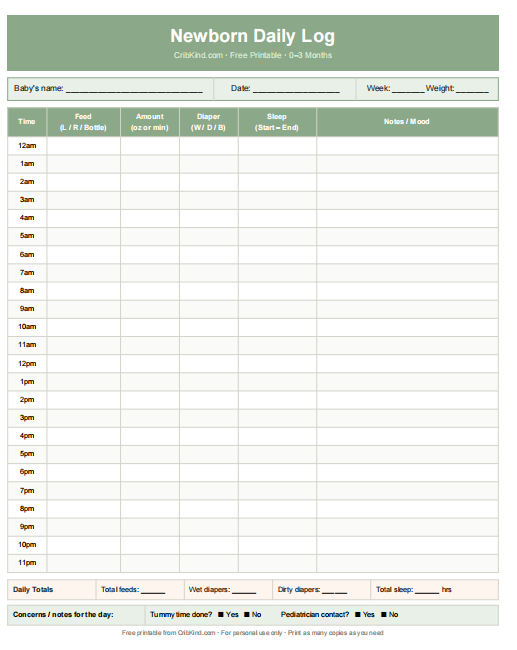
The newborn version is an hourly tracking sheet. Every hour from midnight to 11pm has its own row, covering feeds, diapers, and sleep in a single view. At this stage feeds happen every 90 minutes to 3 hours, the volume of tracking is genuinely high, and you want every hour accounted for rather than trying to remember which cycle you are in.
This printable infant feeding log includes a feed column (time, breast side L or R, bottle amount in oz), a diaper column (wet, dirty, or both), a sleep column (time down and time up), and a notes column for anything that does not fit neatly into those categories. At the bottom there is a daily totals row so you can count feeds and diapers at a glance without re-reading every row, and a notes section for tummy time and anything worth flagging at the next pediatrician visit.
According to the American Academy of Pediatrics, newborns typically feed 8 to 12 times in 24 hours. The hourly layout makes it easy to confirm you are in that range without having to count backwards from memory at midnight.
We used this version from Vihaan’s first night home through about week 10, when the feed spacing had settled enough that tracking every hour felt like overkill.
Printable infant feeding log: version 2 (3 to 12 months)
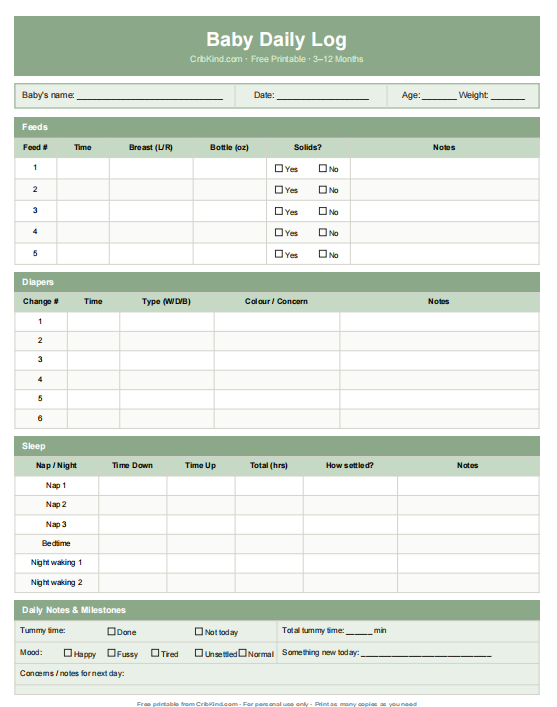
The baby daily log for 3 to 12 months simplifies the layout significantly. Instead of hourly rows, it has dedicated sections for up to 5 feeds, 6 diaper changes, and sleep periods covering 3 naps, bedtime, and 2 night wakings. It also adds fields the newborn version does not need: a solids column once you start introducing food, a daily mood tracker, a tummy time checkbox, a “something new today” field for milestones, and a notes row for anything worth carrying forward.
This version works as a printable baby feeding and diaper log through the entire 3 to 12 month window because the simplified structure matches what actually changes: by 3 months most babies have stretched to predictable feed windows, and tracking every single hour adds work without adding useful information. What you actually want to track at this stage is the pattern, not the granularity.
We switched to this version around 10 weeks and kept it going until Vihaan was about 6 months, when his routine had settled enough that we stopped needing a written record most days.
What your printable baby feeding and diaper log should track
Both versions above cover the minimum fields that a genuinely useful newborn feeding log needs. Here is why each one earns its space on a single page.
Feed time and breast side or bottle amount
For breastfeeding, note the time and which breast (L or R). Duration in minutes is more trackable than volume since you cannot measure intake directly. For bottle feeding, note time and ounces offered, and whether the baby finished fully or left some. Both pieces of information matter at a pediatrician weight check appointment.
Diaper time and type
Wet, dirty, or both. In the first two weeks especially, diaper output is one of the clearest indicators of adequate feeding. The diaper colour column in the baby version (3 to 12 months) catches anything unusual. Unusual diaper colour is an early signal of feeding issues, jaundice, or dehydration in newborns, and if your pediatrician asks what you have been seeing you will want a record rather than a guess.
Sleep start and end times
For the newborn version this is tracked hourly. For the baby version it is tracked by sleep period. Total sleep per day matters because both undersleeping and oversleeping in newborns can signal feeding problems worth flagging, and having a written record makes it easy to answer “how much is he sleeping?” at the 2-week or 1-month check without estimating from memory.
Notes column
The notes column absorbs everything that does not fit elsewhere. Unusual fussiness after a particular feed. A longer sleep stretch than normal. Something that seemed off but resolved. These notes cost nothing to write and have saved us real time at appointments when the pediatrician asked about a pattern we had noticed.
How to use the log so it actually works at 3am
The most common reason a newborn feeding log fails is placement. If the paper is in a drawer you will stop using it within a week. We kept ours on the arm of the glider with a pen tucked into the fold, next to where every feed happened. That is the only reason it survived past day three.
Write it down immediately, not when you think you will remember. At 3am you will not remember. This is non-negotiable. The whole point of the log is that you cannot trust memory at this sleep deprivation level, and the solution is removing the need to remember at all.
For breastfeeding, Spandana found it easier to mark the start time and the side at the beginning of the feed rather than trying to reconstruct the details at the end when the baby has fallen asleep on her. Ten seconds at the start is easier than fifteen minutes of trying to recall at the end of a feed.
For the diaper column, note the type at every change even if it seems obvious. The value is in the pattern over a full day, not in any single entry.
Our newborn sleep and feed schedule guide covers the eat-play-sleep rhythm that this log tracks day to day. If the log is showing unusual feed spacing or sleep patterns, that guide explains what normal ranges look like week by week. And once you move past the peak newborn window, our breastfeeding and formula schedule guide covers how to read hunger cues and adjust timing as your baby grows.
When you can probably stop using the daily log
Most parents naturally stop needing the newborn feeding log somewhere between 3 and 6 months, once the routine becomes predictable enough that you do not need paper to know roughly when the last feed was. That transition is the goal the log is working toward: it builds the record so patterns emerge and the unpredictability decreases.
A few situations where it is worth restarting or keeping it going longer:
- If your baby is being seen for weight gain concerns, your pediatrician will likely ask for a feed log specifically
- During illness, when feeding patterns shift and tracking fluid intake more carefully matters
- When introducing solids, where the baby daily log version’s solids column becomes genuinely useful
- When a new caregiver, grandparent, or nanny is helping and needs a written record to hand off
Once you are past the point of needing the log daily, our guide to when to stop burping your baby covers one of the next transitions most parents hit right around the same time.
Frequently asked questions
What is the difference between a newborn daily log and a daycare daily report template for infants?
A daycare daily report template for infants is designed for childcare staff to file a report that goes home to parents at pickup. It covers what happened at daycare. A newborn daily log for parents at home is for parents tracking their own baby for themselves: what happened since you last checked, what you need to tell the pediatrician, what the pattern looks like over 24 hours. The fields are completely different and the audience is different.
Is this a free printable infant daily report template?
Yes, both versions are free with no email required. The download links above go to a Google Drive folder where you can open and print directly. Print as many copies as you need. Each copy covers one day.
What should a printable baby feeding and diaper log track?
At minimum: feed time, breast side or bottle amount, diaper type (wet, dirty, or both), and sleep start and end times. Optional but useful for the first two weeks: diaper colour, feed duration for breastfeeding, and a notes field for anything unusual. The more granular the record in the first two weeks, the more useful it becomes if any feeding or weight concerns arise at the 2-week check.
How do I track breastfeeding on the infant feeding log printable?
Note the time, which breast (L or R), and the approximate duration in minutes. Duration is more trackable than volume when breastfeeding since you cannot measure intake directly. If you alternate breasts per feed, note both sides with the time on each. The newborn version has a column for this in every hourly row.
Can I use the printable infant feeding chart for formula feeding?
Yes. The bottle amount column in both versions is designed for formula or expressed milk in ounces. Note the time and the amount offered, and whether the baby finished fully or left some. Formula feeding parents often find it easier to track because the amount is measurable. Note both offered and taken if the baby consistently does not finish bottles, since that pattern is worth mentioning at the next appointment.
How long should I keep a newborn feeding log?
Most parents find 6 to 12 weeks is the peak usefulness window for the hourly newborn version. After that the simplified baby daily log for 3 to 12 months works until routines become predictable, usually around 4 to 6 months. Some parents log through the full first year, particularly when tracking solid food introduction from 4 to 6 months onward.
Our Personal experience
The week we stopped keeping the log was a genuine milestone with Vihaan, not because logging is hard, but because not needing it meant the chaos had settled into something recognisable. The first week without it, I noticed I could actually answer “when did he last feed?” in real time without looking at anything.
That transition happens at a different point for every baby. The log does not accelerate it. It makes the unpredictable weeks easier to get through and gives you something real to hand to your pediatrician when they ask how feeding has been going.
What did you track in those first weeks that you are glad you did? Drop it in the comments.