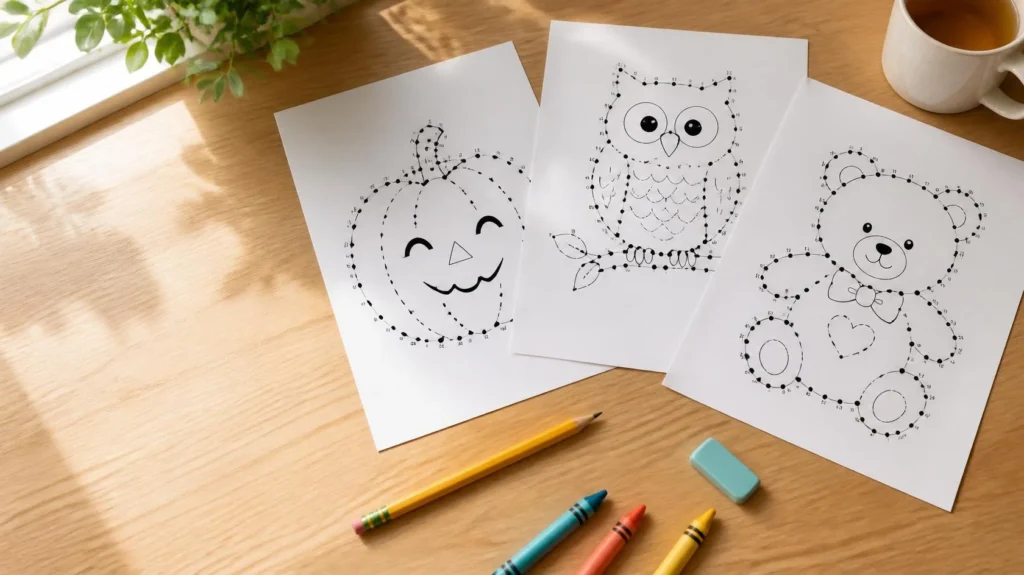
Dot to Dot Worksheets
Most dot to dot worksheets sort their pages by animal. These ones sort by number. There are 15 free printable pages here, built to count to 20, 30, 50 and 100, plus three skip counting pages that climb in 2s, 5s and 10s. Eeshan would probably race toward the biggest number he could find, and Vihaan would probably want company for the first few dots. Pick a page by the highest number your child can say in order, then print one and see how it goes.
Pick a page by the numbers your child knows
A picture is only the reward at the end. The real work on these pages is finding the next number, so the right page depends on counting, not on how grown up your child feels. A child who can count to 20 but mixes up 13 and 31 is ready for a 20 dot page. A child who guesses at 40 and 41 will lose the thread on a 50 dot page, and that is a good moment to step back one level.
The table sorts the whole pack. These dot to dot number worksheets all work the same way, joining the dots in order, and only the size of the numbers changes. If you want a to z dot to dot worksheets instead, the letter set lives in our free dot to dot printables, which have animals and the full alphabet. Ages below are my rough guide based on counting skills, so let your own child set the pace.
| Level | Dots | Pages | Good for ages |
|---|---|---|---|
| Count to 20 | 16 to 20 | 4 | 3 to 5 |
| Count to 30 | 30 | 4 | 4 to 6 |
| Count to 50 and 100 | 50 and 100 | 4 | 5 to 8 |
| Skip counting by 2s, 5s and 10s | 20 to 25 | 3 | 6 to 8 |
Count to 20 pages for the youngest counters
Counting to 20 is a real milestone, and these four pages give it a purpose. Each picture has bold lines, a smiling face and numbers big enough to read at arm’s length. If you are hunting for dot to dot worksheets 1-20 pdf style pages, this is the group to print first. Vihaan would probably want to color the cone before he joined a single dot, and I would let him, since he is still holding a crayon and looking at numbers.
Sit beside your child for the first few dots and say each number out loud as they find it. After four or five dots most children carry on alone. Plain paper and a chunky crayon are plenty at this age.
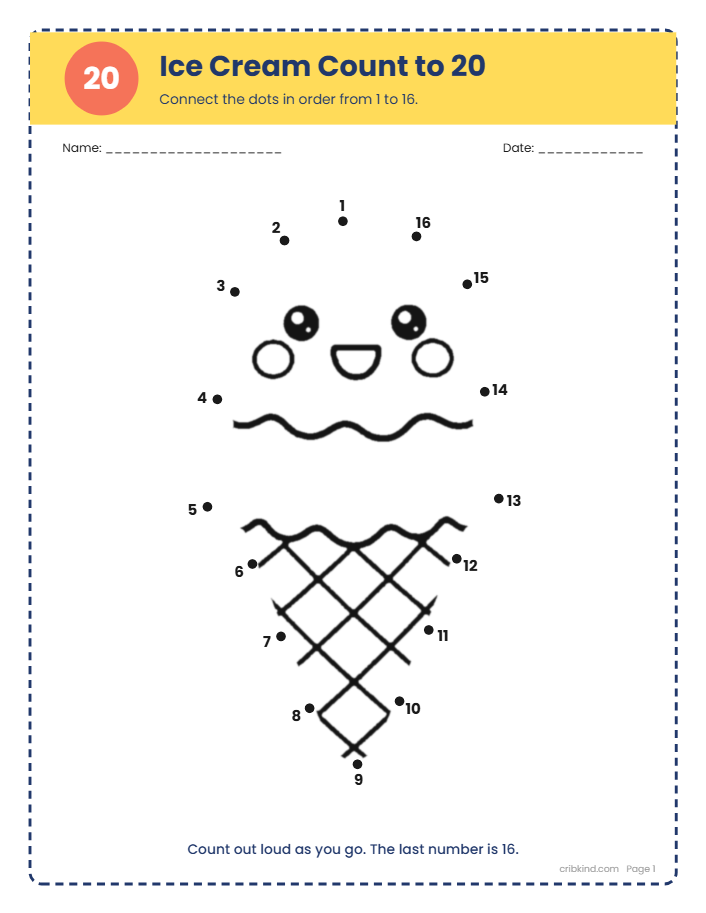
1. Ice cream cone (16 dots)
A smiling two scoop cone with a waffle pattern. Sixteen dots makes it the gentlest page in the pack, so it works as a first try.
2. Rocket (20 dots)
A rocket with a round window, two fins and flames underneath. The flames give a child a satisfying shape to color at the end.
3. Ladybug (20 dots)
A round ladybug with big spots and curled feelers. Both wings match, so a child can guess where the next dot will land.
4. Pumpkin (20 dots)
A smiling pumpkin with a stem and a small leaf. It is also a nice fit for October, and the ridges are already drawn in, so the child only joins the outline.
Count to 30 pages for kindergarten
The jump from 20 to 30 is where counting stops being automatic. At 20 a child can hold the whole run in mind, and at 30 they have to scan the page for the next number. These dot to dot joining worksheets suit a child who can count to 30 and tell the written numbers apart. Eeshan would probably pick the owl first, and I would let him choose the order.
Switch to a regular pencil at this level. The smaller dots reward a more careful hand, and coloring the finished picture with crayons gives you a second activity. A session of about 15 minutes is a good result. For more pages at this age, the free preschool worksheets cover letters, shapes and early numbers.
5. Snail (30 dots)
A grinning snail with a spiral shell and two eye stalks. The spiral is already drawn, which makes the page look nearly finished once the body is joined.
6. Car (30 dots)
A small round car with a smiling front and two wheels. Wheels are easy to spot, so they give children a landmark while they scan for numbers.
7. Owl (30 dots)
A wide eyed owl with a feathered chest. Children who like animals tend to stay with this one to the end.
8. Cupcake (30 dots)
A cupcake with swirled frosting and a cherry on top. The layers of frosting are already drawn, so the dots trace the outer shape.
Count to 50 and count to 100 pages
These pages are for children who read two and three digit numbers easily. They also need a pencil hand steady enough for a full page. A 100 dot page takes 15 to 20 minutes of real attention, which is long enough to feel like an accomplishment. Vihaan would probably be years away from these, while Eeshan would probably want to try the 100 dot tree the moment he saw it.
The numbers sit close together, so a sharp pencil matters. Tell the child to check the number before each line, because one skipped dot shows up straight away and the shape comes out wrong. Noticing that mistake and fixing it is worth more than getting it right the first time. For the hand control side of this, our guide to fine and gross motor skills explains why it matters before writing.
9. Teddy bear (50 dots)
A sitting teddy bear with round ears and big feet. The face is drawn in, so the dots carry the outline of the head, arms and feet.
10. Turtle (50 dots)
A smiling turtle with a hexagon patterned shell. The shell is already drawn, which gives you a good coloring job afterward.
11. Train (50 dots)
A steam engine with a smiling face, a funnel and big wheels. It is a wide picture, so the dots run in a long line across the page.
12. Apple tree (100 dots)
The longest page in the pack, a smiling tree with apples in its branches. The dots around the leaves sit close together, so I would use a sharp pencil and print it at full size.
Skip counting pages for 2s, 5s and 10s
These three pages change the rule. The dots are not numbered 1, 2, 3. They are numbered in jumps, so the child joins 2, 4, 6 or 5, 10, 15 or 10, 20, 30 in order. That is skip counting, and many children meet it around first or second grade. Eeshan would probably enjoy the penguin once he could say the fives, and Vihaan would probably need these pages read aloud for a long while yet.
Say the pattern together before the first line is drawn. Counting by 5s out loud first helps a child spot the next number, and the sound of the pattern does a lot of the work. I would not rush this level, and I would not call it multiplication yet. It is a way to get comfortable with number patterns, and the pages are easier once a child counts to 50 on the other pages.
13. Bee, count by 2s (25 dots)
A striped bee with a smiling face, numbered 2 up to 50. It is a good first skip counting page because the pattern of even numbers is easy to hear.
14. Penguin, count by 5s (20 dots)
A penguin with a round belly and flippers, numbered 5 up to 100. Counting by 5s links nicely to telling time on a clock face.
15. Frog, count by 10s (20 dots)
A smiling frog on a lily pad, numbered 10 up to 200. The tens are easy to say, so the challenge is mostly finding the three digit numbers.
What number dot to dot practice builds
A page of dots looks like a time filler, but three small skills come out of it. The first is number order. Finding 47 after 46 means knowing what 47 looks like and scanning the page for it, which is a close cousin of finding a house number on a street. The second is hand control, since landing a pencil on a small dot asks for a steadier grip than scribbling does.
The third is patience. A long page cannot be rushed without leaving a visible mistake, so a child learns to slow down and check. I would not oversell any of this, and a dot to dot page will not replace counting games, reading together or play. It is a calm, low pressure way to practice things that matter at school. Eeshan would probably call it a game, and that is exactly what I would want him to think.
How to use these at home
Three small habits make the pages go better. Start easier than you think you need to, because a child who finishes a 16 dot page and asks for a harder one is in the right place. Count the first few dots together, saying, “We start at 1, find 2, draw a line,” and then let them take over. Do not correct mid page, since a child who sees the shape go wrong will usually fix it alone. Vihaan would probably invent his own creature if a line went astray, and I would let him.
On a wet afternoon, pair a page with ideas from our rainy day activities for kids. If your child likes coloring afterward, the cute Halloween coloring pages go well with the pumpkin. Here are separate downloads for each level.
Free download: Get all 15 number dot to dot pages as one PDF
These dot to dot worksheets also reuse well. Slip a page into a plastic sleeve and let your child trace the dots with a dry erase marker, then wipe it clean and go again.
Safe practice with pencils and crayons
Sit at a table with good light, and let the child hold the pencil in whatever grip feels natural for now. Grip tends to settle with practice, so there is no need to correct it on every page. Keep sessions short. For a three year old, five to ten minutes is a good result, and stopping early is fine.
Cut off the name line if you want to display a finished page. Many children like seeing their work on the fridge, and that small pride is worth more than a perfect line.
Frequently asked questions about dot to dot worksheets
What are dot to dot number worksheets?
They are printable pages with numbered dots that make a picture when joined in order. This set teaches counting to 20, 30, 50 and 100, and it adds three skip counting pages.
What age are these pages for?
Children can try a 16 or 20 dot page around age 3 to 5 with a grown up beside them. Counting skill matters more than age, so start where your child can name every number on the page.
Are these dot to dot pages free?
Yes. All 15 pages are free to download and print for home use. You can download one level at a time or get the whole set as a single PDF.
How do skip counting dot to dot pages work?
The dots are numbered in jumps, such as 2, 4, 6 or 5, 10, 15, and the child joins them in order. Say the pattern aloud first so the next number is easy to spot.
Do these pages include letters?
No. This pack is only for numbers. The animal pages and the A to Z letters are in our free dot to dot printables.
What should I do if my child skips a number?
Wait before you step in. Most children notice when the shape looks wrong and fix it themselves, which builds the habit of checking their work.
On the day we first print these, I plan to hand Eeshan the 100 dot tree and see how far he gets before he asks for help. Then I will sit beside Vihaan with the ice cream cone and say each number out loud, and I will try hard not to take the pencil. If a line goes to the wrong dot, I will keep quiet and see what shape it becomes.