Worksheets for Preschoolers
If I were printing a first worksheet for a three year old tonight, I would skip the alphabet and the numbers and start with one plain straight line. Many early letters are built from lines and curves, so a crayon that can follow a line has a head start. That is why these 19 free worksheets for preschoolers begin with tracing, then move on to shapes, colors, counting to 5, patterns and scissors. Print one page, not the whole stack, and see how your child feels about it.
Each page is letter size (8.5 by 11 inches) with thick lines and big spaces for a chunky pencil or crayon. Print at 100 percent scale on regular paper, and make as many copies as you need for your own family or classroom.
What worksheets for preschoolers should cover
Most worksheets for preschool ask for a pencil before a child has the hand strength to hold one, which is how a pleasant five minutes turns into tears. I sorted this set into four groups that build on each other: early writing, shapes and colors, counting to 5, and patterns with cutting. Each group takes the skill from easy to a little harder, so you can stop wherever your child stops enjoying it.
These pages are for ages 3 to 5. Under age 3, a ball of dough, a tray of flour and a pile of stacking cups do the same job without paper, and Vihaan would probably prefer the dough at any age. I left out the full alphabet on purpose, because alphabet worksheets for preschool are easy to find and a full set would crowd this one. The only letters here are the ones in your child’s name.
| Page group | Pages | Skill practiced | Good first page |
|---|---|---|---|
| Tracing and early writing | 1 to 5 | Lines, curves, shapes, name, following a path | Page 1 |
| Shapes and colors | 6 to 10 | Naming shapes, matching, color words, big and small | Page 7 |
| Counting to 5 | 11 to 15 | Counting, number order, more and fewer, one more | Page 11 |
| Patterns, matching and cutting | 16 to 19 | Patterns, same and different, symmetry, scissors | Page 17 |
Tracing and early writing worksheets
This is the group I would print first, because a preschooler who can steer a crayon along a dotted line is ready for almost everything after it. Every page has a green start dot so your child knows where to begin. The lines are thick enough to follow without a perfect grip. If your child tires quickly, our list of fine and gross motor skills examples has easy hand strength games to play first. Eeshan would probably trace the first line carefully and then turn the second one into a race car track, which is fine with me.
- Trace the straight lines. Five lines run across, eight run down and six slant in both directions. Each one starts at a green dot and ends at an empty circle.
- Trace the curvy lines. A zigzag, a wave, bumps, loops, steps and a spiral at the bottom, in rising order of difficulty. The spiral is hard, so many children will want to skip it for now.
- Trace the shapes. A circle, square, triangle, rectangle, heart and star, each with its name underneath. Say the name out loud as your child traces.
- Trace and write my name. This is the page that works like the free name tracing worksheets for preschool you may have seen elsewhere, except that no name is printed on it. You write the name on the first line with a highlighter, your child traces it, and then copies it on the lines below. If you are hunting for letter i worksheets for preschool, this is the closest page here, since any name with an i in it makes a good practice set.
- Follow the path. Four winding paths lead from a green dot to an apple, a star, a heart and a flower. A good page to finish with.
Shape and color worksheets
Shapes are the first real vocabulary of math, and a preschooler who can name a triangle can later describe a roof, a slice of pizza or a yield sign. These five pages mix looking, matching and coloring, so they feel more like a game than a drill. Print the matching page first if your child is new to worksheets, because drawing a line between two things that look the same is the easiest task in the set. Vihaan would probably color the shape house in one color and call it finished, and I would let him. For more hands on ideas that use the same shapes, the sensory activities for preschoolers make a good partner.
- Color the shape house. A house, a roof, windows, a door, a chimney, a sun, a tree and a ball are all built from basic shapes. A legend says which color goes with which shape, and a box at the bottom asks how many triangles there are.
- Match the shapes. A circle, square, triangle, rectangle and star on the left, shuffled copies on the right, and your child draws a line between each pair.
- Which one is different? Five rows of four shapes, and in each row one shape does not belong. Your child circles it.
- Color the balloons. Six balloons, each with a color word under it, from red to purple. Because the word is the only clue, a child who cannot read yet will need a grown-up to read it aloud.
- Big and small. Five rows of two pictures, one big and one small, and each row asks for one or the other.
Counting and number worksheets
Counting to 5 is the whole job here. The pages ask a child to count, pick the right number, put numbers in order and notice what “one more” means, which is the idea that adding grows from later. Nothing goes above 5 except the dot to dot, and that page has numbers to follow rather than amounts to work out. These are free preschool worksheets, so print as many copies as you like. These printable preschool worksheets work best in short rounds. Encourage a finger on each picture, since pointing helps a child keep track. Eeshan would probably count the apples twice just to be sure, and I would call that good thinking. If your child enjoys counting games, the sensory bins ideas for preschoolers have lots of things to count and scoop.
- Count and circle the number. Five rows of one to five pictures, and three numbers to choose from beside each. Your child circles the right one.
- Dot to dot, 1 to 10. Ten numbered dots that make a star when joined, so your child must find the next number each time. The numbers sit just outside the dots.
- Color the right number. A big number on the left and five pictures on the right. Your child colors only that many, which is harder than it sounds because they must stop.
- More or fewer? Four pairs of groups with one to five pictures each. Some rows ask for more and some ask for fewer, so a child must read the grown-up’s question each time.
- Draw one more. A group of one to four pictures and a dotted circle beside it. Your child draws one more picture there, then writes how many there are now.
Pattern, matching and cutting worksheets
The last four pages ask a child to notice, copy and make. Patterns come first because they are the earliest step toward algebra, though a preschooler would never describe it that way. Matching pictures and finishing the other half of a drawing train the eye, and the cutting page is one of the best hand strength exercises in the set. Eeshan and Vihaan would probably both ask whether they could keep the scissors afterward, and the answer is no. For a rainy afternoon that needs more than paper, our rainy day activities for kids have more ideas.
- What comes next? Five shape patterns, each followed by a question mark and three shapes to choose from. The first is the simple circle and square pattern.
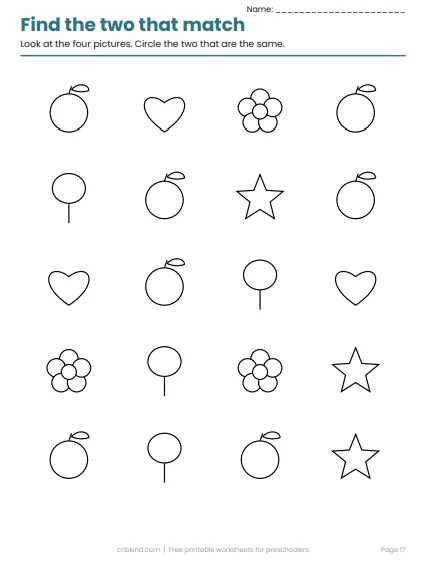
- Find the two that match. Five rows of four pictures with exactly one matching pair in each. Your child circles the two that are the same.
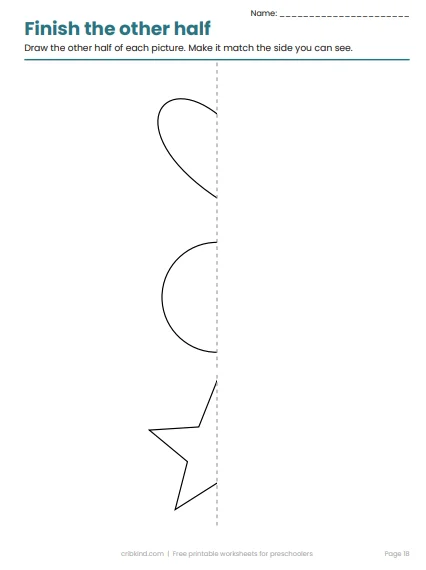
- Finish the other half. A heart, an apple and a star are each drawn on one side of a dotted line, and your child draws the other side. It will not look perfect, and it does not need to.
- Cut on the lines. Four strips with a straight line, a zigzag, a wave and bumps, then a circle and a square to cut out. Start with the straight line and stop there if that is enough for the day.
How to print and use the checklist
Free download: Get all 19 worksheets for preschoolers and the checklist as one PDF
Print only the pages you plan to use that day, and keep the rest in a folder. Begin with page 1 and move on only when your child can trace a straight line without getting frustrated, since the later pages assume that. If a page is too hard, go back one page, and do not worry if you repeat page 1 five times. Page 20 holds both the answers and a checklist of 13 skills, so print it once and keep it away from the table. Treat the checklist as a practice list, not a test.
Sit beside your child for the first page and step back after that. Ask about the picture before the pencil moves, because talking turns a worksheet into a game. When your child is done, let them be the one to check the answers with you, and stop when the interest stops, even if half the page is blank. A calm snack at the end makes the next session easier. Vihaan would probably do three pages if there was a snack at the end, and one if there was not.
Safe practice with pencils and scissors
A full length pencil with an eraser is easier to hold than a short stub, and a chunky crayon is a good alternative for a child who tires quickly. Sharpen the pencil before you begin instead of halfway through a page. Wash hands afterward, and sweep up paper scraps from the floor.
Frequently asked questions about worksheets for preschoolers
What should preschoolers learn from worksheets?
Preschool worksheets are best used for early writing skills such as tracing lines and shapes, along with colors, counting to 5, matching and simple patterns. Your child’s school or program sets the exact goals, so use these as practice.
Where can I find free name tracing worksheets for preschool?
Page 4 of this set is a name tracing page. You write your child’s name on the first line, your child traces it, and then copies it on the lines below, so it fits any name.
Are there alphabet worksheets for preschool in this set?
Not a full alphabet. The only letters are the ones in your child’s name on page 4, which keeps the set focused on early writing, shapes and counting.
What age are worksheets for preschool?
These pages suit ages 3 to 5. Children under 3 usually learn more from play with dough, blocks and crayons on big paper than from a worksheet.
How long should a preschooler work on worksheets?
Five to ten minutes is plenty, and one or two pages a day is a good limit. Stop when your child loses interest, since a short happy session teaches more than a long frustrating one.
Do these worksheets for preschoolers include answers?
Yes. Page 20 has answers for the pages that have them, plus a checklist of skills to practice. Tracing and drawing pages have no right answer, so the key just tells you what to look for.
If I were setting up the first page for Eeshan or Vihaan, I would print page 1, hand over a fat crayon and a green dot to start from, and draw the first line myself so there was something to follow. Then I would sit back and let the crayon go wherever it went. The other eighteen pages can wait in the folder until the day this one feels easy.