40 Rainy day activities for kids
Vihaan at 22 months circled our living room seventeen times on a rainy October Tuesday. I counted. He tried every toy in the basket, rejected them all, then sat down at the patio door and watched the rain for eleven minutes without moving. Rain watching was the activity. These rainy day activities for kids start from that observation , the ones that actually held his attention, sorted by age so you can find the right one in the next five minutes.
Rainy day activities for babies aged 0 to 6 months
At this age, the activity is not the point. The adult is the point. A baby under 6 months has a working range of about 8 to 12 inches from their face , everything beyond that is soft blur. What holds their attention is a face moving expressively at close range, high-contrast patterns, and voices with varying pitch. A rainy day indoor activities for kids at this age is not a problem solved by adding more toys. It is a chance to be the most interesting thing in the room without competing with outdoor stimulation.
1. High-contrast card play
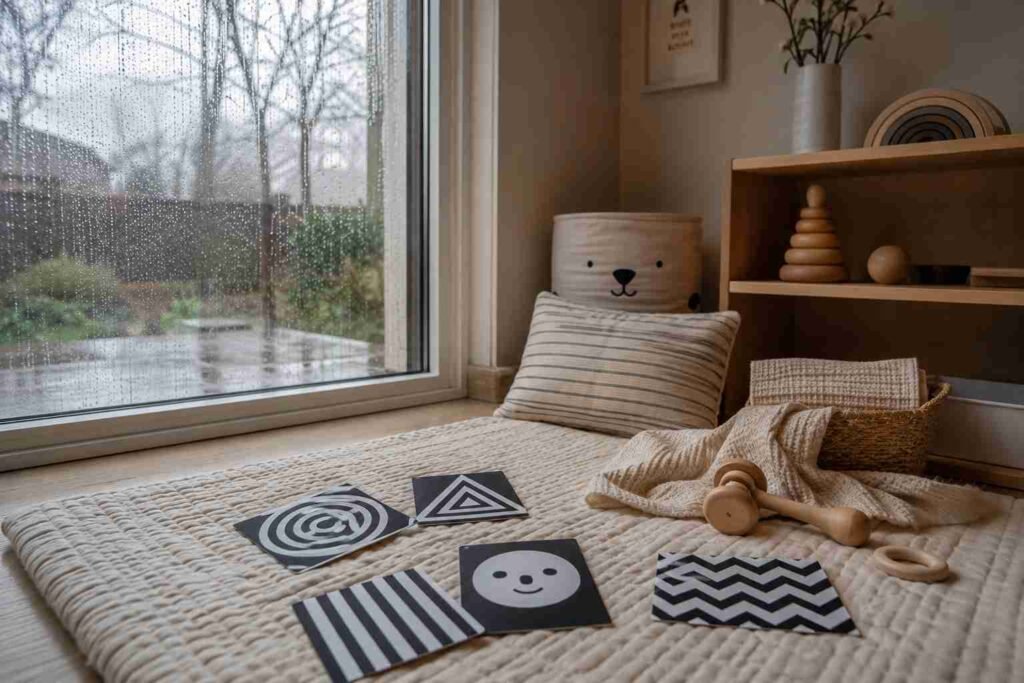
Print or buy black-and-white patterned cards , concentric circles, radiating lines, simple face shapes. Hold them 10 inches from your baby’s face and move them slowly. Newborn visual development responds most strongly to high-contrast edges. This is not infant enrichment content; it is how the visual cortex actually develops in months 0 to 3. Vihaan at 8 weeks tracked a black-and-white bull’s-eye card for four minutes straight. I timed it because I could not believe it.
2. Soft scarf play
Drape a soft, lightweight scarf over your face and pull it away slowly. Peekaboo at its most elemental. At 3 to 5 months, the baby’s social smile is developing and face-appearing-and-disappearing produces it reliably. The scarf version is slower and more dramatic than a standard peekaboo, giving the baby more processing time between appearances. Works in a bouncer, on a play mat, anywhere you can position yourself above them.
3. Rain window watching (the original)
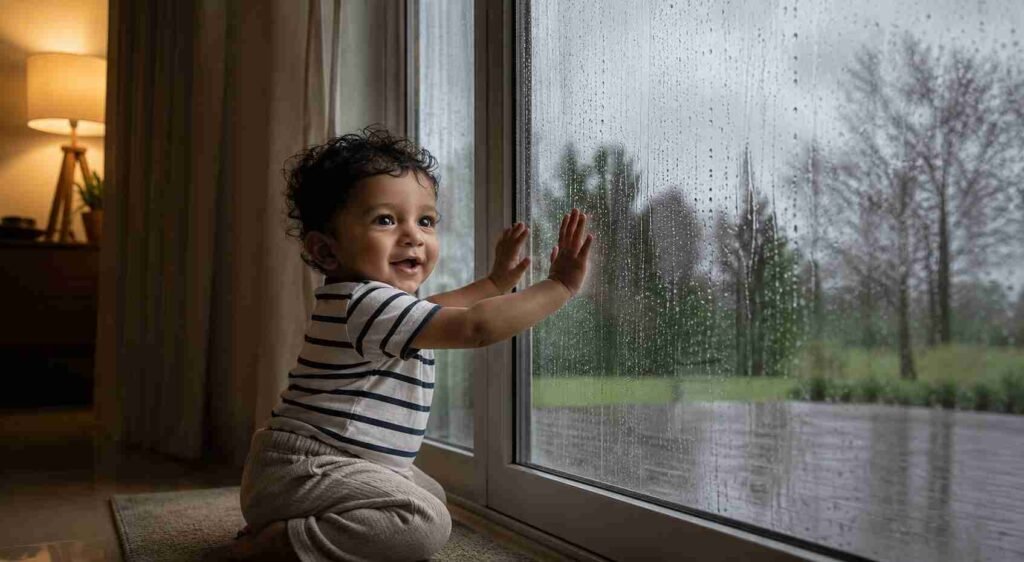
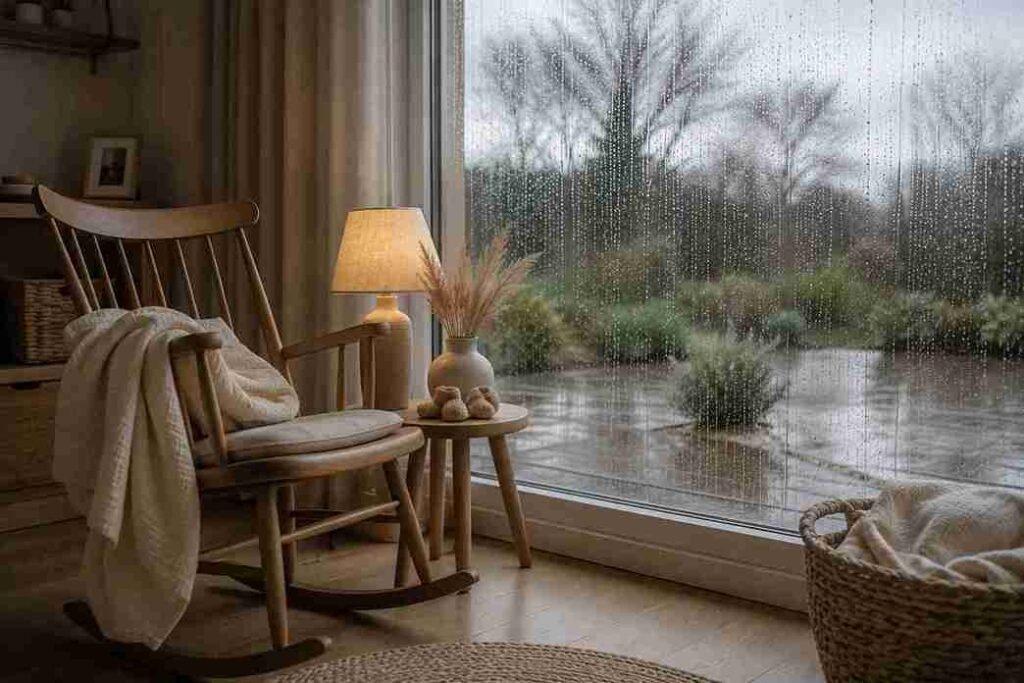
Hold the baby near a window with rain running down it. The moving water is high-contrast against the glass and the movement is slow enough for early visual tracking to follow. Vihaan did this at 4 months before he could do much else and it bought me fifteen minutes of quiet hands-free time. Do not underestimate this one. It costs nothing and works at every age from newborn through toddler.
4. Texture exploration on a mat
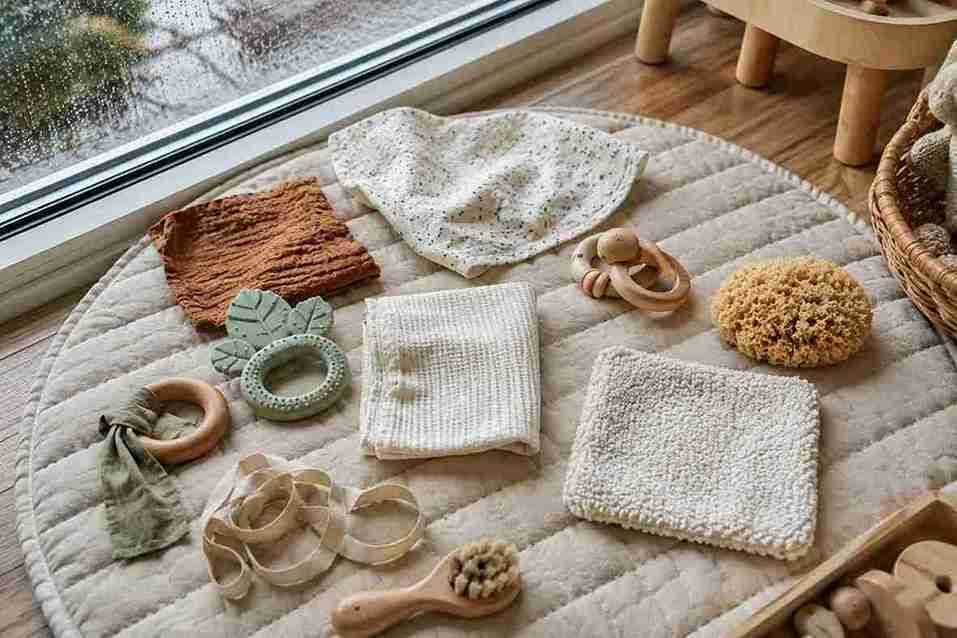
Lay your baby on a play mat and position different textured objects within reaching range , a crinkle toy, a soft fabric square, a plastic ring, a cotton cloth. At 4 to 6 months, grasping and mouthing is the primary way babies learn about the world. A rotation of textures on a rainy morning is genuinely stimulating in the developmental sense, not just entertaining. Everything goes in the mouth. That is the point.
5. Talk-through narration
Talk your baby through everything you are doing. “Now I’m making coffee. This is the kettle. It makes a sound when it boils. The sound means the water is hot.” Not to teach vocabulary , that comes later. The purpose at this age is exposure to sentence rhythm, word boundaries, and the experience of being talked to directly. Research consistently shows that conversational talk (not background TV) predicts language outcomes at age 3. A rainy morning of narrated tasks is real developmental work.
Rainy day activities for babies aged 6 to 12 months
At 6 to 12 months, babies are sitting, starting to pull up, developing object permanence, and discovering cause and effect. Every activity that lets them control an outcome will hold their attention. Pressing something that makes a sound. Dropping something to watch it fall. Putting something in a container. Taking it out. Putting it back in. This seems repetitive. It is repetitive. Repetition is how the brain builds the neural pathways for understanding that actions cause predictable results.
6. Treasure basket
Fill a low basket with 8 to 10 safe household objects , a wooden spoon, a silicone spatula, a metal measuring cup, a clean makeup brush, a fabric square, a small cardboard tube. Set it in front of a sitting baby and let them explore without direction. The treasure basket approach comes from Elinor Goldschmied’s research on heuristic play , the principle that babies learn more from encountering real objects than from toys designed to teach. Vihaan at 9 months spent 25 minutes with a basket containing a spatula, a measuring cup, and a small whisk. The whisk won.
7. Water play in a shallow tray
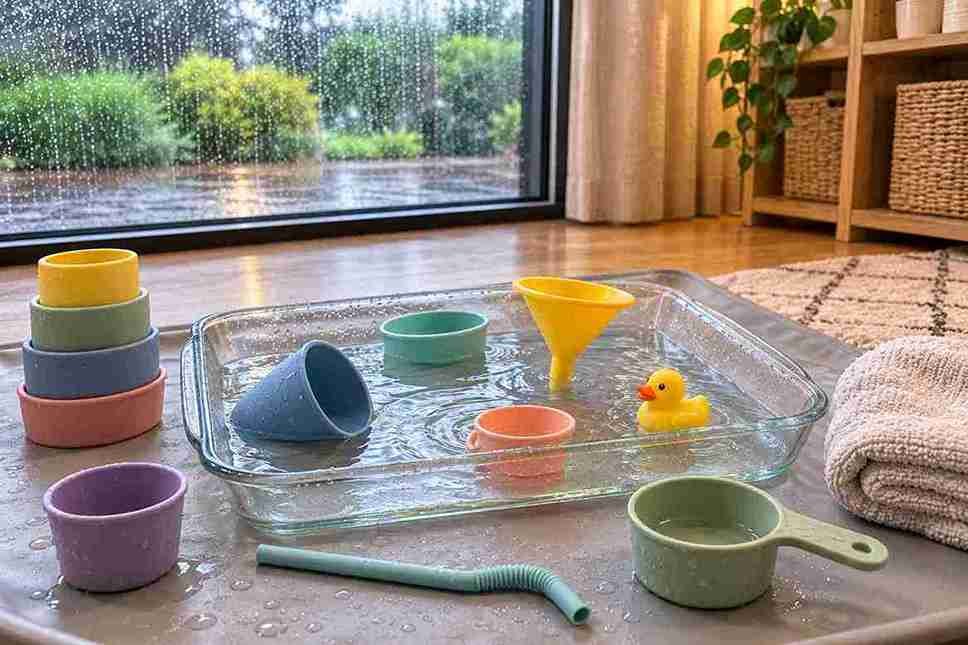
Fill a baking dish with an inch of warm water and set it on a waterproof mat. Add a few bath cups, a small funnel, a silicone straw. Let the baby explore. Supervised always , water safety is absolute , but a baby at 8 to 12 months filling and pouring and splashing is engaging in genuine cause-and-effect learning. The mess is the data. Towels on the floor. This is one of the activities Vihaan sustained longest at every age from 9 months onward.
8. Crinkle paper exploration
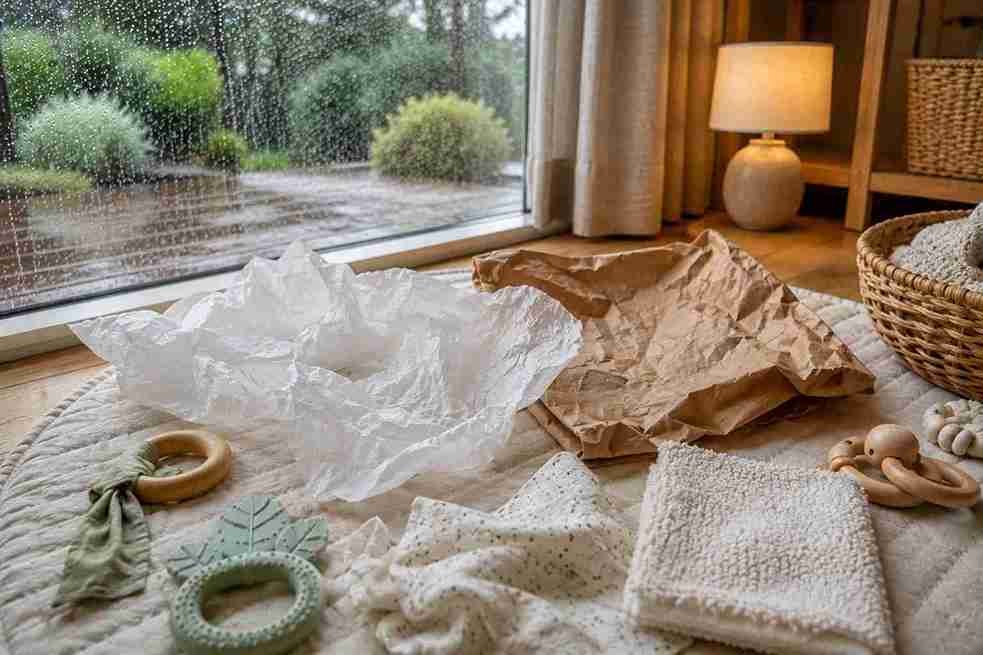
Give the baby a sheet of tissue paper or a brown paper bag (no handle , remove it first). The crinkle sound and texture is almost universally engaging at this age. Watch what they discover: the paper changes shape when you squeeze it, makes a sound, tears in a satisfying way. Tearing is fine. This is not a craft; it is sensory exploration. Clean up is thirty seconds.
9. Mirror play
Hold a baby-safe mirror at face level. At 6 to 8 months, babies are beginning to understand that the face in the mirror is connected to their own movements , but the understanding is not yet complete. The exploration of this is genuinely absorbing. Make faces, wave, put a hat on and take it off. Vihaan at 7 months spent twelve minutes systematically touching the mirror face and then his own nose in a loop.
10. Container in and out
A plastic container with a lid and a collection of large plastic balls or soft blocks. The game is simple: put things in, take them out. Put the lid on, take it off. At 9 to 12 months, object permanence is developing and the fact that the ball is still inside the closed container when you cannot see it is genuinely interesting to process. This is not emptying and filling for its own sake. It is the baby solving a problem about where things go when they disappear.
Rainy day activities for toddlers aged 12 to 24 months
This is the hardest age for rainy days. Old enough to be mobile and determined, not old enough to understand why we cannot go outside. Not old enough for most structured activities. The activities that work at this age are the ones with a clear physical action, an immediate result, and no required explanation. Vihaan’s rainy day repertoire at 14 to 20 months was genuinely short. Things that worked, worked consistently. Failures were immediate and obvious.
The Vihaan test results for this tier: water play won every time. Sticker play on paper sustained him 8 minutes on average. Flour play (a tray of plain flour to pat and poke) got 20 minutes one Tuesday and was immediately worth the cleanup. Playdough got 6 minutes. Sensory bins beat everything when set up correctly.
11. Flour tray sensory play
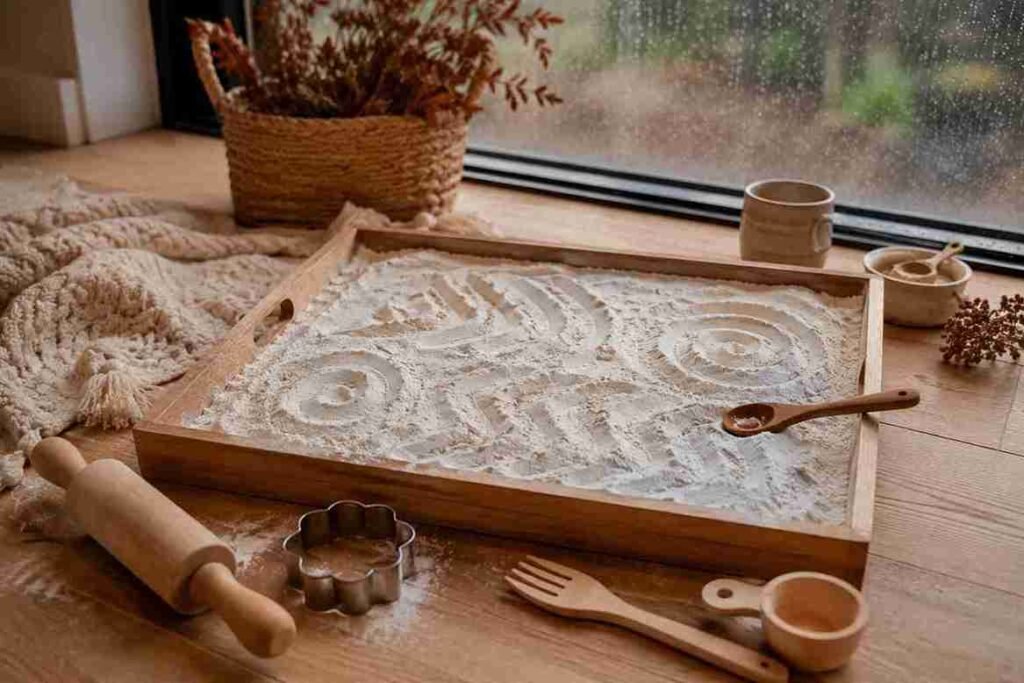
Pour a cup of plain flour into a baking tray. Add a spoon, a fork, a small cup. That is the whole activity. The texture of flour when you pat it, drag your fingers through it, pour it, and press it creates a sensory experience that holds toddler attention longer than most purpose-built activities. Set it on a hard floor with a mat underneath. The cleanup is a broom, not a mop.
12. Sticker play
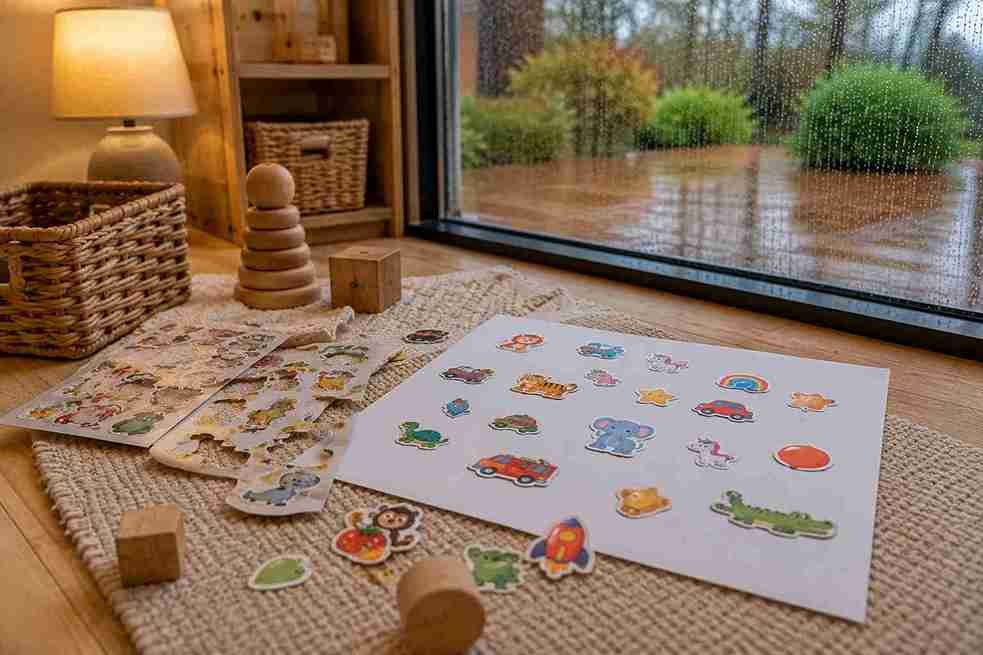
Give a toddler a page of large stickers and a piece of paper. Watch what happens. Peeling the sticker off the backing is a fine motor activity. Placing it (anywhere , they will not stay in lines) is a placement and planning task. The finished page of randomly placed stickers is a complete artwork. Vihaan at 16 months put twelve stickers on his forearm instead of the paper and was satisfied with this outcome. The arm is also paper.
13. Cardboard box play
One large cardboard box. No instructions. The toddler will discover climbing in, climbing out, pushing it, sitting in it, tipping it, turning it into a house, turning it into a boat, tearing pieces off it. The box is the activity. Vihaan’s large box from a stroller delivery lasted four rainy afternoons before it became structurally unsound. Best rainy day investment per dollar we ever made.
14. Water transfer play
Two bowls of water on a towel, a small cup or ladle, and a turkey baster. The task (unspoken , do not explain it) is moving water between the bowls. The satisfaction of filling, pouring, and watching the water level change keeps toddlers busy longer than almost any structured activity. This is Vihaan’s sustained record: 27 minutes at age 21 months. I know because I watched the whole thing and then quietly went and got more water to top up the bowls so it would not end.
15. Sensory bin , fall version
A storage bin with dried pasta, a few small cups, some plastic animals, and a small funnel. Hide three toys under the pasta and let the toddler find them. For more ideas see our fall sensory bin post , the exact materials and setup that held Vihaan’s attention through a full rainy October.
16. Washing fruit or vegetables
Give the toddler a plastic tub of warm water and three pieces of produce , apples, potatoes, whatever you have. A small scrubbing brush. Tell them you need these washed for lunch. The authority of a real task, plus water play, plus sensory texture is a combination that works at this age with remarkable consistency. The produce gets washed. Usually.
17. Painting with water
A wide paint brush and a cup of plain water. The child paints on dark paper, concrete floors, a chalkboard, the side of the bath , anywhere that shows the wet mark. The mark disappears as it dries and they paint again. No mess. Vihaan found this genuinely interesting at 18 months because the mark kept disappearing and reappearing as he painted over and over the same patch. He had strong opinions about this, all of them expressed through the pointing and concentrated effort of someone at work.
18. Duplo or stacking play
At 18 to 24 months, building and knocking down is more satisfying than building and leaving up. Stack towers together. Let them knock it. Repeat. This does not wear out. Eeshan at 20 months knocked down the same tower 46 times in one session. We counted eventually because Spandana thought knowing would help. It did not help but it became a permanent data point.
Rainy day activities for preschoolers aged 2 to 5
Preschoolers can handle longer activities, follow multi-step instructions, and engage with pretend play narratives. The rainy day activities that work at this age are the ones where the child has a role with stakes. Not “let’s bake cookies” but “I need your help because I cannot do it without you.” Not “let’s draw” but “can you draw me a map to the treasure?” The activity is the same. The framing changes everything about how long it holds.
Spandana used this principle in her classroom every rainy day: whatever the activity, give the child a job title. Line manager of the Play-Doh. Head of the Art Department. Chief Cookie Tester. The pretend authority of a role extends engagement by approximately double in her experience. This is not a trick. It is developmentally appropriate , preschoolers are building identity through role play and any activity that gives them a character to inhabit is deeply engaging.
19. Play-Doh with a specific brief
Not “make whatever you want.” That is too open. “Can you make me a dinosaur for our museum?” gives a goal, a context, and an audience. Vihaan at 3 years spent 35 minutes making a dinosaur that was technically a ball with protrusions, but he could explain every feature. The explanation took longer than the making. Both were the activity.
20. Cardboard box architecture
Boxes, tape, markers, scraps of fabric. The brief: build a house for your stuffed animal. Or a spaceship. Or a restaurant. The building is the play. The finished structure will not match the intention. That gap between plan and result is where problem-solving lives. Eeshan at 4 years built a house for his dinosaurs that had a roof made of a cereal box taped upside down. Engineering decisions were made and defended.
21. Baking banana muffins
Not a general “let’s bake” , banana muffins specifically, because the recipe is forgiving, the banana mashing step is satisfying for small hands, and the measuring is manageable for ages 3 to 5. Assign the child specific steps: measuring, pouring, stirring. The kitchen becomes the classroom. Spandana’s classroom baking sessions always used the same recipe because a familiar recipe lets children focus on the steps rather than on deciphering new instructions.
22. Indoor treasure hunt
Hide five objects before the child wakes up or while they are in another room. Draw a simple map. The map does not need to be accurate. The child will interpret it generously. “X marks here” with an arrow that bears no relationship to actual spatial directions still produces a functional treasure hunt because the child wants to find the treasure, not verify the cartography.
23. Puppet show with socks
Two mismatched socks, googly eyes from the craft drawer, a marker. Five minutes of making, twenty minutes of performing. The audience (you) must react genuinely to everything the puppets do. Preschoolers read performed reactions accurately. Fake interest produces flat performances. Genuine laughter at a puppet falling over produces an encore of falling over.
24. Rainy day crafts for kids , paper chain garland
Cut strips of coloured paper. Loop and glue into a chain. This is one of the rainy day crafts for kids that every competitor lists generically. What they do not tell you: give it a purpose. “We’re making decorations for Vihaan’s birthday next week” changes the energy from craft activity to meaningful contribution. The chain ends up longer because the child keeps going rather than stopping when it is “enough.”
25. Obstacle course indoors
Pillows, cushions, a tunnel made from a cardboard box, tape lines on the floor, a hoop made from a pool noodle zip-tied into a circle. Time each run. Write it down. Compete against the previous time. A 4-year-old who is racing their own previous record has infinite motivation. Eeshan at 5 ran our living room obstacle course 34 times in one morning. The course was redesigned twice mid-session based on feedback about which obstacles were fair.
26. Playdough bakery
Playdough, small tools (fork, rolling pin, cookie cutters if you have them, bottle cap if you do not), paper for menus and price tags. The bakery has prices. Customers must order. The baker takes this seriously. This is one of the activities Spandana used as a classroom setup on rainy days , the commercial role-play structure keeps children engaged for forty-five minutes to an hour when set up correctly.
27. Cloud dough (sensory)
Eight cups of flour plus one cup of baby oil. Mix. The result is a crumbly sensory material that holds shape when pressed and breaks apart satisfyingly when dropped. Different from Play-Doh in that it cannot be re-used indefinitely, but the texture is genuinely different from any standard craft material and preschoolers who have not encountered it before find it absorbing. Vihaan at 3 years made twelve “mountains” in a row and named each one.
28. Alphabet or number hunt around the house
Write the alphabet on 26 small pieces of paper. Hide them around the accessible rooms. Give the child a list and a bag. The hunt is finding and collecting in order, which adds a sequence challenge on top of the search challenge. For non-readers, use pictures of household objects they recognise. Spandana’s classroom version of this on rainy days used sight words instead of the alphabet and doubled as genuine literacy practice.
29. Reading marathon with a twist
Stack ten books. Read them in order. But let the child be the one who reads to you , even if they cannot read. They narrate from the pictures. You listen and ask questions. The role reversal (child as expert, adult as learner) produces a level of engagement that standard “you read to me” sessions do not. Eeshan at 4 told us the story of a wordless picture book for 25 minutes, adding details that were not in the pictures and then defending them when questioned.
30. Marble run with paper towel tubes
Save the tubes. On a rainy day, tape them to a door or wall at angles to create a marble run. Drop a marble in the top. Watch where it goes. Adjust. Drop again. The engineering problem of making the marble reach the bottom without falling out is genuinely engaging for ages 4 and up. Eeshan at 5 spent an entire rainy afternoon rebuilding the same run in different configurations. He had a theory about angles. The theory evolved.
Indoor rainy day activities for kids aged 5 to 8
School-age children on a rainy day have a different problem from toddlers. They are not bored because they lack stimulation , they are bored because outdoor play has a social dimension that indoor play rarely replicates. The rainy day activities that work for this age are the ones with a competitive or collaborative element: games with stakes, creative projects with an audience, activities that produce something shareable.
Spandana’s classroom rainy-day indoor activities were always the ones children talked about afterward. Not the art projects , the games that produced a winner and a loser, or the building projects that produced something they could show each other. The social output of the activity mattered as much as the activity itself.
31. Rainy day games for kids , board game tournament
Three games. A bracket. A prize (the winner chooses what’s for lunch, or picks the film for family movie night). The tournament structure transforms individual games into a narrative. Eeshan at 6 kept a written bracket on the back of a cereal box across an entire rainy Saturday. The results were disputed. The disputing was also the activity.
32. Stop-motion animation with Lego
Most smartphones have a stop-motion app or can shoot individual photos for manual assembly. Build a scene with Lego. Move one element. Take a photo. Move again. Take another. At 60 photos per sequence, a basic story takes two to three hours. Eeshan at 7 made a Lego film about a spaceship that lasted 43 seconds and watched it on loop for twenty minutes.
33. Cooking a real meal (not baking , cooking)
Assign the child a real recipe with real stakes , this is what the family eats for lunch. Not a modified child version. A real dish scaled to their skill: pasta with a sauce they make, pancakes for the family, scrambled eggs. The difference between “helping cook” and “being the cook” is the difference between 10 minutes of engagement and 45 minutes. Children who are the cook are deeply motivated.
34. Write and illustrate a book
Fold five sheets of paper in half. Staple the spine. That is the book. Now write and illustrate it. It needs a title, an author name, a dedication page, and an ending. The production design of a book , the physical object with its parts , is motivating in a way that “write a story” alone is not. Eeshan at 6 wrote a book called “The Dinosaur Who Was Also A Lawyer” and it is a genuinely complete narrative with a plot.
35. Science experiment , baking soda and vinegar volcano
Yes, this is on every list. But it is on every list because it is genuinely effective at ages 5 to 8. The question is how you frame it. Not “let’s do a volcano experiment” , “we’re testing whether the amount of baking soda changes the size of the reaction. We are going to measure and record.” Add the scientific method and you have something a 6-year-old can engage with for forty minutes rather than five.
36. Shadow puppetry
A lamp or flashlight, a white sheet hung in a doorway, hands. The classic is hands, but at age 5 to 8, cut-out cardboard shapes on sticks produce more elaborate performances. Give the performance a title. Invite the other parent as the audience. A 7-year-old performing shadow puppetry for an adult audience that responds genuinely will extend the performance indefinitely.
37. Origami
Start with a paper crane , the classic first origami project for ages 6 and up. YouTube tutorials make this accessible. The folding is precise, the result is satisfying, and each crane improves on the last. Eeshan at 7 made eleven cranes in one afternoon, each one slightly more accurate than the previous. By crane eight, they were genuinely beautiful. He gave them to Spandana, one at a time, across the afternoon.
38. Scavenger hunt with photographs
Give the child a phone or camera and a list of things to photograph: something red, something older than me, something that makes a sound, something you would not notice if you were not looking. The photography frame transforms the house into a documentary subject. Eeshan at 6 spent 45 minutes on a list of eight items, producing 47 photographs in the process. Several of the photographs were of his own feet for reasons he explained but which remained unclear.
The rainy day kit , the one thing that changed everything
By the third rainy day in October of Vihaan’s second year, I had run out of ideas. Not because there were no ideas, but because pulling activities together from scratch every time added decision fatigue to the existing problem of entertaining a toddler. Spandana suggested making a box.
The rainy day kit is a physical box of materials that comes out exclusively on rainy days. Ours contains: cloud dough ingredients in a sealed bag, a roll of masking tape, googly eyes, a pack of stickers, a set of watercolour paints, three toilet rolls saved from the previous weeks, a deck of cards, and a printed list of twenty activities that work for Vihaan at his current age.
The box has one rule: it only comes out when it is raining. This is the most important part. The novelty of the materials is preserved because they are not available on non-rainy days. By the time a rainy day arrives, the box itself is the first activity , Vihaan asks to see what’s inside before anything else is suggested. The kit manages his expectations from the moment the rain starts.
For more rainy day craft supplies and ideas, our fall sensory bin post covers the materials that keep coming back to our kit every autumn, and our pumpkin crafts for kids covers twelve craft activities that go directly into our rainy day box in October.
What Spandana adds , classroom rainy day activities for kids
I found Spandana’s laminated rainy day card in the kitchen drawer last winter while we were clearing out. It was from her first year of teaching, ten years ago. The activities on it were the same five I had independently discovered with Vihaan five years after she wrote it. Sensory bin. Drawing with a specific brief. Fort building. Cooking something simple. Reading with the child as narrator.
Same five. Different context, different children, different decade. She had called hers “the anchor activities” , the ones you return to when everything else has failed, because they work reliably at any age and in any mood. I had called mine “the ones that actually worked.” We were describing the same list.
Her classroom version of indoor rainy day activities for kids had one rule that I have since adopted at home: every activity needs a destination. Not a destination like “we’ll be done by noon” , a destination like “we’re making something for the classroom wall” or “we’re making lunch” or “we’re preparing a performance.” The activity needs somewhere to go. Open-ended play is valuable. But on a rainy day with a restless child, an activity with a destination , something to show, something to eat, somewhere to put the finished thing , holds attention longer than one without.
For more Spandana activities sorted by age and development stage, our 200 would you rather questions for kids covers the question format she used most often in her classroom on rainy days and that works just as well at the dinner table on a wet afternoon.
Rainy day activity ideas by material , quick reference
If you have specific materials available right now, here is what to use them for:
- Flour: cloud dough (add baby oil), flour tray sensory play, baking
- Cardboard boxes: architecture, obstacle course component, fort walls, puppet theatre
- Toilet rolls: marble run, craft characters , see our toilet paper roll crafts
- Paint: rainy day crafts for kids , window painting, watercolour books, paper plate art
- Water: water transfer, washing vegetables, water painting, sensory tray
- Paper: book making, origami, treasure hunt clues, puppet show backdrops
- Stickers: preschooler sticker play, alphabet hunt markers, book illustrations
- Play-Doh / cloud dough: bakery, dinosaur museum, systematic mountain building
Frequently asked questions
What are the best rainy day activities for toddlers at home?
The rainy day activities for toddlers that work most consistently at home are water transfer play, the treasure basket, flour tray sensory play, and cardboard box exploration. All four require minimal materials, produce minimal cleanup compared to their entertainment value, and work across the 12 to 24 month range without modification. Water transfer play is the single highest-sustained-attention activity we have tested at this age , Vihaan’s record is 27 minutes at age 21 months. The key for toddlers is choosing activities that have an obvious physical action with an immediate result, not activities that require following instructions or producing a finished object.
What rainy day activities for babies under 12 months actually work?
For babies under 6 months, the most effective rainy day activity is direct interaction , face play, talking, high-contrast card movement. For babies 6 to 12 months, treasure baskets, water play in a shallow tray, and container in-and-out play work consistently. The developmental key for this age is choosing activities that let the baby control an outcome: pressing something that makes a sound, dropping something to watch it fall, fitting something into a container. Rain window watching works at every age from newborn onward and is genuinely among the most effective zero-effort activities available.
What are rainy day activities for kids at home that do not need screen time?
Every activity on this list is screen-free. The highest-engagement screen-free rainy day activities by age: for babies, treasure baskets and water play; for toddlers, water transfer, flour tray, and cardboard boxes; for preschoolers, indoor obstacle courses, playdough with a role-play brief, and baking with a specific recipe; for school-age children, cooking a real meal, book writing, stop-motion animation, and board game tournaments. The common thread across all ages is giving the child a job with stakes rather than an open-ended activity without direction.
How do you keep kids entertained indoors on a rainy day without getting frustrated?
Building a rainy day kit in advance was the single change that most reduced frustration for us , a physical box of materials that comes out exclusively when it is raining. Materials are pre-selected for the child’s current age. Novelty is preserved because the box only appears on rainy days. Opening the box is always the first activity, which gives the child agency at the exact moment they need it most.
What are good rainy day activities for kids when they are bored of everything?
When a child has rejected everything suggested, the problem is usually not the activities but the framing. The activities that recover a bored or frustrated child consistently are the ones with an adult actively participating rather than facilitating. Not “here are some things you could do” , “come help me with this.” Baking, cooking lunch, building something together, or reading where the child narrates to you as the audience all work because they put the child in a position of genuine contribution rather than entertainment. The activity needs an audience, a purpose, or both.
From one dad to another
I found Spandana’s laminated card in a drawer and read through the list twice. Five activities, written in her teacher handwriting from ten years ago. They were the same five I had written in my phone notes over the previous winter with Vihaan, arrived at through completely independent trial and error. I thought I had worked something out. Turns out she had figured it out in her first year of teaching and I had just needed ten years and two children to catch up.
The best rainy day with Vihaan this year was the one where he watched the rain for eleven minutes and I stopped trying to entertain him. Sometimes the window is enough. Sometimes you need 50 activities. This list is for the second kind of rainy day. The window is for the other one.
Saidesh is a dad of two, Eeshan and Vihaan, writing about what he actually tried, tested, and learned the hard way. CribKind covers baby development, sensory play, and real parenting for the first two years.