Thanksgiving math worksheets: 10 free pages with answer keys
If you need something to print before the turkey goes in, this set of thanksgiving math worksheets gives you 10 pages sorted by skill, from counting pies in kindergarten to sharing rolls by division in third grade. Each page names what the child practices and which numbers it uses, and the answer keys sit at the back of the same PDF. Most free pages I read this week skipped the key or kept it for paying members. Pick by what your child has been taught, not by the grade on the label.
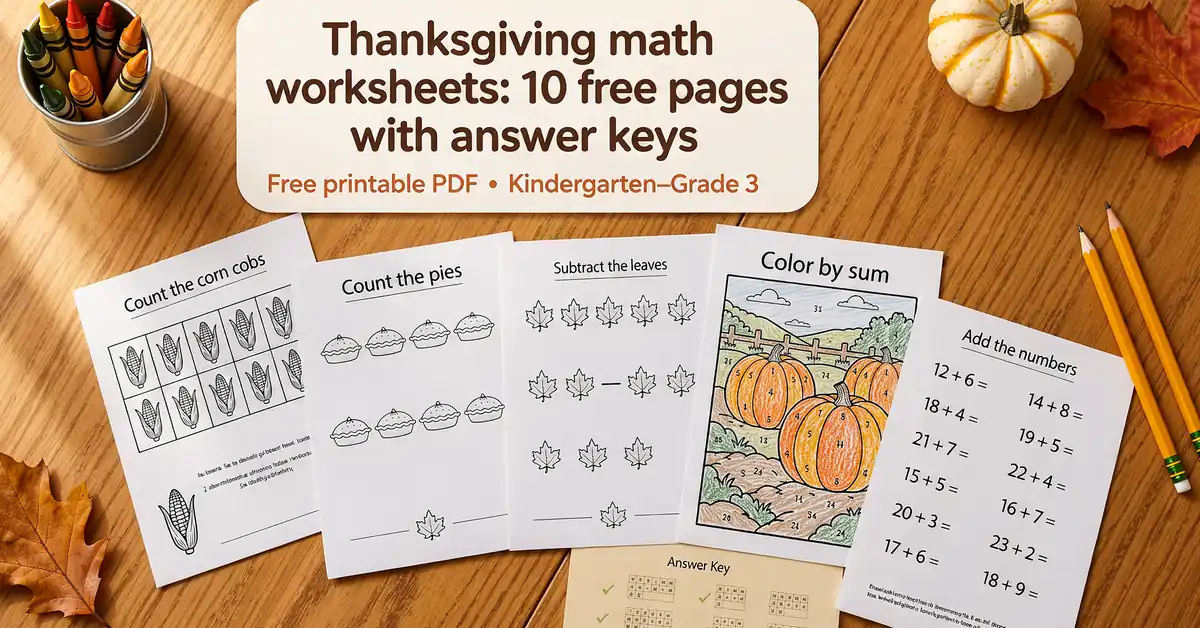
Thanksgiving math worksheets free printable pack, page by page
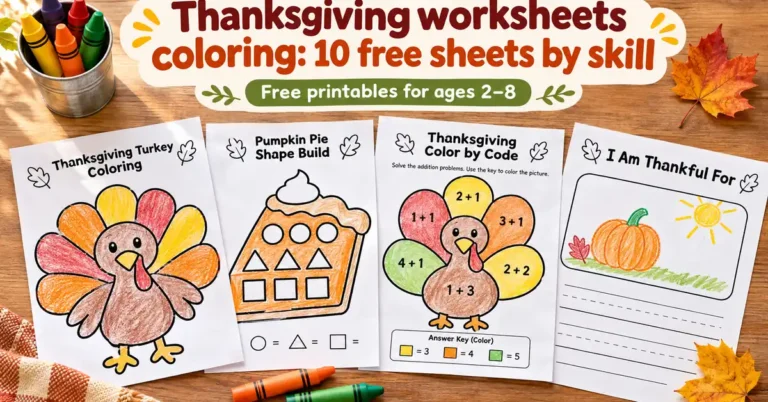
Here is everything in the PDF before you download it, so you can print one page instead of all twelve. The ten activity pages are black line art on letter size paper, and none of them needs scissors or glue. The theme comes from pies, corn, leaves, turkeys and a crowded family table, which keeps the math itself front and center.
| Page | Title on the page | What the child does | Numbers used | Grade guide | Answers on |
|---|---|---|---|---|---|
| 1 | Count the pies | Counts the pies in 10 boxes and writes each number | 1 to 10 | Kindergarten | Page 11 |
| 2 | Turkey feather addition | Adds two groups of drawn feathers | Sums up to 5 | Kindergarten | Page 11 |
| 3 | Falling leaves subtraction | Crosses out leaves and writes how many are left | Within 10 | Kindergarten | Page 11 |
| 4 | Make 10 with corn | Finds how many more kernels fill a ten frame | Up to 10 | Kindergarten to grade 1 | Page 11 |
| 5 | Pumpkin patch color by sum | Solves 12 sums and colors the picture by the answers | Sums 11 to 20 | Grade 1 | Page 11 |
| 6 | Pie slice subtraction | Solves 12 subtraction facts | Within 20 | Grade 1 | Page 11 |
| 7 | Grocery list math | Solves 12 two digit problems, half with regrouping | Within 100 | Grade 2 | Page 12 |
| 8 | Feast table word problems | Solves 6 one step and two step story problems | Within 100 | Grade 2 | Page 12 |
| 9 | Seats and rolls arrays | Writes the repeated addition and the multiplication fact for 6 arrays | Products up to 30 | Grade 3 | Page 12 |
| 10 | Sharing rolls equally | Solves 8 division facts and 2 story problems | Dividends up to 50 | Grade 3 | Page 12 |
If you only print one page for a mixed group of kids, make it page 4. A kindergartner can work it out from the drawn corn, and a second grader can race through it as a warm up before page 7. Once the pencils go down, the quiet game after dinner can come from our list of family games on Thanksgiving Day.
How to pick the right page in two minutes
Grade labels on worksheets are a rough guess, and Thanksgiving lands only about three months into the school year. One first grader in late November is still firming up facts within 10, while another already adds within 20 without fingers. So I would ignore the grade column at first and run a tiny test instead.
Read the first three problems on a page out loud and let your child answer. Three quick, correct answers mean the page fits or is a little easy, so try the next one up. Two misses mean you step back a page, because a holiday worksheet is a bad place to meet something brand new.
For a rough anchor, California’s math standards, which follow the Common Core, put adding and subtracting within 10 in kindergarten and within 20 in first grade. Second grade moves on to two digit numbers within 100, and third grade brings in multiplication and division. A teacher covering a class before the break can use the same idea: hand out the page that matches the last unit taught and keep the next page up for early finishers.
Kindergarten pages for counting, adding and making 10
Pages 1 to 4 suit a child who can count objects and is starting to see that numbers can be put together and pulled apart. Count the pies (page 1) has 10 boxes holding 1 to 10 pies each, in mixed order, and the child writes the number in each box. On Turkey feather addition (page 2), every problem shows two groups of feathers and every sum stays at 5 or under, so the answer can always be counted.
Falling leaves subtraction (page 3) asks the child to cross out leaves and write how many are left, staying within 10. Crossing out is the point. It gives a five year old something to do with the pencil besides guessing.
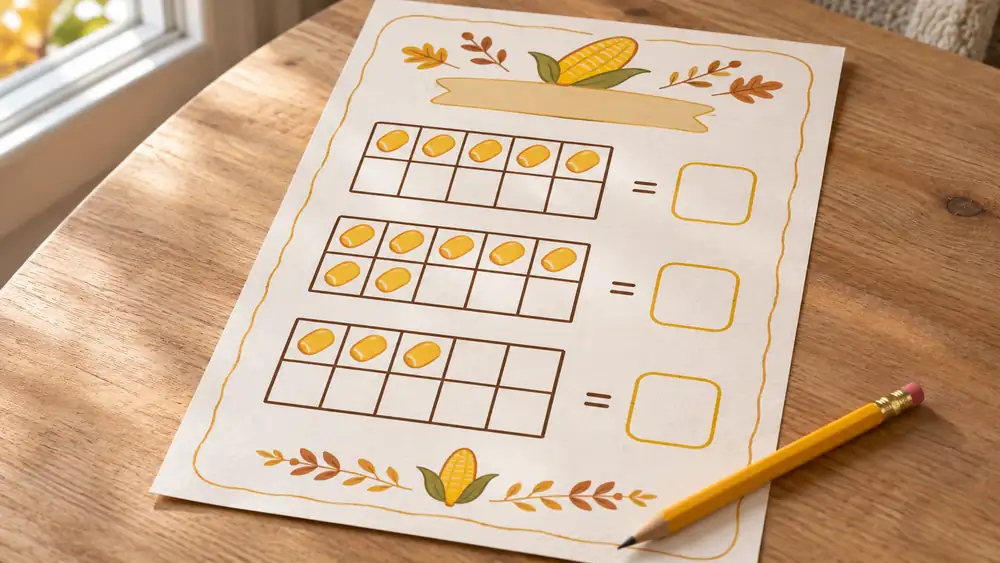
My favorite page in the set is Make 10 with corn. Each problem shows a ten frame with some kernels already drawn in, and the child writes how many more would fill it. A frame with 7 kernels has 3 empty boxes, so the answer is 3, and that same pair of numbers comes back on page 5, which is why the pages run in this order.
For more practice once the holiday is over, our kindergarten math worksheets cover the same skills without the turkeys.
First grade pages, including a color by sum sheet
If your child likes Thanksgiving coloring math worksheets, print page 5 first. Pumpkin patch color by sum has 12 addition problems with sums from 11 to 20, and each answer tells the child which crayon to pick: 11 to 13 is orange, 14 to 16 is yellow and 17 to 20 is green. The finished picture is a pumpkin patch. Kids can partly check themselves as they go, since a wrong sum tends to drop an odd color into a spot where it plainly does not belong.
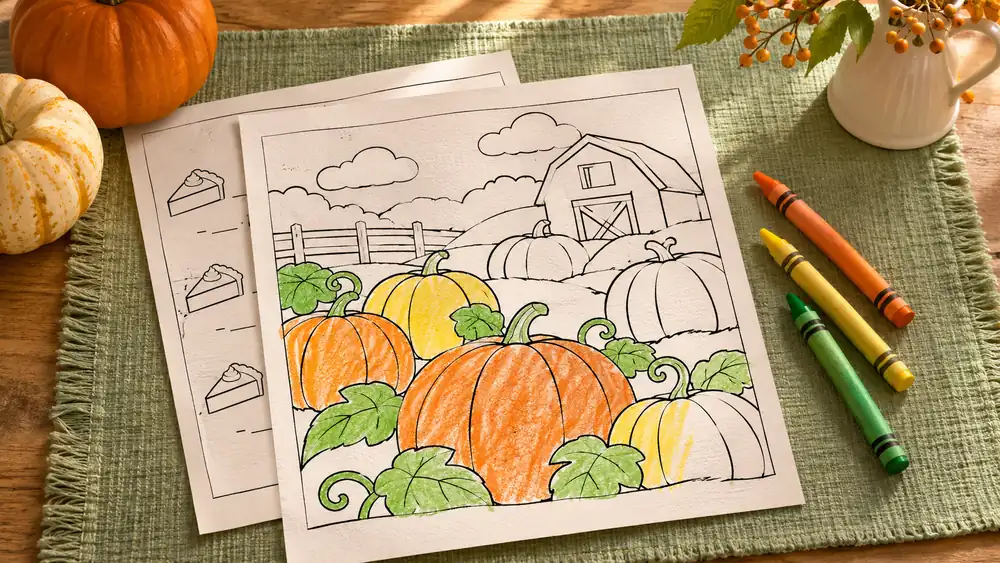
Take 9 + 6. A child who just did page 4 can move 1 from the 6 over to the 9 to make 10, which leaves 5, so the answer is 15 and that space turns yellow. Showing that once, out loud, does more than any amount of “count on your fingers.”
Pie slice subtraction (page 6) has 12 facts within 20, like 15 minus 7 and 18 minus 9, with no pictures at all. It is plainer on purpose. If page 5 went well, page 6 shows you whether the facts hold up without the crayon reward, and a child who grumbles about that can still finish it in ten minutes.
Second grade pages with two digit math and word problems
Grocery list math (page 7) has 12 two digit problems within 100, six adding and six subtracting, laid out in four rows of three. Only the bottom two rows need regrouping. A child who has not learned regrouping yet can stop after row 2 and still finish real work, so check the last unit sent home before you hand over the whole sheet.
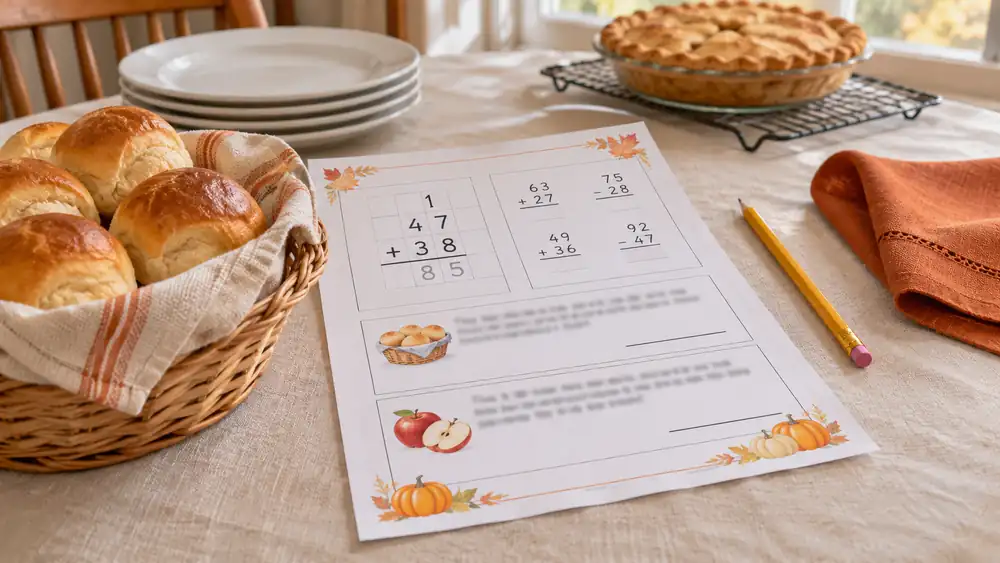
A worked example sits at the top of the page: 47 + 38. Add the ones first, and since 7 and 8 make 15, write the 5 and carry the 1 to the tens. Then 4 tens plus 3 tens plus the carried 1 make 8 tens, for 85.
Feast table word problems (page 8) has six short stories. Some take one step, like 24 rolls on the table with 15 eaten, leaving 9. Others take two: 18 apples and 25 pears go into pies, the pies use 30 pieces of fruit, and 13 are left over. Reading the stories aloud to your child is fine, because this page checks the math and not reading speed. Our 2nd grade math worksheets have more practice at this level.
Third grade pages on arrays and fair sharing
Seats and rolls arrays (page 9) shows six pictures of things in rows, such as 4 rows of 6 chairs around a long table. The child writes the repeated addition first (6 + 6 + 6 + 6) and then the multiplication fact, 4 × 6 = 24. In November that two step habit matters more than speed, since some third grade classes have only just started multiplication.
Sharing rolls equally (page 10) flips the idea around. It has 8 division facts with dividends up to 50, plus two story problems, like 30 rolls shared among 5 baskets, which puts 6 in each basket. A child who freezes on division can draw 5 baskets and deal the rolls out one at a time; it is slow, but it always lands on the right answer.
If your third grader breezes through both pages, our 3rd grade math worksheets pick up from here with a full pack and answers.
Keeping the theme to food, leaves and the table
You won’t find Pilgrims, feathered headdresses or story problems about a first feast anywhere in this pack. I left them out on purpose. A word problem turns whatever it mentions into a fact in a child’s head, and the short school version of the holiday story leaves a lot out.
Pies, rolls, corn and leaves are what kids actually see around the holiday, so they make better counting objects anyway. A child who counted pies on page 1 in the morning might count the real ones on the counter that afternoon, and that small link between paper and table is what makes the numbers stick.
Using the sheets while the turkey roasts
A table full of mixed ages is the normal Thanksgiving setup, and spreading the pack across four grade levels is how it handles that. Seat each child next to someone working a nearby page, so an older cousin can help without just reading out answers. Page 1 also works for a younger sibling who cannot write numbers yet: they color each pie and point while someone else writes the number.
Keep the sessions short. One page per child before dinner is plenty, and a second page after pie is a bonus, not a rule. Kids who finish early and still want paper can move on to our fall to winter dot to dot pages, which keep them counting in order.
Printing the pack and checking the answers
The pack is one PDF of 12 letter size pages. Pages 1 to 10 are the worksheets and pages 11 and 12 are the answer keys, so set the print range to 1 to 10, or type just the one page you picked. Choose Actual size or 100 percent in the print dialog rather than Fit, so the ten frames and arrays print at the size they were drawn.
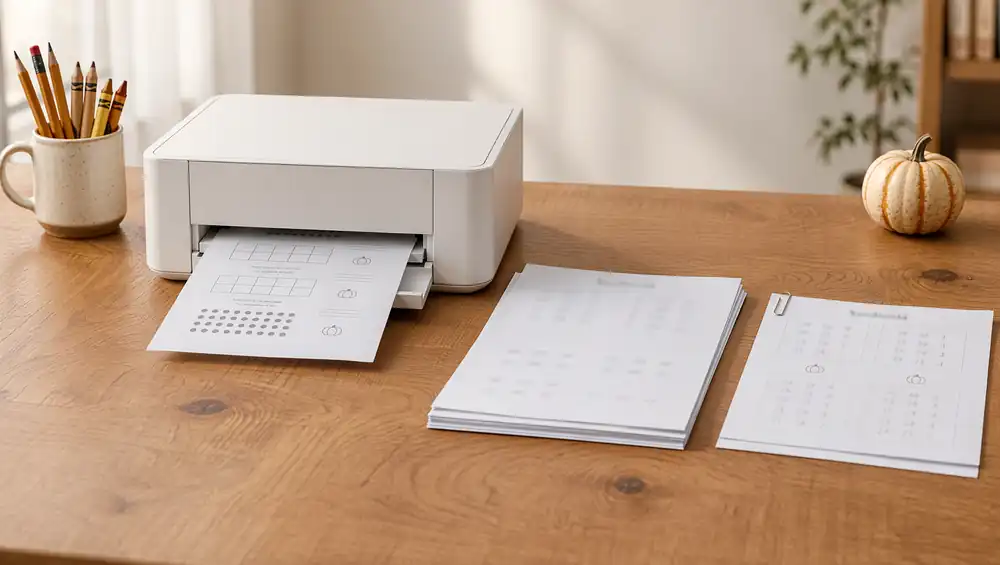
Plain printer paper works for everything, and so does black and white printing, page 5 included, because the color comes from the crayons. If several kids are on the same level, print that page more than once rather than copying a sheet someone already wrote on.
Keep pages 11 and 12 for yourself. Page 11 has the answers for pages 1 to 6, and page 12 covers pages 7 to 10, with the steps for each word problem shown instead of just the final number. All of these free Thanksgiving math worksheets come in the one download just below, so you can grab the whole set now and choose pages later.
Free download: Get all 12 Thanksgiving math worksheets as one PDF
Thanksgiving math worksheet FAQ
What grade are these Thanksgiving math worksheets for?
Kindergarten through third grade. Pages 1 to 4 are kindergarten level, pages 5 and 6 are first grade, pages 7 and 8 are second grade, and pages 9 and 10 are third grade. Use the quick three problem test above if you are unsure where your child fits.
Do the worksheets come with answer keys?
Yes. Page 11 holds the answers for pages 1 to 6, and page 12 holds the answers for pages 7 to 10, with the steps shown for the word problems.
Do I need a color printer for the coloring math page?
No. Every page prints in black and white. On page 5 the child adds the color with orange, yellow and green crayons, following the answer code at the top of the sheet.
What can a toddler do while older kids work on the pages?
Give a toddler page 1 and a crayon that matches the age label on the box, and let them color the pies while you count out loud. Skip real food or small objects as counters for this age, and sit close by.
Can I print just one page?
Yes. Type the page number into the pages box in your print dialog, and print at actual size.
One more thought before the pies come out
Most of the math at a holiday table never touches paper. Someone counts chairs, someone cuts a pie into 8 slices, and someone works out whether there are enough rolls for a second round, which is page 10 without the worksheet. If Eeshan and Vihaan were at the table with this pack, I would give each of them one page before the meal and save the rest of the counting for the food. Ten minutes on a sheet that ends with a kid asking how many slices are left is a good trade. Print one page, keep the key nearby, and let the pie do the rest.