
2nd Grade Math Worksheets
If your second grader can add 8 and 7 in a flash but stalls at 48 plus 37, the gap is usually regrouping, not effort. That is why these 2nd grade math worksheets spend four pages on two digit adding and subtracting. Place value, money, time and measuring come after. There are 19 free printable pages plus an answer key, all on plain letter paper, so you can print only the skill your child needs this week.
Each page is letter size (8.5 by 11 inches) with roomy boxes for writing, so a regular pencil works fine. Print at 100 percent scale on plain paper, and make as many copies as you need for your own family or classroom.
What 2nd grade math worksheets should cover
Most US second grade programs, including the Common Core standards many states build on, spend the year on a short list of ideas: adding and subtracting within 100, place value up to 1,000, telling time, counting money, measuring in inches and reading simple graphs. I built the pages in that order, so each group leans on the one before it. A child who can add 27 and 35 with a carry will find word problems far less scary, and a child who knows what the 5 in 529 means is ready to compare numbers.
These math worksheets for 2nd grade are for ages 7 to 8, which is older than most CribKind readers. If a younger brother is hanging around the table, Vihaan would probably want a pencil too, and I would hand him a crayon and a scrap of paper instead. For children under 3, stairs, blocks and counting songs do the same job without a page in sight.
| Page group | Pages | Skill practiced | Good first page |
|---|---|---|---|
| Facts and fact families | 1 to 3 | Adding and subtracting within 20, fact families | Page 1 |
| Two digit adding and subtracting | 4 to 7 | Adding and subtracting within 100, with and without regrouping | Page 4 |
| Place value and number sense | 8 to 13 | Tens and ones, hundreds, comparing, skip counting, even and odd, arrays | Page 8 |
| Time, money, measuring and fractions | 14 to 17 | Clocks, coins, inches, halves, thirds and fourths | Page 14 |
| Word problems and graphs | 18 to 19 | One step word problems, reading a bar graph | Page 18 |
Addition and subtraction fact worksheets
Everything later in second grade leans on quick facts, so these three pages come first. Page 1 has twelve adding problems with sums between 12 and 17, and page 2 flips the same idea into subtracting from numbers up to 18. Eeshan would probably race through the first row and then slow down the moment a 9 shows up, which is normal, since 9s and 8s are the facts most children find sticky. If the pencil is the hard part, our list of fine and gross motor skills examples has easy hand strength games to play first.
- Add within 20. Twelve problems such as 8 plus 7 and 9 plus 5, each with a big box for the answer. Counting up from the larger number is a good habit to teach here.
- Subtract within 20. Twelve problems such as 15 minus 8 and 12 minus 5, so every one crosses a ten. Thinking “what plus 8 makes 15” often works better than counting back.
- Fact families. Four triangles each hold three numbers, and your child writes two adding and two subtracting sentences from them. It shows that adding and subtracting are two views of the same numbers.
Two digit adding and subtracting worksheets
This is the part of second grade where many children first feel stuck, so I gave it four full pages and split each skill in two. The first adding page has no carrying at all, and the second needs a carry in every problem. Subtracting works the same way, with a plain page first and a trading page second. Many math worksheets 2nd grade classes use squeeze all of this onto one page, so I pulled it apart. Vihaan would probably want to skip straight to the hard pages, and I would let him try one before going back, since a quick wrong answer teaches more than a lecture. For a break between pages, the rainy day activities for kids have easy movement games.
- Add two digit numbers. Twelve stacked problems where the ones never add up to ten, such as 23 plus 45. Start from the ones column every time.
- Add and regroup. Twelve problems where the ones make a new ten, such as 27 plus 35. Your child writes the small carried 1 above the tens column.
- Subtract two digit numbers. Twelve problems such as 78 minus 35 with no trading needed. It builds the habit of lining up the columns.
- Subtract and regroup. Twelve problems such as 52 minus 28, where the ones digit on top is smaller. Your child trades one ten for ten ones first, and this is the page worth repeating.
Place value and number sense worksheets
Place value is the idea underneath all the carrying and trading, so I put it right after the adding pages. Page 8 shows tens rods and single blocks, and your child counts them and writes the number. The pages after it move to hundreds, comparing numbers, skip counting, even and odd numbers, and arrays. Eeshan would probably enjoy the rods and wonder why a ten is drawn as a stick. That question is the whole lesson, and I would answer it by counting the ten little squares along the side of one rod. If you want a calm reading break between math pages, our sight words flash cards guide fits the same age.
- Tens and ones. Six boxes show rods and blocks for numbers between 23 and 62. Your child writes how many tens, how many ones and the full number.
- Hundreds, tens and ones. Four problems turn parts into a number, and four turn a number into parts. A few include a zero, which is where children often slip.
- Compare numbers. Twelve pairs, from 47 and 52 up to 499 and 501, and your child writes less than, greater than or equal to in each circle. Two pairs are equal on purpose.
- Skip counting. Seven rows count by 2s, 5s, 10s and 100s, then start from 35 and 120, then count backward by 10s from 90. Some boxes are blank in every row.
- Even and odd numbers. Your child circles the even numbers in a group of twelve, then looks at dots paired up in twos and writes E or O. A leftover dot means odd.
- Arrays. Four grids of circles, such as 3 rows of 4, and your child writes the rows, the columns, the repeated adding sentence and the total. It is a gentle first step toward multiplying.
Time, money, measuring and fractions worksheets
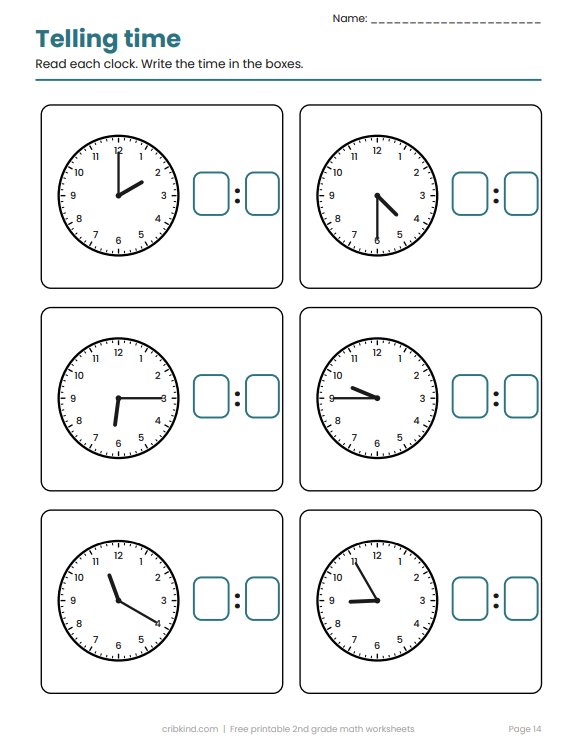
These four pages step away from pure number work and into things a child meets at home. Reading a clock to the nearest five minutes, adding coins and measuring a pencil all show up in everyday life, so they tend to feel more like play. Page 14 uses six clocks, and your child writes the hour and minutes in two small boxes. Page 16 has a ruler under each pencil, which only works if you print at 100 percent, so check your print settings first. Vihaan would probably hold a real ruler up to the page just to see whether the printed one is honest. The back to school checklist for parents has more ideas for getting ready for the school year.
- Telling time. Six clocks show times such as 2:00, 6:15 and 8:55, and your child writes each one. The hour hand sitting between two numbers trips up many children.
- Counting money. Six rows of pennies, nickels, dimes and quarters, and your child writes the total in cents. Count the quarters first, then the dimes, then the nickels, and finish with the pennies.
- Measure with a ruler. Six pencils between 1 and 6 inches long, each with a ruler underneath. The left end of the pencil lines up with the zero.
- Fractions. Your child colors one half, two thirds and one fourth of a shape, then writes the fraction for shapes that are already shaded. Many programs only name halves, thirds and fourths in second grade, so treat this page as a gentle preview.
Word problems and graph worksheets
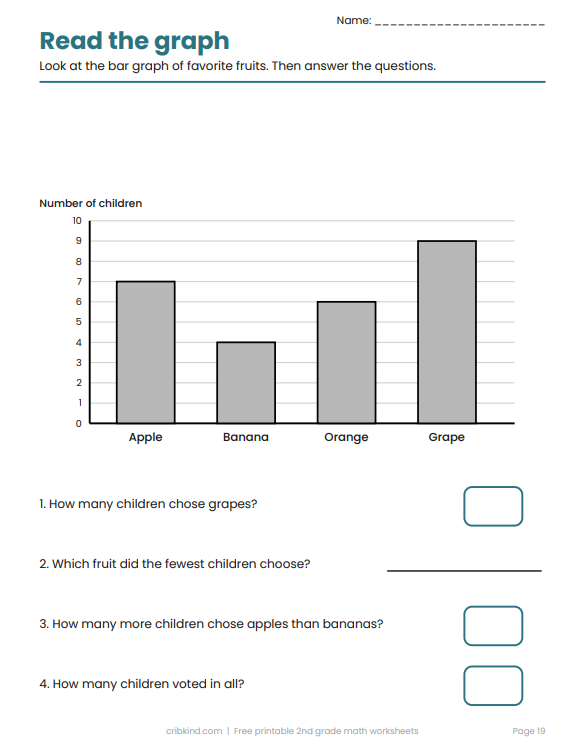
The last two of these 2nd grade math worksheets put the skills to work. Page 18 has six short word problems, each one step, with a dotted box for drawing or writing the work. Page 19 shows a bar graph of favorite fruits and asks four questions about it, including how many more children chose apples than bananas. A child who can do the math but freezes at the words usually needs to underline the numbers and circle the question. Eeshan would probably draw a picture for every problem, and I would let him, since a quick sketch is a perfectly good strategy.
- Word problems. Six problems about stickers, balloons, buses, pages, muffins and cents. Some add, some subtract, and each answer fits in one box.
- Read the graph. Four bars show what children chose, and your child answers four questions. The last one asks for the total, which means adding all four bars.
How to print and use the answer key
Free download: Get all 19 second grade math worksheets and the answer key as one PDF
Each page is letter size (8.5 by 11 inches) with roomy boxes for writing, so a regular pencil works fine. Print at 100 percent scale on plain paper, and make as many copies as you need for your own family or classroom.
Parents who search for 2nd worksheets math usually want pages they can print tonight, and nothing here needs a login. Print only the pages you plan to use that day, one or two at a time. Start with the page of the set that matches what your child’s class is working on right now, and go back a page if it feels too hard. Nobody is hurt by repeating the regrouping pages three times. Page 20 is the answer key, so print it once and keep it away from the table.
Keep each session short, about 10 to 15 minutes. A pencil with a good eraser helps, since a child who fears mistakes slows down. I would sit beside the child for the first page and then step back, answering questions instead of correcting answers. Check the work together with the key afterward, and let your child be the one to mark a wrong answer. Vihaan would probably enjoy being the person holding the key far more than doing the page.
Safe practice with pencils and young siblings
A second grader can handle a regular pencil, but a short stub is hard to grip. Use a full length pencil with an eraser, and sharpen it before you start instead of in the middle of a page. Wash hands afterward, especially if crayons or coins were also out.
Frequently asked questions about 2nd grade math worksheets
What math should a 2nd grader know?
Most second grade programs focus on adding and subtracting within 100, place value up to 1,000, telling time, counting money, measuring in inches and reading simple graphs. These worksheets follow that order, but your child’s school sets the exact goals.
Where can I find free 2nd grade math worksheets?
This post has 19 free 2nd grade math worksheets to print, plus an answer key. Download the PDF with the button near the top and print as many copies as you need.
Are these math for 2nd graders worksheets printable on regular paper?
Yes. Every page is letter size and prints on plain paper. Print at 100 percent scale, and the ruler on page 16 will measure true inches.
Do these worksheets include answers?
Yes. Page 20 is an answer key for pages 1 to 19, so you can check your child’s work together. Pages with a choice of answers, such as coloring a fraction, show what a correct page looks like.
How many worksheets should a second grader do in a day?
One or two is plenty for most children, at 10 to 15 minutes per page. Stop when your child is tired, since frustration teaches less than a short, easy page.
What if my child gets stuck on regrouping?
Go back to the plain adding or subtracting page, then try regrouping again another day. Drawing tens as sticks and ones as dots next to each problem helps many children see why the trade works.
If I were setting up the first page for Eeshan or Vihaan, I would print page 1, hand over a sharp pencil, and tell them to start with the 9s. Then I would keep my mouth shut until the last box was filled and ask which problem felt trickiest. The other pages can wait in the folder for another day.



One Comment