Kohlberg’s 6 Stages of Moral Development
Have you ever paused and wondered how people decide what is right or wrong? Why does something feel fair to a child, questionable to a teenager, and completely different to an adult?
This shift does not happen overnight. Our moral thinking slowly grows and changes as we do.
A psychologist named Lawrence Kohlberg spent years studying this exact question. He wanted to understand how our sense of right and wrong develops from childhood into adulthood.
According to the American Psychological Association, moral development describes how people gradually learn to reason about right and wrong as they grow.
Who Was Lawrence Kohlberg?
Lawrence Kohlberg was an American psychologist who focused on moral development. In simple terms, he wanted to know how people learn to make ethical decisions.
Building on earlier work by Jean Piaget, Kohlberg proposed that moral thinking develops in stages. Children do not reason about right and wrong the same way adults do, and that difference matters.
What Is Kohlberg’s Theory About?
Kohlberg believed that moral reasoning becomes more complex as people grow.
At first, children follow rules mainly to avoid trouble. Over time, they begin to care about social approval, fairness, and eventually deeper principles like justice and human rights.
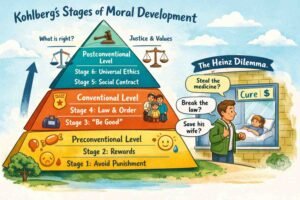
To explain this growth, Kohlberg divided moral development into three levels. Each level includes two stages that show how thinking evolves.
- Preconventional level: Common in young children. Decisions are based on personal consequences like punishment or rewards.
- Conventional level: Typical for teenagers and many adults. People care about rules, approval, and maintaining order.
- Postconventional level: Reached by some adults. Moral reasoning is guided by principles such as fairness, justice, and human dignity.
The diagram below shows how these stages build on one another.
The Six Stages of Moral Development
Let’s walk through each stage in everyday terms.
Level 1: Preconventional Morality
Stage 1: Obedience and Punishment
At this stage, children follow rules mainly to avoid punishment.
A child may avoid stealing a cookie not because it feels wrong, but because they fear getting scolded.
Stage 2: Self-Interest and Rewards
Here, actions are guided by personal benefit.
A child might help clean up their room because they expect praise or a reward afterward.
Level 2: Conventional Morality
Stage 3: Being Good to Please Others
People start caring about how others see them.
A teenager may behave kindly or volunteer because they want approval from family, friends, or teachers.
Stage 4: Law and Order
Rules and laws begin to feel important for keeping society running smoothly.
Adults at this stage often follow laws not just out of fear, but because they believe rules create stability.
Level 3: Postconventional Morality
Stage 5: Social Contract and Individual Rights
People understand that laws exist to protect everyone.
At the same time, they may believe laws should change if they are unfair or harmful.
Stage 6: Universal Ethical Principles
This stage is guided by deeply held moral values such as justice, equality, and respect for human life.
Someone at this stage may challenge laws if they believe those laws violate basic human rights.
The Heinz Dilemma: Moral Thinking in Action
To study moral reasoning, Kohlberg used short stories called moral dilemmas.
One of the most well-known is the Heinz dilemma.
In this story, Heinz’s wife is seriously ill. A medicine could save her life, but Heinz cannot afford it. The question is simple but uncomfortable. Should Heinz steal the medicine?
- Stage 1 thinking: Heinz should not steal because he would get punished.
- Stage 3 thinking: Heinz should steal because a good husband takes care of his wife.
- Stage 6 thinking: Saving a life matters more than following the law.
There is no single correct answer here. What matters is how people explain their reasoning.
Many early thinking and emotional skills develop through play, which is why our sensory activities guide focuses on hands-on experiences that shape how kids learn and respond to the world.
Why Kohlberg’s Stages Matter
Kohlberg’s theory helps parents, teachers, and caregivers understand how moral thinking develops over time.
It reminds us that children are not being difficult when they focus on rewards or rules. They are reasoning at a level that fits their development.
- Parents can move beyond because I said so and start explaining the reasons behind rules.
- Teachers can encourage discussion about fairness and consequences.
- Adults can reflect on their own values and decision-making.
Important Points to Keep in Mind
Kohlberg’s theory is helpful, but it is not perfect.
- Psychologist Carol Gilligan pointed out that the theory focuses heavily on justice and rules, while care and relationships also shape moral decisions.
- Moral reasoning can look different across cultures, especially in communities that value harmony over individual rights.
- Knowing what is right does not always mean someone will act that way, especially under pressure.
Even with these limits, Kohlberg’s stages offer a clear framework for understanding how moral thinking grows.
- Lawrence Kohlberg’s stages of moral development show that our understanding of right and wrong develops step by step.
- We move from avoiding punishment as children to thinking about fairness, justice, and human dignity as adults.
- Understanding these stages helps us respond with more patience, guide children more gently, and reflect more honestly on our own choices.