
Should I Give My Newborn a Pacifier?
Yes, you can give your newborn a pacifier. For most babies it is safe, beneficial, and even recommended by the American Academy of Pediatrics (AAP). The only real rule is timing if you are breastfeeding, wait until 3 to 4 weeks so nursing is fully established first.
When Eeshan was born, we tried a pacifier for a few days. He took to it right away. Then life got busy, we stopped offering it consistently and just like that, he forgot it ever existed. So I get it. You are staring at this little squishy human and wondering whether you should even bother. Let’s walk through everything you actually need to know.
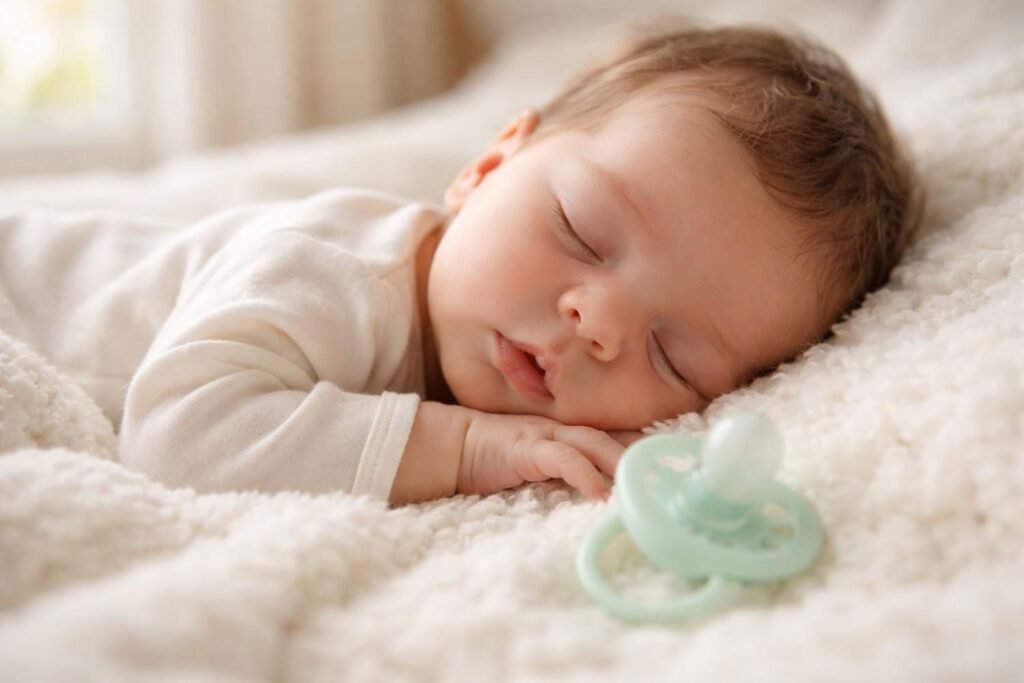
What Does a Pacifier Actually Do for a Newborn?
Babies are born with a strong sucking reflex. It’s not just about hunger. Sucking is how they self-soothe, calm down, and feel safe. A pacifier satisfies that need between feedings without you having to nurse on demand every single time.
Think of it as a tool, not a crutch. When your newborn is fussy after a full feeding, gassy, or just wants comfort, a pacifier can buy you 10 to 15 minutes of calm. Any new parent knows how much those 10 minutes mean at 3am.
Pacifier for Newborn: Pros and Cons
Before you decide, here’s what the research actually says. No fluff.
Benefits of Giving Your Newborn a Pacifier
- Reduces SIDS risk significantly. This is the big one. Multiple studies show pacifier use during sleep can reduce the risk of Sudden Infant Death Syndrome (SIDS) by more than half. The American Academy of Pediatrics (AAP) specifically recommends offering a pacifier at naptime and bedtime for this reason.
- Soothes a fussy baby fast. Sucking releases calming hormones in babies. When your newborn is crying from gas, overstimulation, or just needing comfort, a pacifier works quickly.
- Helps during medical procedures. Studies show babies feel less pain during blood draws and shots when they have a pacifier to suck on.
- Great for travel. On a flight, a pacifier helps relieve ear pressure pain for babies just like swallowing does for adults.
- Easier to wean than thumb sucking. You can take away a pacifier. You can’t take away a thumb.
Cons of Giving Your Newborn a Pacifier
- Can interfere with breastfeeding if introduced too early. Sucking a pacifier is easier than nursing. If you offer it in the first 2 to 3 weeks, your baby might get lazy at the breast.
- Can become habit-forming. If your baby needs the pacifier to fall asleep and it falls out at 2am, you’re getting up to pop it back in. Every. Single. Night.
- Slightly increases ear infection risk after 6 months. The AAP recommends weaning from pacifier use after 6 months partly for this reason.
- Dental concerns if used too long. Prolonged use past age 2 can affect tooth alignment. For newborns though, zero concern here.
According to research published by NIH, pacifier use is associated with a significantly reduced risk of SIDS when offered consistently during sleep.
Side Effects of a Pacifier for Newborns: What Parents Should Know
When used correctly, a pacifier has very few side effects for newborns. The main things to watch out for:
- Nipple confusion only a risk if introduced before 2 to 3 weeks in breastfed babies
- Sleep dependency baby may wake and cry every time it falls out
- Ear infections slightly increased risk after 6 months of continuous use
- Dental changes only if used heavily past age 2
None of these are reasons to avoid a pacifier entirely. They’re just things to keep in mind as your baby grows.
When Should I Introduce a Pacifier to My Newborn?
This depends on whether you’re breastfeeding or bottle feeding.
If you’re bottle feeding: You can offer a pacifier from day one. The nipple on a bottle is similar enough to a pacifier that there’s no confusion.
If you’re breastfeeding: Wait until your milk supply is established and your baby is latching well, usually around 3 to 4 weeks. Introducing it too early can cause nipple confusion, where your baby starts preferring the easier pacifier over the breast.
The AAP recommends introducing the pacifier between 2 and 6 weeks for breastfed babies. Don’t wait too long either, because some babies refuse it entirely if introduced after 2 months.
Can I Give My Newborn a Pacifier at Night?
Yes, absolutely. The AAP actually encourages offering a pacifier at bedtime and during naps specifically because of the SIDS protection benefit. You don’t need to remove it once your baby falls asleep either. If it falls out on its own, that’s perfectly fine.
For bottle-fed babies: Safe from birth.
For breastfed babies: Wait until 3 to 4 weeks and breastfeeding is going smoothly.
According to the Sleep Foundation, bottle fed babies can safely sleep with a pacifier from birth, while breastfed babies should wait until at least 3 to 4 weeks.
One thing to keep in mind. If your baby wakes up crying every time the pacifier falls out at night, that becomes its own sleep challenge. Some parents find this exhausting around the 3 to 4 month mark. Just something to be aware of going in.
Can a 2 Day Old or 5 Day Old Baby Sleep With a Pacifier?
For bottle-fed babies yes, from birth is fine. For breastfed babies, those first 2 to 5 days are critical for establishing milk supply and a good latch. Hold off until at least 2 to 4 weeks before introducing one if you’re nursing.
Can I Give My Newborn a Pacifier While Breastfeeding?
You can, but timing matters. The concern is nipple confusion. Pacifier sucking is passive and easy, while breastfeeding requires active work from your baby. If you introduce the pacifier before your baby has the hang of nursing, they might resist the breast.
The sweet spot is waiting until breastfeeding is fully established, usually 3 to 4 weeks, and then offering the pacifier only between or after feedings. Once nursing is solid, most breastfed babies use pacifiers without any issue.
Looking for the best pacifier for a breastfed newborn? Scroll down. We cover that below.
What Is the Best Pacifier for a Newborn?
Not all pacifiers are the same and yes, newborns can be picky. Here are the most trusted options recommended by pediatricians and parents:
- Philips Avent Soothie The one most hospitals send home with you. One piece silicone, easy to clean, great for newborns.
- NUK Orthodontic Pacifier Flat nipple design that mimics breastfeeding. One of the best pacifiers for breastfed newborns specifically.
- Tommee Tippee Closer to Nature Soft, round shield that fits tiny newborn faces well.
- MAM Newborn Pacifier Self-sterilizing case and ultra-soft nipple. Very popular with new moms.
If you’re breastfeeding, look for an orthodontic or breast-shaped nipple. This reduces nipple confusion risk significantly.
How to Introduce a Pacifier to a Newborn (Without the Struggle)
Some babies take to it immediately. Others spit it out like you just offered them a lemon. Here’s what works:
- Try different shapes. There are orthodontic, round, and flat nipple options. Some babies are picky.
- Offer it when calm, not crying. A screaming baby won’t take a pacifier. Soothe them first, then offer it.
- Dip it in breast milk. Just once, to introduce the familiar smell and taste.
- Hold it gently in place for the first few seconds. Babies often push it out initially before the sucking reflex kicks in.
- Don’t force it. Some babies just don’t want one, and that’s completely fine.
How Do I Keep the Pacifier in My Newborn’s Mouth While Sleeping?
Honestly? You can’t always and that’s okay. Gently hold it in place for a few seconds until the sucking reflex kicks in. Once your baby is in deep sleep, it will fall out naturally. You do not need to reinsert it during the night. If they wake up wanting it, that’s the sleep association piece to work on around 3 to 4 months.
When Should You Stop Using a Pacifier?
weaning by age 1, and definitely before age 2 to protect developing teeth. The 6 to 12 month window is ideal because babies are less emotionally attached to it at that stage and the habit is easier to break.
If you’re worried about pacifier teeth, we covered that in detail in our Pacifier Teeth guide. Signs, what it looks like, and how to fix it.
FAQ: Should I Give My Newborn a Pacifier?
Should I give my newborn a pacifier?
Yes, for most babies a pacifier is safe and beneficial. It soothes, helps with sleep, and most importantly reduces SIDS risk during sleep. If breastfeeding, wait until 3 to 4 weeks to introduce it.
Is it ok to use a pacifier with a newborn?
Yes, it is completely okay. The AAP endorses pacifier use for newborns, especially during sleep, for SIDS prevention. Just follow age-appropriate timing if you’re breastfeeding.
Is it okay to leave a newborn with a pacifier?
Yes, it is safe to leave a newborn with a pacifier during supervised sleep. If it falls out on its own, you do not need to replace it. Never attach a pacifier string around your baby’s neck. That is a choking hazard.
Can I give my newborn a pacifier at night?
Yes. The AAP recommends offering a pacifier at naptime and bedtime. You don’t need to reinsert it if it falls out once your baby is asleep.
Can I give my newborn a pacifier while breastfeeding?
Yes, but wait until breastfeeding is well established, around 3 to 4 weeks. Introducing it too early can cause nipple confusion and affect your milk supply.
Can a 2 day old or 5 day old baby have a pacifier?
For bottle-fed babies, yes, from day one is fine. For breastfed babies, wait at least 2 to 4 weeks so breastfeeding is fully established first.
Is it okay to give a pacifier only at night?
Absolutely. Many parents offer the pacifier only for sleep and not during awake time. This actually makes weaning easier later on.
How do I know if my newborn needs a pacifier?
Watch for non-hunger sucking cues. Baby sucking on fists, rooting after a full feeding, or being fussy despite being fed, changed, and held. These are signs the sucking reflex needs satisfying beyond feeding.
What are the side effects of a pacifier for newborns?
When used correctly, side effects are minimal. The main risks are nipple confusion if introduced too early during breastfeeding, sleep dependency, and a slightly higher ear infection risk after 6 months of use.
What happens if I give a pacifier too early?
For breastfed babies, offering it in the first 2 weeks may lead to nipple confusion, reduced nursing, or a drop in your milk supply. For bottle-fed babies, timing doesn’t matter.
How do I keep the pacifier in my newborn’s mouth while sleeping?
Hold it gently in place for a few seconds until the sucking reflex kicks in. Once in deep sleep, it will fall out naturally. You don’t need to reinsert it.
Do pediatricians recommend pacifiers for newborns?
Yes. The AAP recommends pacifier use during sleep for SIDS prevention. They suggest introducing it once breastfeeding is established and weaning by age 1.
What is the best pacifier for a newborn?
Top choices include the Philips Avent Soothie, NUK Orthodontic, Tommee Tippee Closer to Nature, and MAM Newborn Pacifier. For breastfed babies, choose an orthodontic or breast-shaped nipple to reduce nipple confusion.


One Comment