15 Free Ocean Animal Coloring Pages With Fun Facts
Vihaan went through a fish phase at 18 months that I was unprepared for. Every board book went straight to the ocean pages. He would point and look at me and wait. I started drawing fish on envelopes at dinner just to keep him at the table. A wobbly jellyfish, a round pufferfish, an octopus with four arms because I ran out of space. Those drawings became these ocean animal coloring pages. Below: 20 animals sorted by shape complexity so you can match the right page to where your child actually is.
Ocean animal coloring pages for babies and toddlers (ages 1 to 3)
These sea animal coloring pages use the simplest outlines in the collection. Big shapes, bold lines, no interior detail. Perfect for toddlers and babies who are just starting to hold a crayon.
At this age, the coloring page is really just a conversation starter and a fine motor warm-up. Big simple outlines with no interior detail work best. Vihaan still colors outside every line and considers it finished when he has made at least one mark on the page, which I consider a complete success.
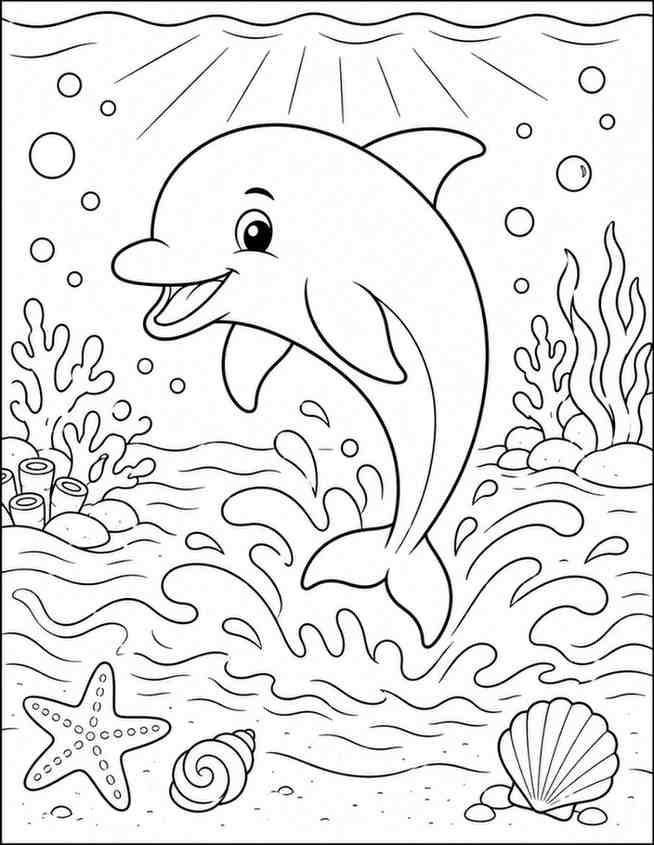
1. Dolphin coloring page
Download Dolphin Coloring Page (Free PDF)
A single large dolphin outline with a smiling face is the most pinned ocean animal coloring page on Pinterest for a reason. The shape is immediately recognisable, the body has large open areas that are easy for small hands to fill, and children who have seen a dolphin at an aquarium or in a book have an instant connection to it. Big curved body, round eye, happy mouth. That is all the detail needed at this age.
Fun fact to read aloud: Dolphins talk to each other using clicks and squeaks. Every dolphin has its own special whistle that works like a name.
Extension: After coloring, ask your child to make their own dolphin sound. Vihaan’s was a loud raspberry, which he maintained was accurate.
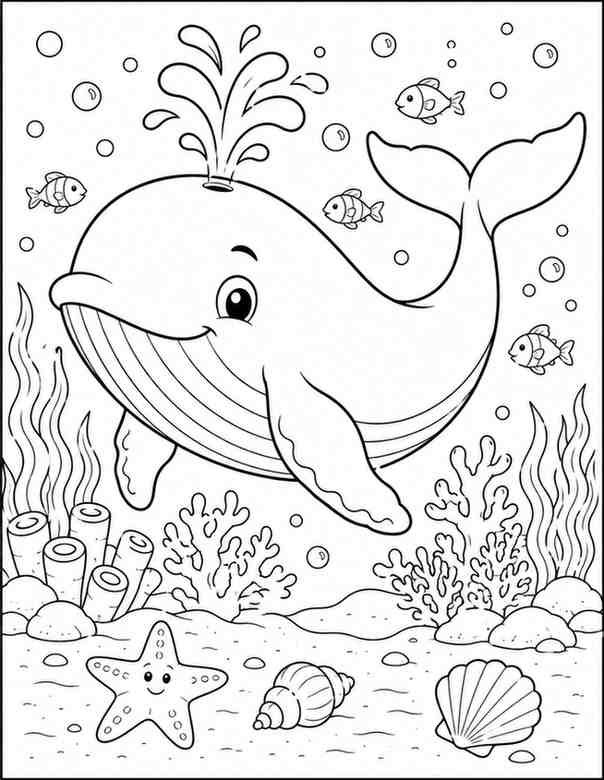
2. Whale coloring page
Download Whale Coloring Page (Free PDF)
A humpback whale or blue whale outline gives the youngest colorers the largest canvas on this list. The big flat body takes crayon marks well and the spout coming from the blowhole gives children something specific to colour blue. Simple, satisfying, hard to mess up.
Fun fact: Blue whales are the biggest animals that have ever lived on Earth. Their hearts are about the size of a small car.
3. Starfish coloring page
Download Starfish Coloring Page (Free PDF)
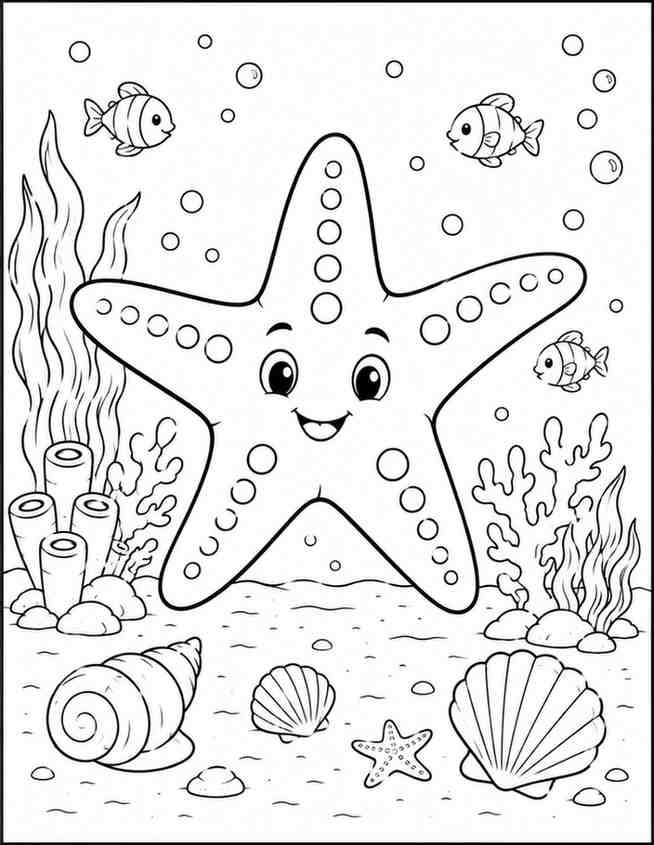
Five arms radiating from a centre circle. That is the whole shape. Starfish coloring pages work for 18-month-olds who are just learning to grip a crayon because the arms give them five obvious sections to work on sequentially. Orange is the natural choice but we have had purple, green, and one memorable gold attempt from Eeshan at 3.
Fun fact: Starfish have no brain and no blood. They use seawater instead of blood to move around.
Extension: Count the arms together before coloring starts. Point and count each one. Simple, repetitive, and the kind of thing toddlers want to do again immediately.
4. Crab coloring page
Download Crab Coloring Page (Free PDF)
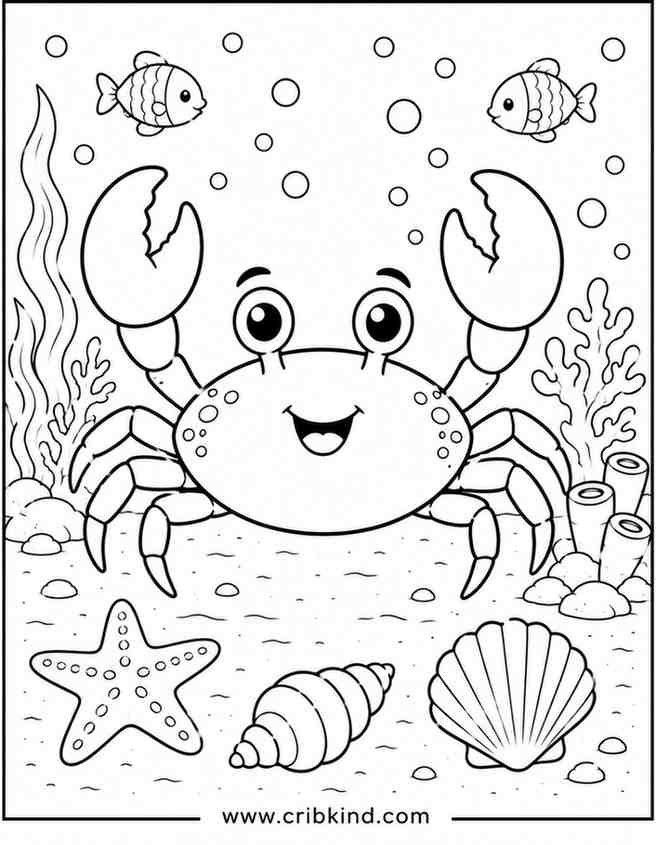
A front-on view of a crab with two big claws is the toddler-friendly version of this animal. The symmetrical shape, two large claw shapes either side, big eyes on stalks, is visually distinctive and the round body in the centre gives a clear focal point. Red is the obvious colour choice, but real crabs come in blue, green, and purple, which opens up the page for creative choices.
Fun fact: Crabs walk sideways. The next time you are at the beach, show your child how to crab-walk sideways along the sand.
5. Clownfish coloring page
Download Clownfish Coloring Page (Free PDF)
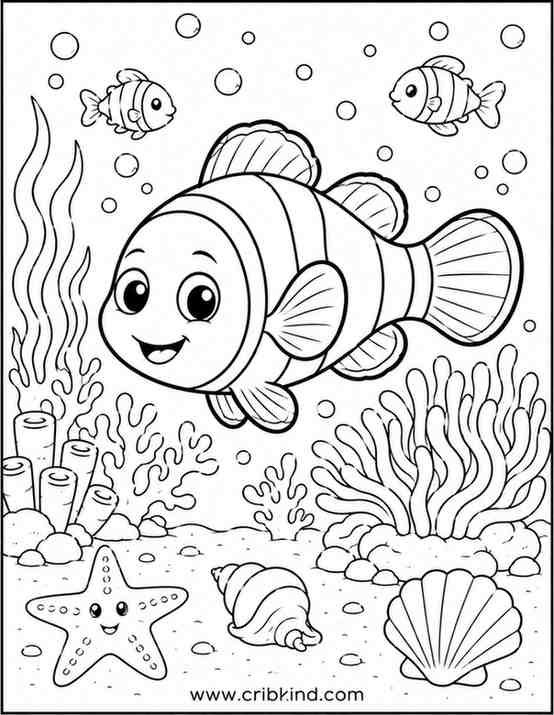
Every child who has seen Finding Nemo knows exactly what this fish should look like. Orange with white stripes. That specificity is an advantage for a toddler coloring page because the child has a clear visual goal and feels the satisfaction of recognising what they made. The stripes give natural sections to work within, which is good fine motor practice even when the crayon goes over the lines.
Fun fact: Clownfish live inside sea anemones. The anemone’s stinging arms protect the clownfish, and the clownfish brings food to the anemone. They help each other.
Ocean animal coloring pages for preschoolers (ages 3 to 5)
Preschoolers can handle more interior detail and are starting to enjoy choosing specific colours for specific parts of an animal. They also ask questions constantly during coloring, which is exactly what the fun facts below are designed for. In my classroom years, ocean week was always the week with the most conversation.
6. Octopus coloring page
Download Octopus Coloring Page (Free PDF)
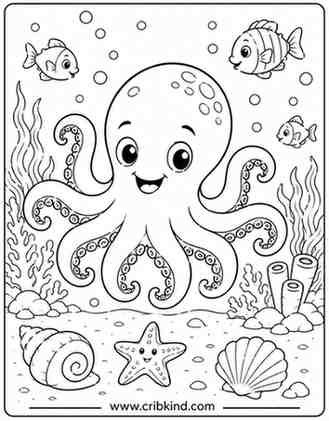
An octopus with all eight arms visible is a natural preschool coloring page because counting the arms is built into the activity. Spandana drew a simplified octopus for Vihaan first, but the full eight-armed version works well for 3 and 4 year olds who are learning to count reliably. Each arm can be a different colour, which children this age find deeply satisfying.
Fun fact: Octopuses have three hearts and blue blood. They are also incredibly smart. They can open jars, solve puzzles, and remember the faces of people they meet.
Extension: Put a small toy inside a plastic container with a loose lid and let your child try to open it. Then explain that an octopus can do the same thing with its arms.
7. Seahorse coloring page
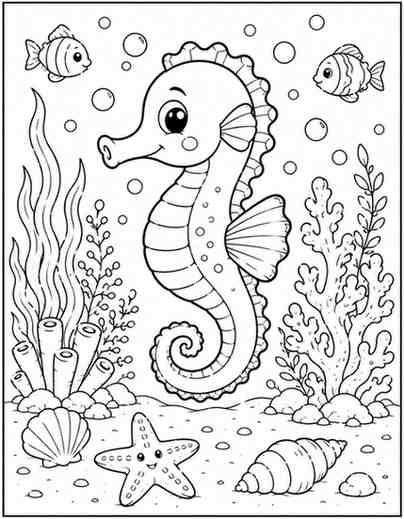
Download Seahorse Coloring Page (Free PDF)
The seahorse outline is one of the most detailed and most pinned of all the ocean animal coloring pages for preschoolers. The segmented body, the curled tail, the small fin, the snout, all give a child multiple distinct areas to colour differently. Yellow and orange are the classic choices but seahorses come in almost every colour, which means any colour choice is technically accurate.
Fun fact: Father seahorses carry the babies in a special pouch on their tummy. They give birth to hundreds of tiny seahorses at once.
Eeshan learned this fact at 4 and told every adult he met for approximately three months. The seahorse he coloured that day is still on his bedroom wall.
8. Sea turtle coloring page
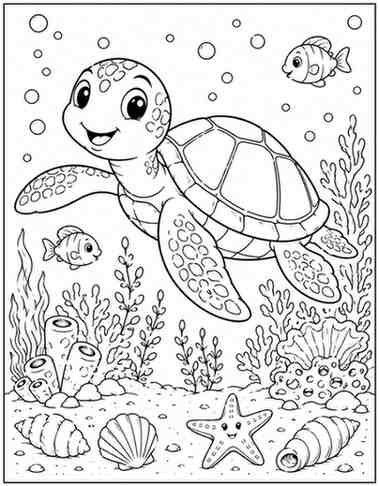
Download Sea Turtle Coloring Page (Free PDF)
A sea turtle with the shell pattern visible is the most educationally rich of the preschool coloring pages because the shell sections give a child a natural grid to work within. Each hexagon or polygon section of the shell can be a different colour, which produces a beautiful finished result and keeps a child engaged longer than a simpler outline would.
Fun fact: Sea turtles come back to the exact beach where they were born to lay their eggs, even if it takes them 30 years to return.
9. Jellyfish coloring page
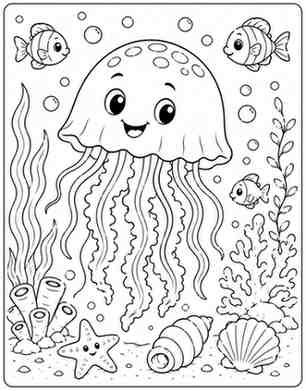
Download Jellyfish Coloring Page (Free PDF)
A jellyfish with flowing tentacles beneath a bell-shaped body is a preschool page that particularly suits children who are starting to enjoy using different colours in a single piece. The bell can be one colour and each tentacle a different shade. Pastels look beautiful here and the finished result often looks genuinely pretty rather than just coloured in, which preschoolers notice and take pride in.
Fun fact: Jellyfish have no brain, no heart, and no bones. Their bodies are 95 percent water. Some jellyfish glow in the dark.
10. Shark coloring page
Download Shark Coloring Page (Free PDF)
A side-view shark with visible fins and a slightly open mouth is the page most requested in my experience with both classroom coloring sessions and home printing. Children who are in a shark phase, and there is almost always a shark phase somewhere between ages 3 and 6, treat this page as more of a trophy than a coloring exercise. Grey and blue are the obvious choices but some of the most memorable shark pages I have seen were pink.
Fun fact: Sharks have been on Earth for longer than trees. They have survived five mass extinctions. They are one of the oldest animals alive today.
Ocean animal coloring pages for older kids (ages 5 and up)
Children aged 5 and up enjoy detail, accuracy, and being given interesting information about what they are coloring. These pages work well for quiet time, summer holiday activity packs, and classroom ocean units. Spandana used the pufferfish and stingray pages in her final year of teaching as part of a week-long ocean theme.
11. Pufferfish coloring page
Download Pufferfish Coloring Page (Free PDF)
A pufferfish in its inflated round state, covered in spines, is a detailed and satisfying page for children who enjoy precise colouring. The spines give dozens of small areas to work on and the round body lends itself to careful shading. Yellow or orange with darker brown spine tips is the most realistic version, but the exotic colour options for real pufferfish (blue, green, spotted) make creative choices equally valid.
Fun fact: When a pufferfish is scared, it swallows water and inflates to three times its normal size. The spines that stick out when it is puffed up contain a poison that is more powerful than cyanide.
12. Stingray coloring page
Download Stingray Coloring Page (Free PDF)
A top-down view of a stingray with the distinctive flat diamond body and long tail is a page that works well for children who enjoy unusual shapes. The wingspan of the ray creates a large canvas and the pattern of spots or markings on some ray species gives children who want more detail something to add themselves.
Fun fact: Stingrays are related to sharks. They hide on the sandy seafloor by covering themselves with sand until only their eyes are visible. Shuffle your feet in shallow water at the beach to warn them before you step.
13. Lobster coloring page
Download Lobster Coloring Page (Free PDF)
A lobster with segmented body, two large claws, and multiple legs is a complex enough page for children aged 5 and up who enjoy working on detailed coloring. The segments of the tail, the articulated claws, and the antennae all give distinct areas to colour separately. Red is the most commonly chosen colour but raw lobsters are actually brown or blue-green, which is a surprising fact most children enjoy discovering.
Fun fact: Live lobsters are brown or dark green. They only turn red when they are cooked. They can grow new claws if they lose one.
14. Seal coloring page
Download Seal Coloring Page (Free PDF)
A seal coloring page, either a pup or an adult, suits children who prefer rounder, friendlier animal shapes over the more dramatic ocean predators. The smooth curved body and large eyes make this one of the more appealing finished results for children who want to display their work. Grey with a white belly and large dark eyes is the standard palette.
Fun fact: Seals can hold their breath for up to two hours underwater. They sleep floating on the surface of the ocean, rocking gently in the waves.
15. Penguin coloring page
Download Penguin Coloring Page (Free PDF)
A standing penguin with the classic black and white colouring is technically an ocean animal coloring page because penguins spend most of their lives in the water, coming ashore only to breed. Children aged 5 and up enjoy the precise two-tone colouring that a penguin requires, black on the back and white on the front, and the small details of the orange beak and feet give them finishing touches to add.
Fun fact: Penguins cannot fly, but they are faster swimmers than most fish. Emperor penguins can dive deeper than 500 metres, deeper than most submarines.
If your toddler is in the same ocean phase Vihaan was at 18 months, our sensory activities for newborns covers water-themed sensory play that pairs perfectly with coloring time. For more printable activity ideas, our 35 back to school crafts post has ocean-themed activity extensions that pair well with coloring time, and our sensory activities for infants covers water play ideas for babies who are too young for coloring pages but are in the same ocean animal phase Vihaan went through at 18 months.
How to use these ocean animal coloring pages with toddlers and preschoolers
A few things I have learned from years of classroom coloring sessions and from watching Eeshan and Vihaan work through these pages at home.
Print on white cardstock rather than printer paper. Cardstock takes crayon, marker, and paint without buckling or tearing. A colored page on cardstock can be cut out, taped to a window as a suncatcher effect, glued to a shoebox for an ocean diorama, or simply kept flat without curling. Printer paper works but cardstock makes the finished result feel more substantial, which matters to children.
Read the fun fact before they start coloring, not after. In my classroom, reading the fact before the coloring began meant children had the information active in their minds while they colored. They would ask questions mid-coloring, make connections, and return to the fact. Reading it after felt more like a lesson. Before felt more like sharing a secret.
Let them choose which animal to color first. A child who chooses the shark will color it with more care than a child who was handed a starfish. Autonomy at the selection stage produces better engagement at the coloring stage. Put the full set on the table and let them point.
These free ocean animals coloring pages and underwater coloring pages also work for the youngest toddlers who are not yet ready to color independently, the pages work just as well as a pointing and naming activity. Print a few, lay them on the floor, and ask your child to point to the fish or the whale. That is a completely legitimate use of a coloring page at 12 to 18 months.
Frequently asked questions
What are the best ocean animal coloring pages for toddlers?
The best ocean animal coloring pages for toddlers are the ones with the biggest, simplest outlines: dolphin, whale, starfish, and crab. These shapes are recognisable, have large open areas easy for small hands to fill, and connect to animals toddlers already know from books and toys. Avoid pages with interior detail lines for children under 3 , the simpler the outline, the more successfully a toddler can complete the page independently.
Are these ocean animal coloring pages free to print?
Yes. All ocean animal coloring pages linked in this post are free to print for personal use at home or in a classroom. Print as many copies as you need. The full set of 20 pages is available as a single PDF download via the link above. For commercial use or redistribution, please contact CribKind directly.
What age is best for ocean animal coloring pages?
Ocean animal coloring pages work from about 18 months onward, though the right page depends on the child’s age. Simple single-outline pages work from 18 months. Pages with interior detail suit ages 3 and up. Detailed pages with multiple sections suit ages 5 and up. The sorting in this post follows those age bands, so you can pick the right section for where your child actually is rather than guessing.
What do you do with finished coloring pages?
Tape them to a window for a suncatcher effect, cut them out and glue them to a shoebox to make an ocean diorama, laminate a favourite and use it as a placemat, or string several together on twine with mini clothespins as a bedroom garland. Eeshan’s seahorse from age 4 has been on his bedroom wall for three years. Framing a child’s coloring page takes about two minutes and means significantly more to them than most parents expect.
From one teacher and mom to you
Ocean week was the best week of the school year in every classroom I taught in. Not because of the curriculum objectives, but because of the questions. Every child has a question about the ocean that nobody has ever answered for them properly. Why is the ocean salty. How big is a whale actually. Do fish sleep. Those questions come out during coloring in a way they do not during a lesson, because a child with a crayon in their hand and something forming under their fingers is a child who is comfortable enough to ask the things they are actually wondering about.
The seahorse Eeshan coloured when he was 4 is still on his bedroom wall. He coloured it during a long afternoon when I was trying to keep him occupied and I was not thinking about keeping it. He asked me to put it up. I am glad I did.
Written by Spandana