12 Best Toys for 5 Year Old Boys
If you’re standing in a toy aisle guessing what a 5 year old boy will actually touch after the first day, I’ve got a shortcut. I teach elementary school, and the toys that show up again and again in show and tell, indoor recess bins, and birthday conversations are almost never the ones marketed hardest at back to school time. Watching five year olds play, year after year, has taught me the difference between a toy that photographs well and one that actually gets used.
Why the toys that market hardest are not always the ones that get used
Five is a strange age for toy shopping. Kids this age are past the simple cause and effect stage but not yet ready for anything with real complexity or fine print rules. A lot of what gets marketed at this age either talks down to them or assumes a reading level they haven’t hit yet.
What I’ve noticed matters more than the box’s age range is whether a toy gives a kid something to actually get better at. A five year old wants to be good at something, and the toys that hold up over months are the ones where practice visibly pays off, not the ones that do all the work for them.
What actually holds a 5 year old’s attention
Three patterns show up again and again with this age group, across very different kids and very different interests.
- A visible skill ceiling. Something they can get incrementally better at, not a toy that’s the same experience on day one and day fifty.
- Room for their own rules. Five year olds love inventing their own version of how a game or toy should work. Toys that allow that flexibility get reinvented for months. Rigid ones get abandoned once the “correct” way gets boring.
- Something to show someone. This age is deeply social about play. A toy that produces something showable, a built structure, a finished drawing, a high score, gets talked about and returned to far more than one that doesn’t.
Building and STEM toys
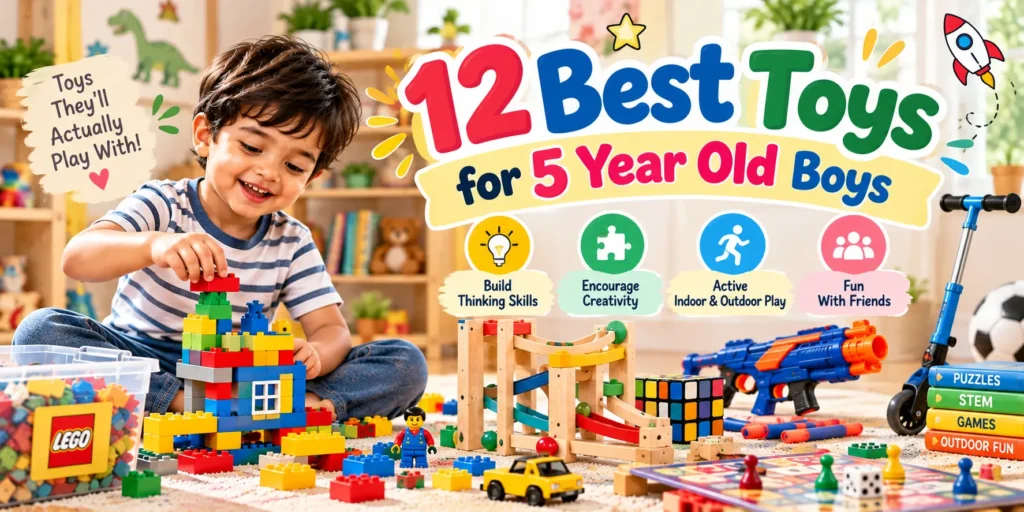
[Best open ended building set] LEGO Classic Creative Brick Box
A generic brick set without a licensed theme or single build option tends to outlast the specific character sets by a wide margin. Kids at this age start building their own designs rather than following the box, which is exactly the skill worth encouraging.
Honest downside: no instructions means no guardrails for a kid who wants a clear goal. Pair it with an idea book or a simple challenge if your child needs more direction to get started.
[Best solo logic game] ThinkFun Rush Hour Traffic Jam Logic Game
A sliding block puzzle that scales in difficulty across dozens of included challenge cards. This is the rare toy that works well for independent quiet time, since it’s entirely solo and self paced, no partner or supervision required once the rules click.
Honest downside: the easiest cards can feel too simple for a kid who’s already had practice with puzzles, and the hardest ones can genuinely stump an adult. The middle range is where most five year olds land.
[Best hands on building without screens] Melissa & Doug Wooden Marble Run
Stacking and rearranging the wooden track pieces to actually get the marble to the bottom is a genuine trial and error exercise, and rebuilding a track that fails is a different kind of persistence than most toys ask for at this age.
Honest downside: pieces are compatible with the specific set’s own connector design, so it doesn’t mix with every other wooden building brand on the market.
Active and outdoor toys
[Best for outdoor gross motor] Razor A Kick Scooter
By five, most kids have the balance and coordination for a real kick scooter rather than a toddler ride on toy, and it’s often the first piece of gear that gets a kid genuinely excited about outdoor time on its own, no adult prompting needed.
Honest downside: it requires a helmet every time, which is a rule worth setting firmly from day one rather than negotiating later.
[Best backyard active play] Nerf Elite 2.0 Blaster
Genuinely good for encouraging outdoor, moving, aiming play rather than sitting still, and it tends to pull in siblings or neighborhood friends for actual group play rather than solo entertainment.
Honest downside: darts get lost constantly, and this one needs a clear household rule about where it’s allowed to be used before day one, not after the first incident.
[Best first sport setup] Franklin Sports Kids Basketball Hoop Set
An adjustable height hoop gives a five year old a repeatable skill to practice on their own, which matters more than it sounds. Shooting baskets alone in the driveway is exactly the kind of self directed practice loop this age responds well to.
Honest downside: cheaper adjustable stands can tip in wind or with an enthusiastic dunk attempt. Check the base weight and stability before buying.
Science and discovery kits
[Best science excavation kit] National Geographic Dinosaur Dig Kit
Chiseling a dinosaur skeleton out of a plaster block gives an immediate sense of real discovery, and this is consistently one of the toys kids bring up unprompted days or weeks later, which is a genuine sign of lasting engagement rather than a one time novelty.
Honest downside: it’s a one time use kit. Once the dig is done, there’s no replay value beyond displaying the finished piece.
[Best hybrid tech and hands on learning] Osmo Genius Starter Kit
Uses a tablet as a mirror to react to physical pieces a child manipulates on the table in front of it, rather than the child just tapping a screen. It’s the rare screen based product that keeps hands and problem solving in the loop rather than passive tapping.
Honest downside: it requires a compatible tablet you may not already own, which adds real cost on top of the kit itself. Check compatibility before buying.
Creative and pretend play
[Best for imaginative car play] Hot Wheels Ultimate Garage Track Set
A big, multi level track and garage combo that supports genuinely open ended imaginative play rather than a single fixed use. Kids at this age tend to narrate elaborate stories around the cars rather than just rolling them down a ramp once.
Honest downside: it takes up significant floor or shelf space permanently, which is worth planning for before buying.
[Best sensory creative play] Kinetic Sand Beach Sand Set
Holds its shape better than regular sand and doesn’t dry out, which means it stays a genuine creative material rather than a one time novelty that gets abandoned once it’s messy or crumbly.
Honest downside: it does track through the house despite claims of being mess free. A contained tray or bin is worth buying alongside it.
[Best for early drawing confidence] Crayola Light Up Tracing Pad
Backlighting makes tracing lines and shapes far easier to see clearly, and kids who feel discouraged by freehand drawing often gain real confidence once tracing gives them a cleaner result to feel good about.
Honest downside: some kids lean on tracing and avoid freehand drawing altogether once they have the option. Balance it with plain paper and markers too.
Games and social play
[Best first board game] Sequence for Kids
Simple enough for a five year old to genuinely understand the rules rather than needing constant adult help, which matters for actually building the turn taking and strategy skills a board game is supposed to teach in the first place.
Honest downside: younger siblings often want to join and struggle with the rules, which can turn game night into more referee work than actual play some evenings.
The one toy that gets returned or ignored every year
The pattern I see most often with disappointing toy purchases at this age is a toy that requires an adult to run it, complex electronic games with a long setup process, multi step kits that need constant supervision to complete. Five year olds want independence in their play. A toy that keeps pulling an adult back in for help stops feeling like their own accomplishment, and that’s usually when it ends up back in the closet.
Frequently asked questions about toys for 5 year old boys
What are good toys for a 5 year old boy who has everything?
Look for a skill based toy rather than another object, a logic game, a sport he hasn’t tried yet, or a building set with a level of complexity slightly above what he already owns. Novelty of category matters more than novelty of object at this age.
Do 5 year olds still need educational toys, or is this too old for that?
Five is not too old for developmentally supportive play, it just looks different than it did at two. At this age it’s less about basic cause and effect and more about problem solving, planning, and following multi step rules.
What is a good screen free alternative to tablets for a 5 year old?
Logic puzzles, building sets, and kits with a clear finished result tend to hold attention nearly as well as a screen, especially when there’s a visible skill to improve at over repeated attempts.
How much should you spend on toys for a 5 year old?
Price does not reliably predict how much use a toy gets at this age. Several of the picks above are under $30 and outlasted pricier options in terms of actual daily use.
What toys hold attention longest for boys this age?
Toys with a visible skill ceiling, something to get incrementally better at, tend to outlast toys that offer the same experience every single time they’re used.
Are STEM toys really worth it at 5 years old?
The ones with a genuine hands on building or problem solving component tend to hold up well. STEM branding alone is not a reliable signal; check whether the toy actually requires the child to build, test, and adjust something themselves.
I’ve watched a lot of five year olds walk into a classroom carrying whatever new toy they got that weekend, and by Monday the ones that get mentioned twice are never the flashiest ones. They’re the ones a kid figured something out with, on their own, over a few tries. That’s the pattern worth shopping for, more than any specific toy on this list.
Related reading: sight words flash cards by grade level, early childhood education quotes, Kohlberg’s 6 stages of moral development, and wooden educational toys we tested.