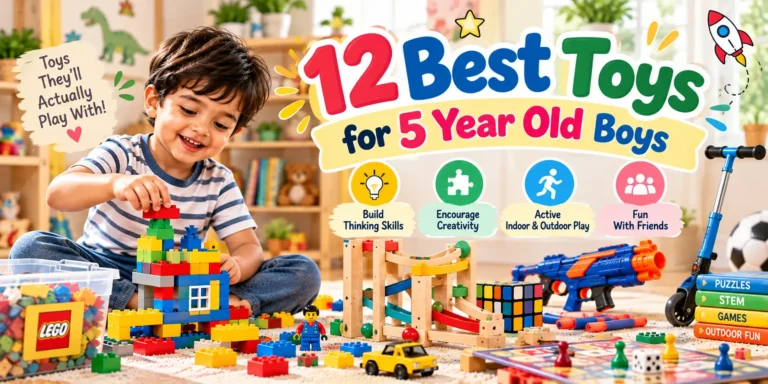
6 Best Pop Up Toys for Infants
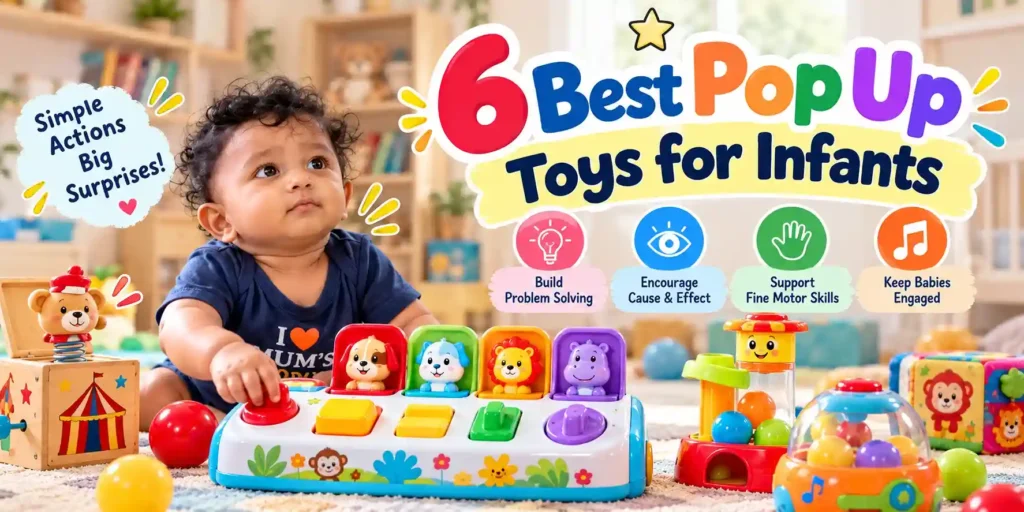
I put a pop up toy in front of Vihaan at 5 months mostly to get ten quiet minutes to eat breakfast. He stared at the dial, batted it by accident, and froze completely when the little dog popped up with a squeak. Then he did it again on purpose four times in a row before I’d even finished my coffee. That was the fastest I’d ever seen either boy figure out cause and effect from a cold start, and it’s the reason pop up toys became a genuine category in our house rather than a one-off gift.
Why pop up toys click faster than most other infant toys
Most infant toys ask a baby to notice something happening. Pop up toys ask them to make something happen, and that difference matters more than it sounds. Vihaan needed weeks to warm up to toys with a delayed or subtle reaction. A pop up toy gave him a result within a second of touching it, loud enough and visible enough that the connection was obvious on the very first try.
The American Academy of Pediatrics points to this kind of immediate, action driven feedback as one of the clearest ways infants build early problem solving skills. A pop up toy isn’t more educational than a quiet sensory toy in some abstract sense, it’s just a faster, louder version of the same lesson, which is exactly why it tends to be the toy that gets a reaction from a baby who hasn’t shown much interest in anything else yet.
What actually makes a pop up toy worth buying
- A range of difficulty across panels. The best ones have at least one easy trigger a 5 month old can manage by accident and one harder one that takes real coordination closer to 10 or 12 months, so the toy doesn’t get outgrown in a month.
- A genuinely satisfying pop. Weak springs or a slow pop lose a baby’s interest fast. The reaction has to be fast and obvious to feel like a real result.
- Sturdy enough for repeated slamming. Babies do not press gently. Anything with a flimsy hinge or a thin plastic dial broke within weeks in our house.
Classic pop up toys
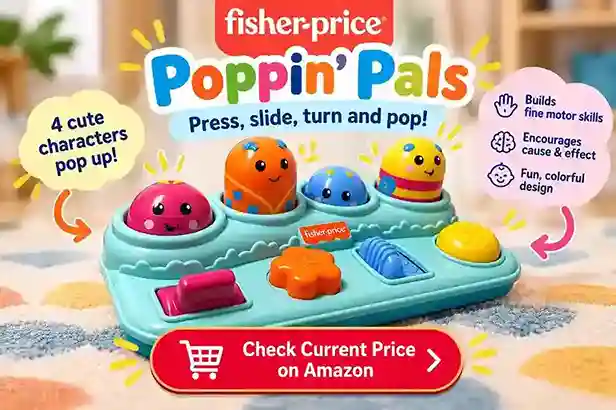
Fisher-Price Poppin’ Pals
This is the toy from the story above, and it’s still the one both boys came back to most, well past the age where it should have gotten boring. Four animals pop up through four different actions, a dial, a lever, a button, a slide, giving a real range of difficulty in one toy.
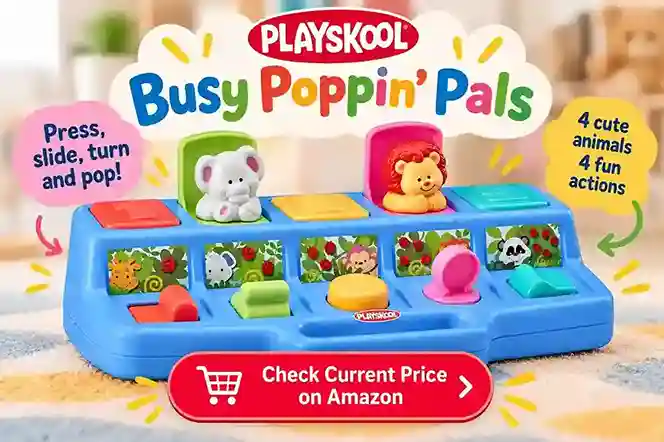
Playskool Busy Poppin’ Pals
A similar concept at a noticeably lower price point, with slightly simpler actions across the board. This was the toy we kept at the grandparents’ house since it survived travel and rough handling just as well as the pricier version.
Pop up toys with a second mechanism
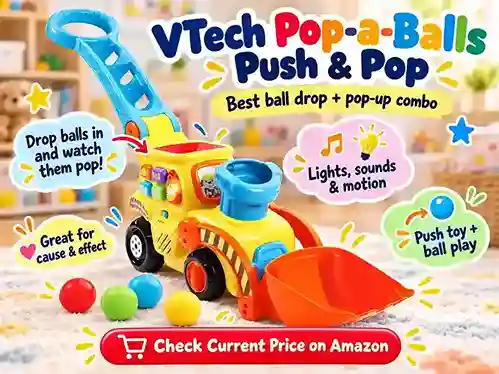
[Best ball drop and pop up combo] VTech Pop-a-Balls Push and Pop
Balls get pushed into a tube and pop out the top with lights and sound, combining a pop up reaction with a small amount of cause and effect delay, since the ball takes a beat to travel before it pops. Eeshan liked the very slight delay here more than instant pop toys once he was around 9 months, since it gave him a second to anticipate the result.
[Best musical crossover pick] Fisher-Price 4-in-1 Poppity Pop Musical Ball
Combines a spinning ball popper with music and lights, which we’ve mentioned before in our musical toys for babies roundup. The pop up mechanism here is more about motion and sound together than a single satisfying pop, which made it a good second toy once the boys already had a pure pop up toy in rotation.
Screen free and tummy time pop up toys
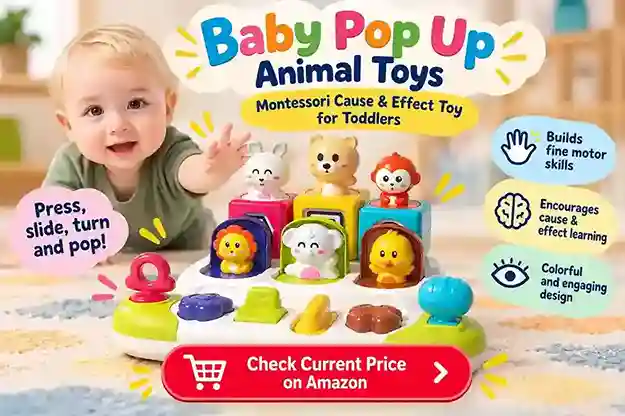
Baby Pop Up Animal Toys, Montessori Cause & Effect Toy for Toddlers
Sits low to the ground with soft, large buttons designed to be pressed from a lying down position, which made it one of the few toys that actually kept Vihaan interested during tummy time around 4 months, before he had the strength to sit and use an upright panel toy.
[Best screen free wooden option] Melissa & Doug Wooden Jack-in-the-Box
A crank handle turns to a tune before a wooden figure pops open the lid, giving a build up and anticipation that none of the instant button pop toys have. This became Eeshan’s favorite closer to 12 months, once he had the hand coordination to actually turn the crank himself instead of needing help.
The pop up toy that never got a second look
We were given a plush pop up toy, animals hidden inside soft fabric flaps rather than a hard plastic mechanism. Neither boy engaged with it past a few tries. The soft flaps gave no real resistance and no satisfying pop, just a slow reveal that didn’t register as a result the way a spring loaded mechanism did.
The pattern held across everything: pop up toys without real mechanical resistance and a fast, obvious payoff got ignored, no matter how nice or soft they looked. The mechanism has to actually feel like a result, not just a gentle change.
Frequently asked questions about pop up toys for infants
What age are pop up toys good for?
Most pop up toys work well from around 5 to 6 months, once a baby has enough hand control to press or pull deliberately, through about 18 months. Some, like crank style toys, work better closer to 12 months and up.
Are pop up toys good for cause and effect learning?
Yes, often faster than other toy categories, since the immediate, obvious result makes the connection between action and outcome very easy for a baby to notice right away.
Are pop up toys safe for babies who still mouth everything?
Check for small detachable pieces before handing a pop up toy to a baby who mouths objects. Ball drop style toys in particular need supervision, since the balls themselves are a choking risk.
Why does my baby ignore the pop up toy I bought?
Check whether the mechanism is easy enough for their current hand strength and whether the pop itself is fast and obvious. A weak spring or a stiff button that takes real force to press loses interest fast at this age.
What is the best first pop up toy for a 5 month old?
Look for one with at least one easy button or lever action, since a baby this age is just starting to trigger things on purpose rather than by accident. Save harder dial or crank mechanisms for closer to 10 to 12 months.
Do pop up toys need batteries?
Not all of them. Mechanical spring and crank versions, like a classic jack in the box, work entirely without batteries. Musical or light up versions typically do need them.
Vihaan still occasionally goes back to that same Poppin’ Pals toy, well past a year old now, mostly just for the dial he took months to figure out the first time. I don’t think either of us expected a toy I bought for ten minutes of quiet breakfast to still be earning its shelf space this long later.
Related reading: musical toys for babies we tested, brain development toys for a 1 year old, sensory toys for infants 0 to 12 months, and wooden educational toys we tested.