
Baby Teeth Chart: Order, Timeline & Care Guide
Most parents don’t think much about baby teeth until one actually appears. Then suddenly you’re examining your baby’s gums every single morning, Googling at 2am, and wondering if that tiny white sliver is early, late, or perfectly normal. Is this a tooth? Is something wrong? Should something be happening by now?
Here’s what I wish someone had told me earlier: baby teeth follow a pretty predictable pattern, the range of “normal” is wider than most people think, and once you understand the timeline, the whole thing gets a lot less stressful.
This complete baby teeth chart covers when teeth come in, the order they arrive, what teething actually feels like, how to keep those tiny teeth healthy, and when it’s time to call a dentist. Bookmark it you’ll come back to it more than once.
When Do Baby Teeth Start Coming In?
Most babies get their first tooth somewhere between 4 and 7 months of age. But the honest answer is that it varies a lot, and the range of normal is wider than most parents expect.
According to the American Dental Association (ADA), babies are born with all 20 primary teeth already formed inside their jaws just sitting below the gumline, waiting. The first one usually pushes through around 6 months, but some babies start as early as 3 months, and others don’t see a single tooth until 12 months or later. Both are completely normal.
Here’s something that surprised me when I first learned it: teething isn’t a single event. It’s a two-year process. Most children won’t have their full set of 20 baby teeth until around their third birthday. When Eeshaan was 5 months old, I was convinced every single day was the day. It was another six weeks before anything actually appeared.
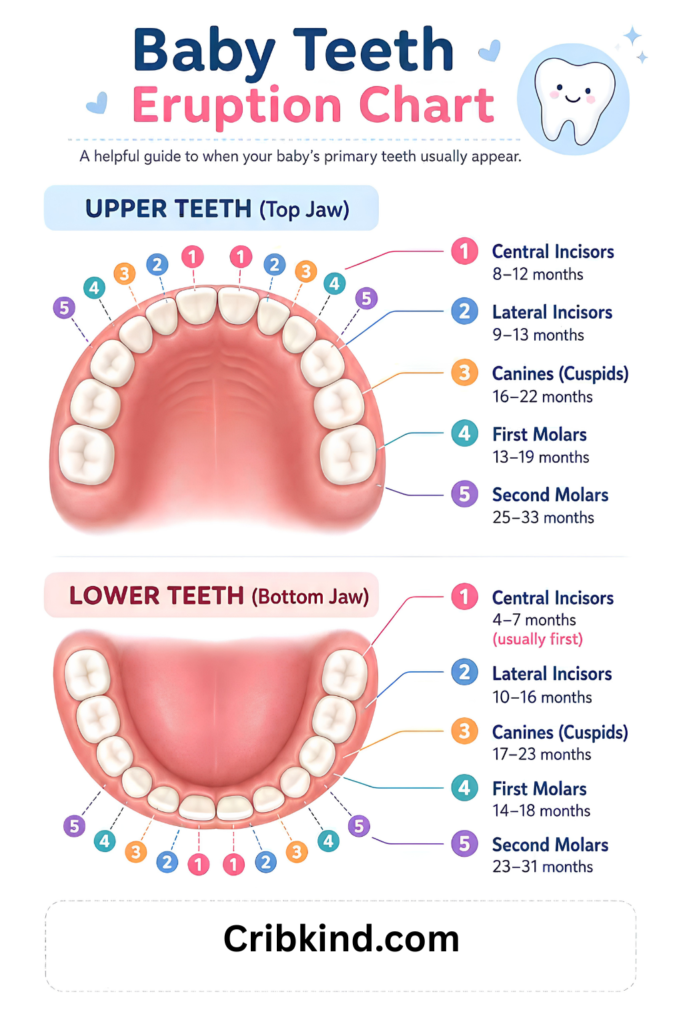
Baby Teeth Eruption Chart (All 20 Primary Teeth)
This chart is based on American Dental Association (ADA) guidelines the most cited reference for primary teeth timelines in the US. Every tooth has an eruption window and a shedding window, and knowing both helps you track exactly where your child is in the process.
Upper teeth (top jaw)

| Tooth | Erupts | Falls Out |
|---|---|---|
| Central Incisors (front 2) | 8–12 months | 6–7 years |
| Lateral Incisors | 9–13 months | 7–8 years |
| Canines (Cuspids) | 16–22 months | 10–12 years |
| First Molars | 13–19 months | 9–11 years |
| Second Molars | 25–33 months | 10–12 years |
Lower teeth (bottom jaw)
| Tooth | Erupts | Falls Out |
|---|---|---|
| Central Incisors (front 2) usually FIRST | 4–7 months | 6–7 years |
| Lateral Incisors | 10–16 months | 7–8 years |
| Canines (Cuspids) | 17–23 months | 9–12 years |
| First Molars | 14–18 months | 9–11 years |
| Second Molars | 23–31 months | 10–12 years |
What Order Do Baby Teeth Come In?
Teeth don’t show up randomly. There’s a predictable sequence, and knowing it takes away a lot of the “wait, what comes next?” anxiety.
- Lower central incisors : the two bottom front teeth, usually the very first to appear (4 to 7 months)
- Upper central incisors : the two top front teeth (8 to 12 months)
- Upper lateral incisors : the teeth on either side of the upper front pair (9 to 13 months)
- Lower lateral incisors : the same position on the bottom (10 to 16 months)
- First molars : upper and lower, the first back teeth for grinding (13 to 19 months)
- Canines : the pointy ones, upper and lower (16 to 23 months)
- Second molars : the final set of baby teeth to arrive (23 to 33 months)
Vihaan got his top two teeth before his bottom ones, which is a little unusual but entirely fine. Dentists call it a variation, not a problem. What matters most is that the teeth are coming in not that they’re arriving in a perfect textbook sequence.
Teething Symptoms: What’s Normal, What’s Not
This is the part where every parent’s experience is completely different. One baby breezes through with barely a fuss. Another barely sleeps for a week. Both are normal, and both happen in the same family sometimes.
Common signs your baby is teething
- More drooling than usual: which, at this age, is really saying something
- Chewing on everything : fingers, toys, your shoulder, the side of the crib
- Swollen, tender gums : you may see a small red bump where the tooth is pressing through
- Increased fussiness, especially in the evenings and overnight
- Slight decrease in appetite : sore gums make eating uncomfortable
- Drool rash: the skin around the mouth and chin can get irritated from constant moisture
What teething does NOT cause
Here’s where a lot of parenting forums get it wrong, and it’s worth being direct about. The American Academy of Pediatrics (AAP) is clear: teething does not cause high fever, diarrhea, or vomiting. A very mild temperature under 100.4°F can sometimes come with teething. Anything above that is unrelated, and you should call your pediatrician.
Teething Relief That Actually Works
When Eeshaan hit his molar phase around 14 months, I tried everything I could find. Here’s what actually made a difference, and what the ADA and AAP say is safe.
Safe and effective options
- Cold washcloth or gauze : wet it, chill it in the fridge (not the freezer), and let baby chew. Simple, free, and recommended by the ADA.
- Chilled teething ring : solid rubber only. Avoid liquid filled ones because they can crack and leak.
solid rubber only, not the liquid filled ones. Also buy two if you have a dog. Chitti (our pet) grabbed Eeshaan’s one afternoon and by the time I found him. We threw it out and I ordered another one at midnight. Eeshaan was not pleased about the wait. - Gentle gum massage : clean your finger and rub small circles over the sore gum. Takes thirty seconds and genuinely helps.
- Cold purees : if your baby is eating solids, chilled applesauce or plain yogurt can soothe sore gums while getting some food in.
- Infant acetaminophen or ibuprofen : if nothing else is helping and your baby is really uncomfortable, infant Tylenol or Motrin (for babies 6 months and older) is safe and effective when used at the correct dose for your baby’s weight.
Things to avoid
- Benzocaine gels (Orajel, Anbesol) : the FDA advises against using numbing gels containing benzocaine in children under 2 due to the risk of methemoglobinemia, a condition that reduces the blood’s ability to carry oxygen.
- Amber teething necklaces : both the AAP and the FDA advise against these. The claimed mechanism has no scientific support, and the choking and strangulation risk is real.
- Homeopathic teething tablets : some products have been recalled for inconsistent levels of belladonna. The FDA has issued multiple warnings.
- Amber teething necklaces : I ordered one of these when Eeshaan was around 7 months old. It was $28, it looked adorable, and three different mom groupsswore by it. It sat in a drawer within a week because I actually read what the AAP had to say. Both the AAP and the FDA advise against these the claimed mechanism has no scientific support, and the choking and strangulation risk is very real. Don’t waste your money.
Toddler Molars: The Teething Phase Nobody Warns You About
Just when you think the worst of teething is behind you the molars arrive. First molars come in between 13 and 19 months, and because they’re larger and have a broader surface area pushing through, they tend to be more uncomfortable than the front teeth.
Then the second molars follow between 23 and 31 months right around the time many toddlers are already in full “terrible twos” mode. The overlap is real, and it’s exhausting. Many parents spend months thinking their toddler’s behavior is purely developmental, when part of it is just a back molar working its way through.
If your toddler is between 13 and 33 months and suddenly fussier, drooling more, or waking up more at night for no obvious reason, check the back gums. You might find a flat white bump where a molar is pushing through.
Toddler Molars: When They Come In, Symptoms and How to Help
Is Your Baby Grinding Their Teeth?
Once those first teeth appear, some babies start grinding them together especially at night. The sound is genuinely unsettling the first time you hear it.
The medical term is bruxism, and it’s actually very common in babies and toddlers. Most children grow out of it naturally without any treatment. In babies, it’s often just a response to the new sensation of having teeth. In older toddlers, it can be linked to teething pressure from incoming molars, mild stress, or simply a sleep habit.
Where it becomes worth watching is if you notice grinding during the day, if the teeth are visibly wearing down, or if your child seems to be in discomfort. In those cases, a quick chat with your pediatric dentist is worth it.
Baby Grinding Teeth: Causes, Signs and Solutions
White Spots on Baby Teeth: What They Actually Mean
White spots on toddler teeth can look alarming, but they don’t all mean the same thing. The four main causes early tooth decay, dental fluorosis, enamel hypoplasia, and plaque buildup can look similar to the untrained eye but require completely different responses.
Early decay shows up as a chalky white patch near the gumline and is the one that needs the most attention. Fluorosis appears as smooth, symmetrical streaks across multiple teeth and is cosmetic only. Enamel hypoplasia often feels rough or pitted when you run a finger over it. And sometimes it really is just plaque that hasn’t been fully brushed away.
The location matters more than the color. Near the gumline is more concerning than across the middle of the tooth.
White Spots on Toddler Teeth: Causes, Fixes and When to See a Dentist
When to Start Brushing Baby Teeth
This is where most parents wait too long. The standard assumption is that you can hold off until there are more teeth, or until the child is older and can cooperate. The ADA says otherwise.
Start brushing as soon as the first tooth appears.
- Use a soft bristled infant toothbrush : the head should be small enough to fit comfortably in your baby’s mouth
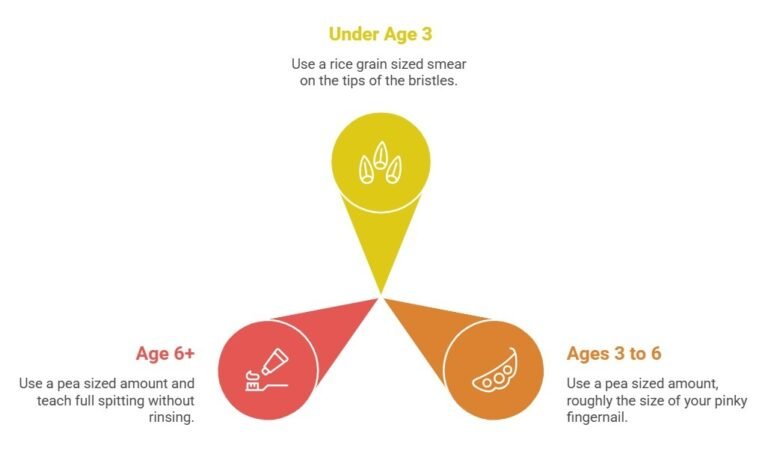
- Add fluoride toothpaste in an amount no bigger than a grain of rice for children under 3
- Brush twice a day, and make sure one of those times is right before bed
- From ages 3 to 6, increase the amount to a pea sized smear and teach your child to spit
- You do not need to rinse after brushing : leaving a tiny residue of fluoride toothpaste on the teeth helps strengthen enamel
When Do Baby Teeth Fall Out?
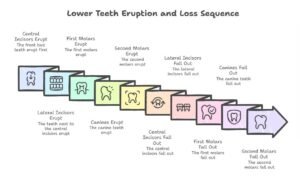
Baby teeth start falling out around age 6, and they generally shed in roughly the same order they arrived lower central incisors first.
| Age | Teeth That Fall Out |
|---|---|
| 6 to 7 years | Lower and upper central incisors |
| 7 to 8 years | Lateral incisors |
| 9 to 11 years | First molars |
| 9 to 12 years | Canines |
| 10 to 12 years | Second molars. the last to go |
The whole process can stretch into early teen years. Permanent teeth replace all 20 baby teeth, and four additional molars (the 12-year molars) erupt at the back of the mouth without replacing anything.
If an adult tooth is visibly coming in behind a baby tooth that hasn’t fallen out yet, this is commonly called “shark teeth.” It’s more common than most parents realize, especially around ages 5 to 7. If the baby tooth doesn’t loosen and fall out on its own within 2 months of the permanent tooth appearing, see a dentist.
When Should Your Baby See a Dentist?
The American Academy of Pediatric Dentistry (AAPD) recommends your baby’s first dental visit by their first birthday, or within six months of the first tooth erupting whichever comes first.
This first visit isn’t about drilling or filling anything. It’s about:
- Confirming that teeth and gums are developing normally
- Getting personalized brushing guidance for your baby’s age and current teeth
- Catching early signs of decay before they progress
- Getting your child comfortable in a dental chair early, so it’s not a source of fear later
Look for a pediatric dentist specifically they complete additional residency training focused on children, and the environment in a pediatric dental office is designed to be calm and non threatening for babies and toddlers. Our own pediatric dentist caught an early white spot on Eeshaan’s tooth at his 12 month visit that I never would have noticed on my own.
Infant Lip Ties: What New Parents Actually Need to Know
Frequently Asked Questions
My 10 monthold still has zero teeth , should I be panicking?
Probably not. Late teething no teeth by 12 to 15 months is usually just normal variation. Some babies are simply late bloomers, and it has nothing to do with anything you did or didn’t do.
If no teeth have appeared by 15 to 18 months, a quick checkup with a pediatric dentist is worth it not because something is definitely wrong, but because it’s faster and less stressful than spending another five months wondering.
How many teeth is my toddler supposed to have by now?
It depends on age. By around 12 months, most babies have between 2 and 8 teeth. By age 2, most toddlers have 12 to 16. The full set of 20 primary teeth is usually complete somewhere between age 2½ and 3. If your child is consistently on the lower end of that range, mention it at your next well child visit but a few teeth behind is almost never a sign of anything serious.
Are those big flat teeth in the back baby teeth too?
Yes. those are molars, and they’re part of the 20 primary teeth. Babies get two sets: first molars (13–19 months) and second molars (23–31 months). They’re replaced by permanent molars later in childhood. A lot of parents are surprised to learn this because the molar teething phase can be rougher than the front teeth, and it catches people off guard around the 14-month mark.
Do baby teeth actually have roots? My kid’s wobbly tooth looks hollow underneath.
They do have roots shorter than permanent teeth, but real ones. What you’re seeing when a baby tooth falls out is the result of the permanent tooth developing underneath it, which gradually dissolves the root. That’s why baby teeth get wiggly and fall out on their own rather than needing to be pulled. A hollow-looking fallen tooth is completely normal.
There’s a new tooth growing behind my kid’s baby tooth. is that a problem?
This is called shark teeth and it’s more common than most parents realize, especially between ages 5 and 7. In most cases, the baby tooth eventually loosens and falls out on its own once the permanent tooth signals it’s time.
If the babytooth is still firmly in place after about two months, see your dentist sometimes it just needs a gentle nudge or a quick extraction to let the permanent tooth come in straight.
Can babies actually be born with teeth? I saw a photo and couldn’t tell if it was real.
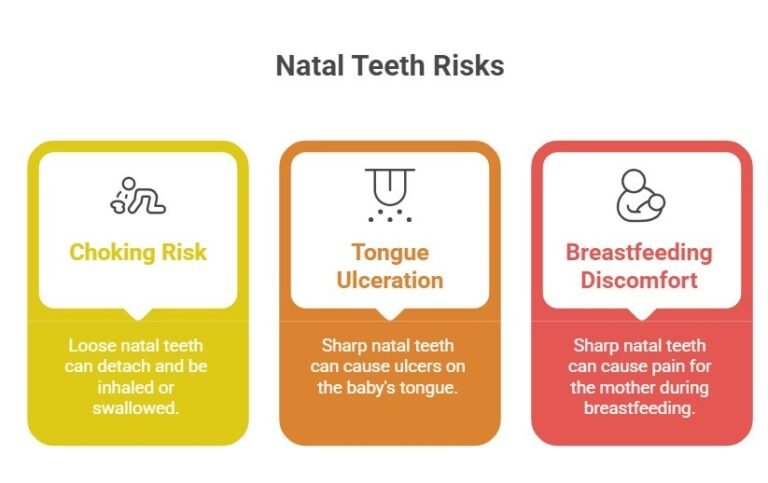
It’s real, and it happens in about 1 in 2,000 births. These are called natal teeth and they’re usually the lower central
incisors. They may be loose, which is why your pediatrician will check them a loose natal tooth can be a feeding hazard. Whether they stay or get removed depends on how stable they are. It’s rare, but it’s not a sign that anything is wrong with your baby.
3 Comments