When Do Babies Start Playing With Toys? (A Month by Month Guide)
When Eeshan was about two weeks old, a well meaning family member asked me what toys I had bought him. I listed a few things: a rattle, a soft stuffed animal, a colorful play mat. she nodded approvingly. Then she watched him stare blankly at the ceiling for ten minutes and asked, a little too gently, whether something was wrong with him.
Nothing was wrong. He was playing. He just was not doing it in any way that looked like what we think of as playing with toys. When do babies start playing with toys in the way parents actually picture it? The answer depends entirely on what month you are asking about, because the definition of play changes completely every few weeks in that first year.
What “play” actually means for a newborn
The most important thing to understand before looking at any timeline is this: play and toys are not the same thing, especially in the early months.
From birth, your baby is playing. They are making eye contact with your face, listening to your voice, tracking a moving object with their eyes, feeling the texture of a blanket against their skin. Every one of those experiences is their brain actively processing information. That is play in its earliest form.
What babies start playing with toys in a deliberate, intentional way is a different question entirely, and that does not really happen until around 2 to 3 months. Before that, everything you offer your baby is more about sensory experience than interaction.
That shift matters a lot when you are standing in a toy store at 4 weeks postpartum wondering what on earth to buy.
When do babies start playing with toys by age
0 to 2 months: sensory exploration, not toy play
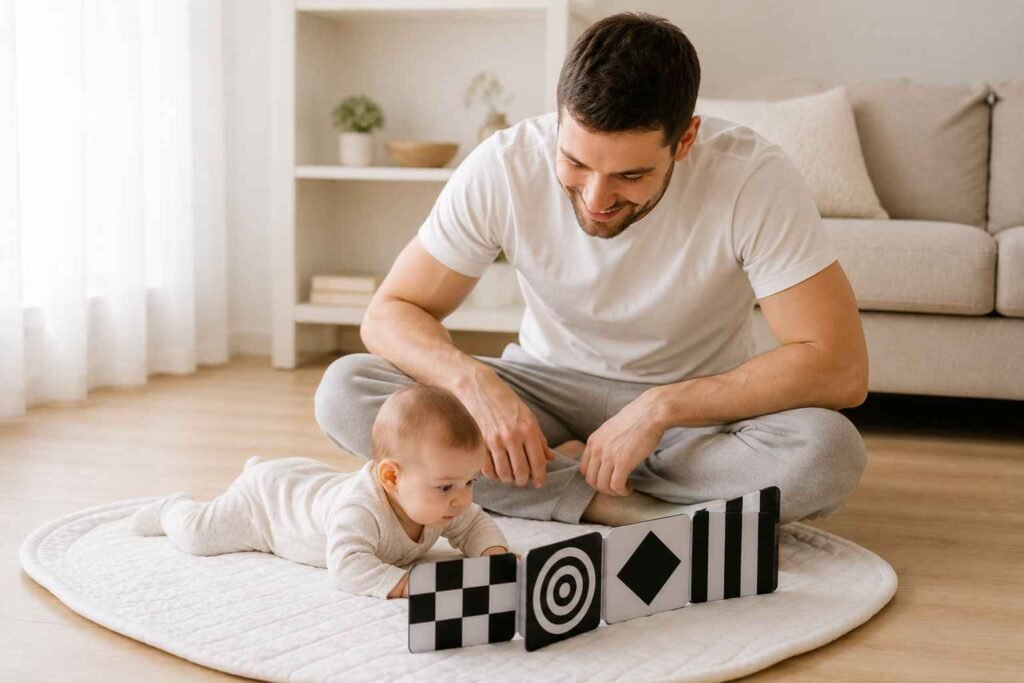
- In the first two months, your baby cannot reach for or grasp toys intentionally. What they can do is look, listen, and feel. Their vision is limited to about 8 to 12 inches, they can track slow-moving objects, and they respond to your face more than anything else you could buy.
- The best things to offer in this window are high contrast black and white toys and books, a play gym with hanging elements they can look at during floor time, and your own face and voice during tummy time sessions. Eeshan spent most of his awake time in this phase staring at a high contrast board book propped up against his bassinet. That was play. It did not look like much, but his brain was working hard.
- What to introduce: high contrast books and cards, a black and white play gym, soft rattles they can feel against their hands even if they cannot grip yet.
2 to 3 months: the first real interactions begin
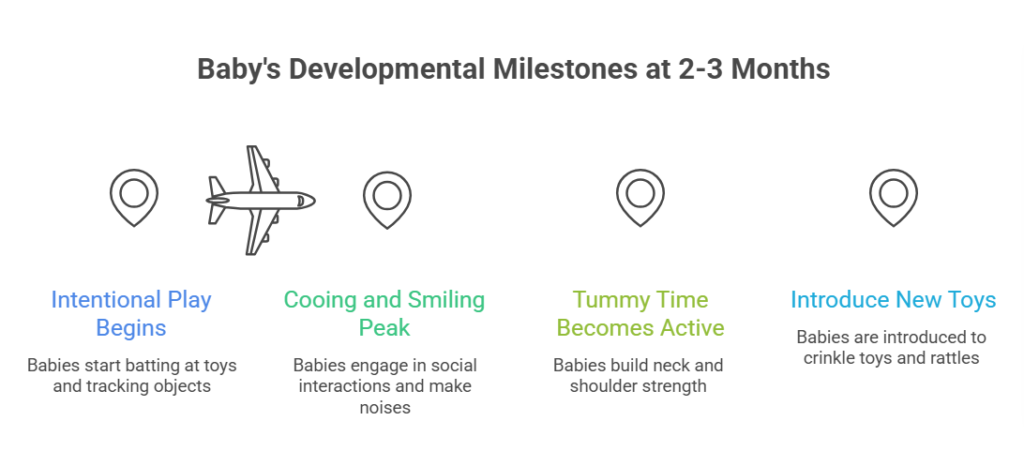
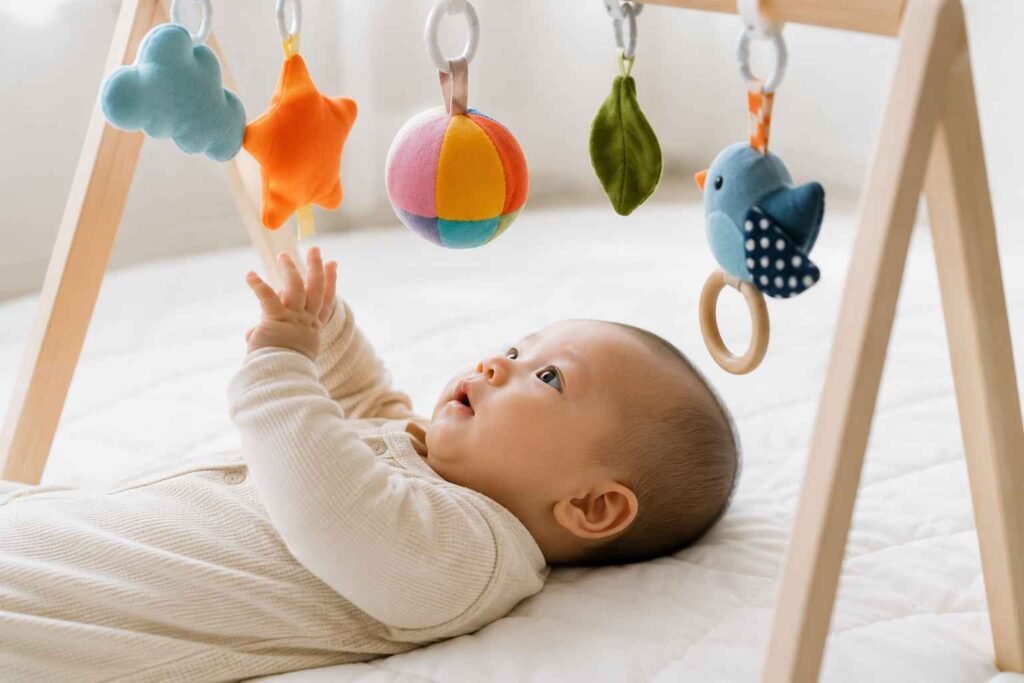
- Around 2 to 3 months is when you start seeing something that looks like intentional play for the first time. Your baby will begin to bat at hanging toys, track objects more deliberately from side to side, and start to bring their hands to their mouth.
- This is also when cooing and social smiling peak. They are responding to you, making noise in response to your noise, and genuinely engaging. If you have never had a conversation with a 10-week-old, the experience is something else entirely. Vihaan at 11 weeks old had full opinions about everything I said to him and was not shy about sharing them.
- Tummy time becomes much more active in this window. Your baby is building the neck and shoulder strength that will eventually support reaching, rolling, and sitting. High contrast toys at eye level during tummy time sessions give them a reason to hold their head up longer.
- What to introduce: crinkle toys, soft rattles, tummy time mirrors, board books with high contrast images, play gyms with batting toys overhead.
3 to 4 months: reaching and grasping arrive
- Between 3 and 4 months, intentional reaching for objects becomes possible for most babies. This is a significant milestone because it means your baby is now making a decision to interact with something. They see a toy, they want it, and their arm goes toward it.
- The grasp at this stage is still a whole-hand scoop rather than a controlled grip, but it works. Toys with interesting textures, sounds, and easy-to-grab shapes are ideal here. Rattles that make noise when shaken become genuinely exciting because your baby is starting to understand cause and effect.
- Reading books aloud daily makes a real difference at this stage. Less than half of babies are read to from birth despite the research showing measurable language development benefits from early reading. Point to pictures, use different voices, let them touch the pages.
- What to introduce: easy-grip rattles, soft crinkle toys with different textures, simple board books, teethers (early teething symptoms often start around now even before the first tooth appears).
4 to 6 months: play actually looks like play
- This is the window most parents mean when they ask when babies start playing with toys. Between 4 and 6 months, babies are deliberately grabbing toys, transferring them between hands, bringing everything to their mouth for exploration, and responding to cause-and-effect moments with obvious delight.
- Tummy time by now typically extends to several minutes without protest. Your baby may begin pushing up on their forearms and possibly starting to rock or prepare to roll. Floor mirrors become fantastic at this stage because babies at 4 months are deeply interested in their own reflection.
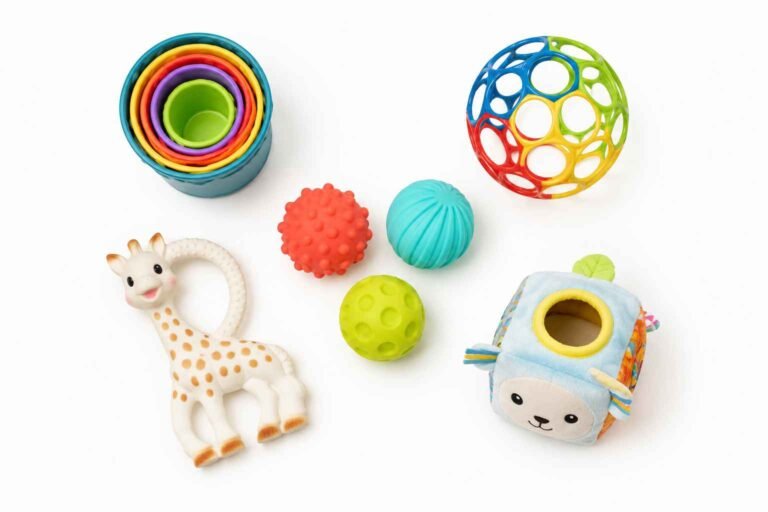
- Soft stacking toys, sensory balls, and anything that moves or makes a gentle sound when touched all work well here. The key is giving them objects that reward their attempts. If they bat at something and nothing happens, they lose interest. If they bat at something and it makes a sound, they do it again.
- What to introduce: floor mirrors, soft stacking rings, sensory balls, rattles with multiple textures, board books with lift-the-flap or touch-and-feel elements.
6 to 9 months: sitting up changes everything
When your baby learns to sit independently, typically between 6 and 8 months, their entire world expands. Both hands are suddenly free to explore, their field of vision doubles, and they can manipulate objects in a completely different way than they could while lying on their back.
- Object permanence begins developing here: the understanding that things continue to exist even when they disappear from sight. This is when peekaboo stops being random entertainment and becomes genuinely educational. Hide a toy under a blanket and watch your baby look for it. That search behavior is their brain making a major cognitive leap.
- At this stage, babies also start imitating your actions deliberately. If you knock a block tower over, they will try to knock the next one over. If you wave, they attempt to wave back. Play is no longer just sensory; it is becoming social and communicative.
- What to introduce: nesting cups, soft blocks for knocking down, pull-back cars, activity cubes with buttons and dials, board books with simple touch-and-feel elements.
9 to 12 months: independent exploration and imitation
By 9 months, play looks remarkably intentional. Your baby likely has a favorite toy. They may crawl to retrieve something from across the room. They are imitating your actions with increasing accuracy, developing a pincer grasp that lets them pick up small objects, and starting to point at things to share their attention with you.
- Independent play starts to become possible in small doses at this stage, though it is important to have realistic expectations. At 9 months, five minutes of independent play is a win. The research is clear that joint play, playing together, comes before and supports independent play. Leaving your baby to play alone before they are ready leads to frustration for both of you.
- Vihaan at 10 months had a wooden stacker he carried everywhere and would not stop banging against everything. That counted. All of it counted.
- What to introduce: push toys and activity walkers, ring stackers, simple puzzles with large pieces, cause-and-effect toys, soft puppets for early pretend play.
How to choose the right toy for your baby’s age
The age recommendations on toy packaging are a starting point, not a rule. What matters more is whether the toy matches where your baby actually is in their development right now.
- A few questions worth asking before buying anything: Can my baby physically interact with this toy in the way it is designed to be used? Does it respond to their actions in a way they can notice? Can they hold it safely? Does it grow with them past the next two months?
- Toys that do too much take the thinking away from your baby. A toy that lights up, spins, and plays music on its own does not require your baby to do anything. A toy that only does something when your baby acts on it teaches cause and effect. The simpler option is almost always the better developmental choice in the first year.
- The high contrast toys we used with both Eeshan and Vihaan in the newborn phase are a good example of this. A black and white board book does exactly one thing: it exists with bold patterns your baby can look at. That simplicity is the point. You can find our full list of what worked in our high contrast baby toys guide for newborns.
When to talk to your pediatrician about play development
Every baby develops at their own pace and there is a wide range of what is normal. That said, there are some signs worth mentioning to your pediatrician if you notice them.
- By 3 months, most babies are making eye contact, smiling socially, and beginning to track objects. By 6 months, most babies are reaching for toys, babbling, and responding to their name. By 9 months, most babies are playing back-and-forth games, imitating simple actions, and showing clear interest in interacting with you and with objects.
- If you are not seeing these things at these ages, that is a good conversation to have with your pediatrician. Early intervention, when needed, makes a significant difference and there is no downside to asking.
Frequently asked questions
When do babies start playing with toys on their own?
Brief independent play typically starts around 6 to 9 months once babies can sit independently and both hands are free to explore. At first this might only last a few minutes. Longer independent play develops gradually through the toddler years.
What toys are best for a 2 month old?
High contrast black and white books and cards, a play gym with hanging elements, and soft rattles they can feel even before grasping intentionally. At 2 months your baby is primarily using vision and hearing to explore, not their hands.
Is it normal for a newborn to not be interested in toys?
Completely normal. In the first 4 to 6 weeks, your baby is adjusting to life outside the womb. Your face, your voice, and your warmth are far more stimulating to them than any toy you can buy. Real interest in objects develops gradually over the first few months.
When do babies start grabbing toys?
Most babies begin intentional reaching and grasping between 3 and 4 months. Before that they may swipe at things but without the deliberate intent that comes later. By 4 months most babies can hold a rattle placed in their hand and will attempt to bring it to their mouth.
Do babies need lots of toys?
No. Research consistently shows that fewer, simpler toys support better play than overwhelming variety. Having too many toys out at once actually reduces how long babies engage with any single object. A small rotation of age-appropriate toys works better than a full toy chest.
When that family member asked if something was wrong with Eeshan at two weeks old, the honest answer was that he was doing exactly what a two-week-old brain is supposed to do. He was staring at ceiling shadows and processing sensory information at a rate his developing nervous system could handle. That was play.
–
The toys and the reaching and the knocking things over. All of that comes. It builds gradually, month by month, in a way that is genuinely remarkable to watch from close up. You do not need to rush it or buy more things to make it happen faster. You just need to show up, get on the floor with them, and let them lead at whatever stage they are actually in.
Both boys taught me that. It just took me a little longer with Eeshan to stop worrying and start watching.
Saidesh : dad of two, Eeshan and Vihaan, writing about what he actually tried, tested, and learned the hard way. CribKind covers baby development, sensory play, and real parenting for the first two years.