
12 Best High Contrast Baby Toys for Newborn Brain Development
When Eeshan was born, I stood in his room holding a bright red rattling giraffe someone had gifted us, thinking: surely this is what babies like?
Turns out, he could not even see it properly. Newborns can only focus on objects 8 to 12 inches from their face, and everything else is blurry gray noise. What kept Eeshan locked in for minutes at a stretch were bold black and white patterns. That was my introduction to high contrast baby toys for newborn brain development, and after going through the newborn phase again with Vihaan, the lesson has stuck. Here are the 12 that actually mattered.
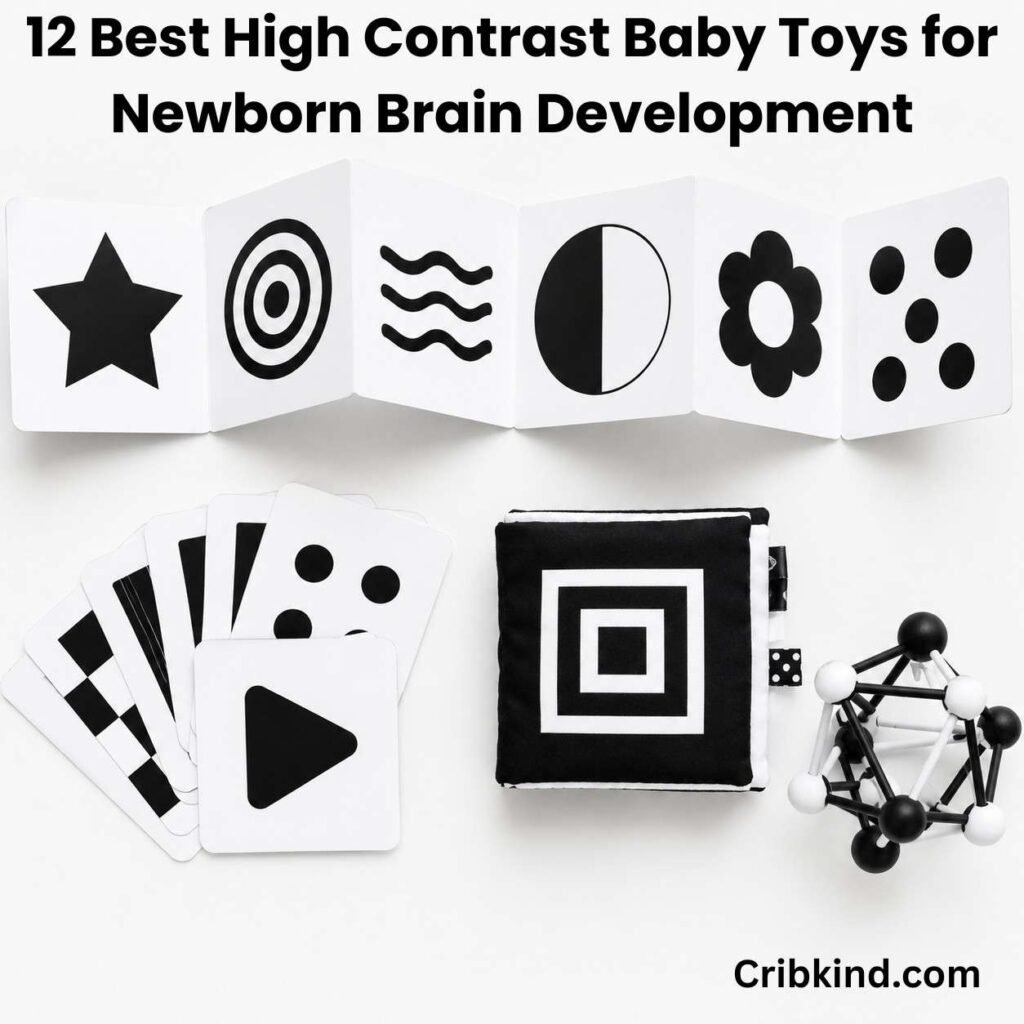
Why newborns need high contrast toys
Your baby’s visual system is the least developed of all their senses at birth. Their retinas and optic nerves are still forming, and the visual cortex is actively wiring itself in those first weeks.
- That sounds clinical until you picture it: your baby is essentially staring at a foggy world, and most of what we put in front of them registers as background hum. When Eeshan would look right past a toy we had carefully placed, that was exactly what was happening.
- High contrast patterns, especially black and white, give that developing visual cortex the strongest possible signal. Every time your newborn stares at a bold pattern, their brain is building new neural pathways that will later support tracking, focusing, depth perception, and early cognitive skills.
- Think of soft pastels as a whisper and black and white as a shout. A newborn’s brain needs the shout.
- By around 3 to 4 months, color vision starts to switch on, beginning with bold reds and greens. Until then, high contrast is the most effective visual input you can offer.
12 best high contrast baby toys for newborn brain development
1. Happy Start high contrast board book
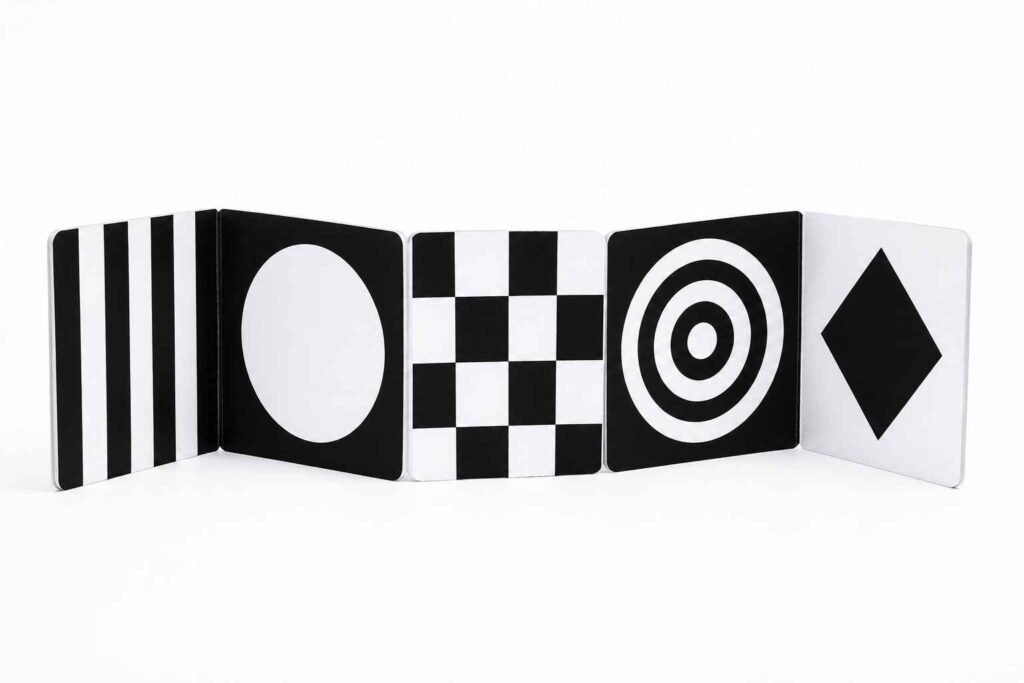
This is the one I would tell every new parent to buy first. The accordion-fold design means you can prop it open long or short, giving your baby something to focus on during awake time without you having to hold it the whole session. Hospital approved and winner of The Bump’s Best Newborn Toy for Visual Development in 2025.
Stand it up against the side of the bassinet during those alert windows after a feeding. Eeshan would stare at it for a full five minutes at three weeks old, which felt like a genuine miracle at that stage.
2. Lovevery black and white card set
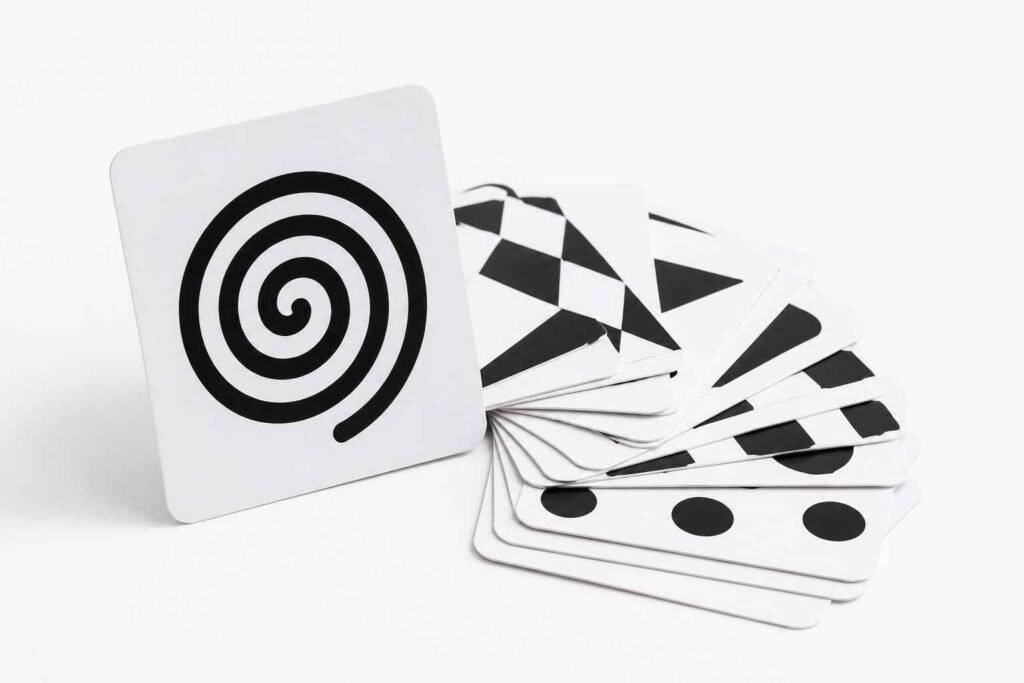
Bold geometric cards designed specifically to match newborn vision range. The technique matters more than the cards themselves: hold one about 10 inches from your baby’s face, let them focus, then very slowly sweep it left to right. You are exercising their eye-tracking muscles, not just giving them something to look at.
Keep a few in the diaper bag. They turn a pediatrician waiting room from a disaster into something manageable.
3. Tiny Love black and white developmental gymini
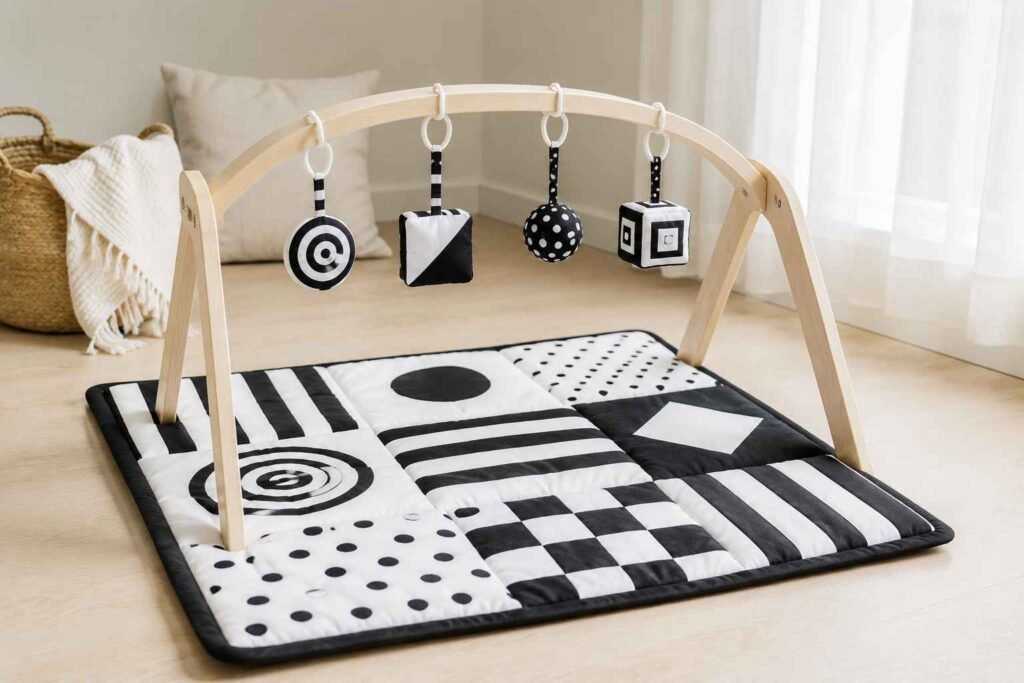
A full activity gym where the mat itself features high contrast patterns, which most gyms skip entirely. The hanging toys are also black and white, so the whole setup is calibrated for where your newborn’s vision actually is, not where it will be in six months. Designed by child development experts, tested by The Bump as best newborn toy for strength-building.
The mat doubles as a tummy time surface. High contrast patterns at eye level give your baby a reason to lift their head, so motor development and visual development work together in one session.
4. Beiens high contrast soft crinkle book
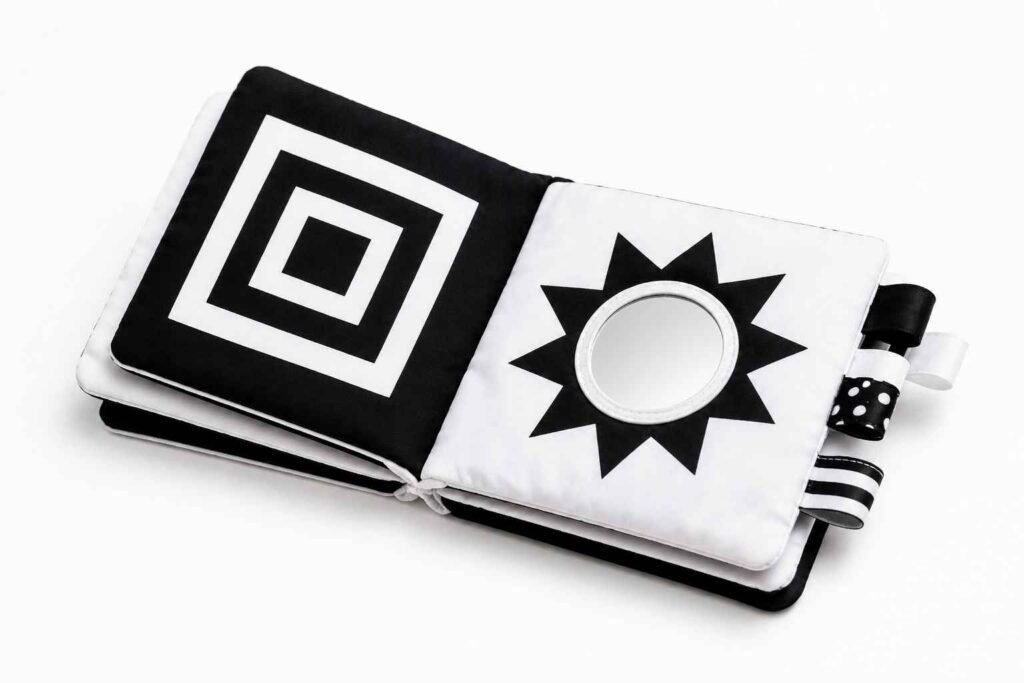
This soft book layers high contrast visuals with crinkle sounds and touch-and-feel textures, hitting vision, hearing, and tactile input in one toy. As your baby outgrows the pure black-and-white phase, the sensory elements keep it relevant well into the second half of the first year.
It also straps onto strollers and car seat handles, which is why it became one of the most-used things we owned in those early months.
5. Joyreal high contrast baby toy bundle
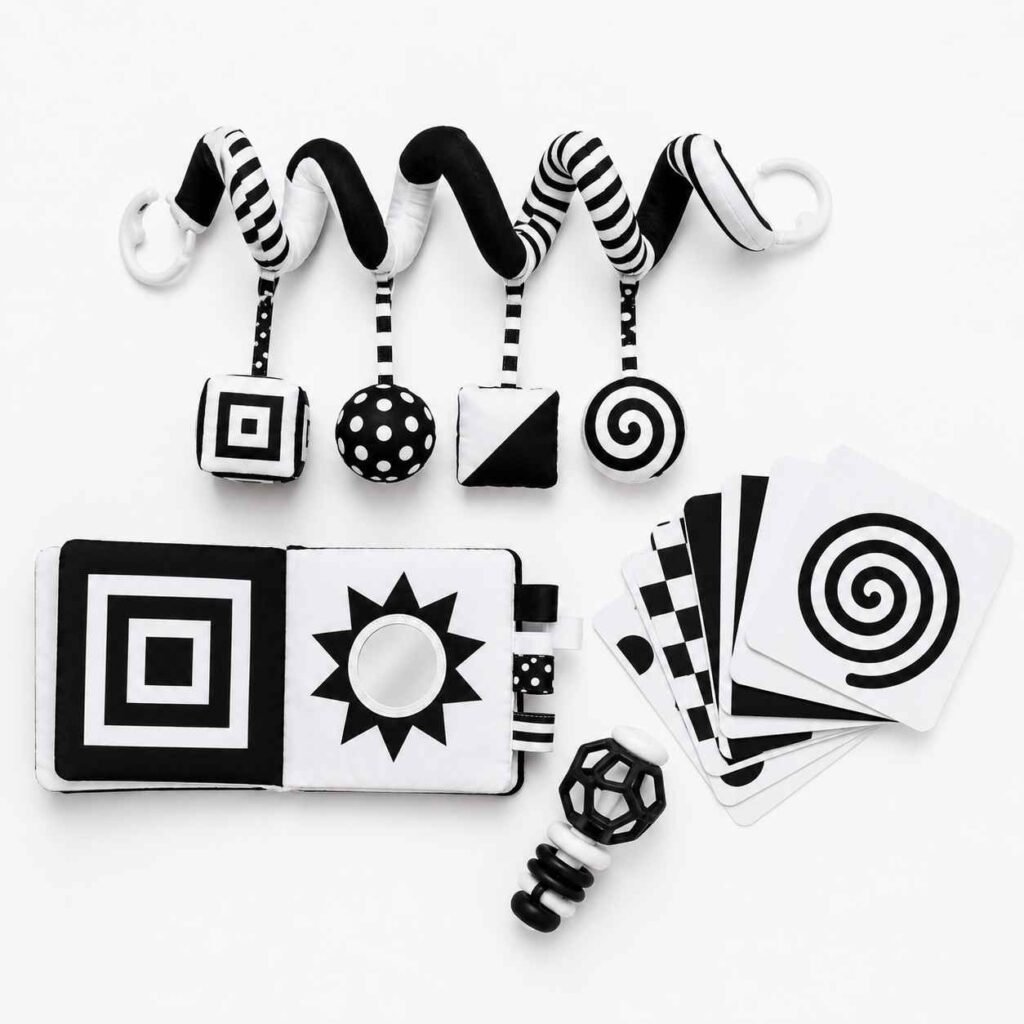
A car seat toy, a rattle, a soft book, and high contrast flash cards in one portable set. If you want a single purchase that covers multiple situations, home, car, and stroller, this one does it without a complicated buying process.
The car seat hanger alone earns its place. Babies spend a surprising amount of time in car seats in the early months, and having high contrast patterns in their line of sight makes that time count developmentally.
6. URMYWO tummy time high contrast set
A soft book, a baby-safe mirror, and crinkle elements, all designed for tummy time. The mirror is the quiet star of this set. Babies are hardwired to pay attention to faces, including their own reflection, and a mirror at tummy time height gives them a compelling reason to push through the discomfort and lift their head.
We used this with Vihaan from about six weeks. It genuinely made tummy time sessions go longer with noticeably less protest.
7. Merka newborn flash cards (set of 50)
Fifty black and white cards covering geometric shapes, animals, and simple patterns, all for around $10 to $12. The variety means you can rotate cards to keep things fresh as your baby’s visual ability grows and they need more complexity to stay engaged.
Tape a few to the wall next to the changing table. Diaper changes become less of a negotiation when there is something interesting at eye level for your baby to study.
8. SmartNoggin NogginStik developmental light-up rattle
This rattle has a high contrast face design with a light-up element that draws your baby’s gaze. Hold it in their line of sight, light it up, let them lock on, then move it very slowly to encourage tracking. One of the few toys that actively asks you to participate rather than prop and walk away. Multiple award winner including the Oppenheim Platinum Award and The Bump’s Best of Baby.
That participation matters. Shared attention and eye contact in these early weeks are laying the groundwork for communication skills that show up months later.
9. Dr. Rapeti tummy time floor mirror
A floor-level mirror with a high contrast crinkle book attached. The mirror sits upright at tummy time height, so your baby can see themselves. Babies are deeply drawn to faces, and a mirror face holds their attention long enough to make the whole tummy time session more productive.
Washable and non-toxic materials, which every parent of a drooling newborn will appreciate more than any other spec on the box.
10. Black and white baby mobile (Munari-style)
Before your baby has head control or can reach for anything, a crib mobile is one of the few toys that works from day one. A Munari-style mobile uses black and white geometric shapes that rotate slowly with air currents rather than a motor, which is gentler and more appropriate for the very early weeks.
11. Beiens high contrast baby flashcards (0 to 3 months)
A dedicated flashcard set targeting the 0 to 3 month window when pure black and white geometry is most effective. These give you a rotating library of bold patterns to use during awake windows without any setup. Small enough to tuck into a pocket or diaper bag front pouch.
Different from the beiens soft crinkle book above: this is for structured, quick visual sessions rather than tactile play. At under $10, it is the lowest-cost item on this list and one of the most practical.
12. URMYWO spiral high contrast car seat toy
A black and white spiral toy that wraps securely around any car seat handle, stroller bar, crib rail, or play gym. Includes four detachable hanging toys with a rattle, squeaker, crinkle paper, and a baby-safe mirror, all in high contrast black and white patterns. Currently a bestseller in Amazon’s baby car toys category.
Most spiral car seat toys are brightly colored, which does nothing for a newborn’s visual development. This one is calibrated for where your baby’s vision actually is in the first three months.
| Toy | Best for | Age range |
|---|---|---|
| Happy Start high contrast board book | Visual development from birth | 0+ months |
| Lovevery black and white card set | Visual tracking practice | 0 to 3 months |
| Tiny Love black and white gymini | Tummy time and floor play | 0 to 6 months |
| Beiens high contrast soft crinkle book | Multisensory stimulation | 0 to 12 months |
| Joyreal high contrast baby toy bundle | On the go stimulation | 0 to 6 months |
| URMYWO tummy time high contrast set | Tummy time motivation | 0 to 6 months |
| Merka newborn flash cards (set of 50) | Budget pick, versatile | 0 to 3 months |
| SmartNoggin NogginStik rattle | Visual tracking and early interaction | 0 to 12 months |
| Dr. Rapeti tummy time floor mirror | Tummy time, floor play | 0 to 6 months |
| Munari-style black and white mobile | Crib time, very early weeks | 0 to 2 months |
| Beiens high contrast baby flashcards | Structured daily sessions | 0 to 3 months |
| URMYWO spiral car seat toy | On the go visual stimulation | 0 to 6 months |
How to actually use high contrast toys, week by week
The age at which you introduce these matters as much as which ones you pick.
From birth to six weeks, hold cards or books 8 to 12 inches from your baby’s face during alert periods. Keep sessions to 3 to 5 minutes. There is no need to move the toy at this stage. Let them look at their own pace. Eeshan would get glassy-eyed and look away after about four minutes, which was the signal to pack it in for that session.
From six to ten weeks, introduce slow movement. Hold a card in their line of sight, let them focus, then sweep it left to right very slowly. This is visual tracking practice. A few reps per session is enough, not a workout.
At two to three months, introduce tummy time with high contrast props at eye level. The motivation to look at something interesting helps them push through neck fatigue and lift their head longer. Floor mirrors and tummy time books earn their keep here.
At three to four months, color vision is coming online. Start layering in bold primary colors alongside your high contrast toys. You are not replacing the black and white, just adding to it as their visual range expands.
A quick note on overstimulation
More is not always better with newborns. Their nervous systems are still calibrating, and too much input, even genuinely good input, can tip them into fussiness fast.
When Vihaan was around five weeks, I set up three different high contrast things in his line of sight at once, thinking more stimulation was better. He lasted about ninety seconds before melting down completely. One thing at a time is the rule.
Frequently asked questions
Do high contrast toys really make babies smarter?
They support visual brain development, which is one piece of early cognitive growth. They are not a magic intelligence booster. What they do is give your baby’s developing visual cortex the right input at the right developmental stage, supporting the neural pathway formation that underlies later skills like tracking and focusing.
When should I stop using high contrast toys?
Around 3 to 4 months when color vision starts developing, high contrast toys become less exclusively necessary. Keep using them alongside colorful toys. They remain stimulating, they just no longer need to be the only input.
Are colored toys bad for newborns?
Not harmful, just less effective. A pastel toy will not hurt your baby. In the first 8 weeks, the contrast is too low for their developing eyes to register clearly, so they get very little visual stimulation from it.
What is the best first high contrast toy to buy?
A board book or flash card set. Inexpensive, versatile, usable from day one, and easy to prop without a complicated setup.
When Eeshan was born, I wish someone had put a black and white board book in my hands instead of that colorful rattle. Not because the rattle was bad, but because I would have understood what he actually needed in those first weeks, and I would have felt a lot less helpless watching him stare blankly at walls.
High contrast toys are not a parenting trend. They are the right visual input for where a newborn’s brain is developmentally. Start simple, keep sessions short, and do not overthink it. A bold black and white book held 10 inches from your baby’s face is doing more for their brain right now than any battery-powered singing toy ever will.
Both boys got real use out of these. Yours will too.
Saidesh is a dad of two, Eeshan and Vihaan, writing about what he actually tried, tested, and learned the hard way. CribKind covers baby development, sensory play, and real parenting for the first two years.

4 Comments