18 Thanksgiving Crafts for Kids by Age
Eeshan didn’t want anything to do with Thanksgiving crafts until he was four years and two months old. Not the handprint turkey, not the paper plate version with the googly eyes, not even the popsicle stick one I thought was a sure thing. Then Vihaan came along and treated every craft like it was the most important project he’d ever been invited to. I learned more about what actually works at each age from those two reactions than from any tutorial I’ve ever followed.
Every craft below includes a mess level rating (★☆☆ = clean, ★★☆ = manageable, ★★★ = commit to the chaos) and a tip for what to do if your child loses interest halfway through. All of these link to each other in the way seasonal crafts should: once you’ve tried the toddler version, there’s a preschool version waiting. For the Halloween versions of these formats, our paper plate Halloween crafts and toilet paper roll Halloween crafts cover October in the same format.
What you need for most Thanksgiving crafts
Most crafts in this list pull from the same short supply list. Buy these once and they’ll cover you through the whole season.
- Washable tempera paint (brown, red, yellow, orange)
- Paper plates (plain white, any size)
- Construction paper (brown, orange, red, yellow, black, white)
- Toilet paper rolls
- Brown paper lunch bags
- Craft feathers (multicolor bags from the craft store)
- Googly eyes (optional but strongly recommended)
- Glue sticks and white glue
- Watercolors or washable markers
- Coffee filters
- Popsicle sticks
- Scissors (adult pair and child-safe pair)
- A drop cloth or table cover you don’t love
Thanksgiving crafts for babies and toddlers, ages 1-2
At this age the craft is really about the sensory experience, not the finished product. The turkey doesn’t have to look like a turkey. The point is the paint on the hands, the paper that crinkles, the feathers that stick. Vihaan’s first Thanksgiving craft was a handprint turkey that looked more like a sunset with fingers. I kept it for three years.
Handprint turkey [Mess Level: ★★☆ Manageable]
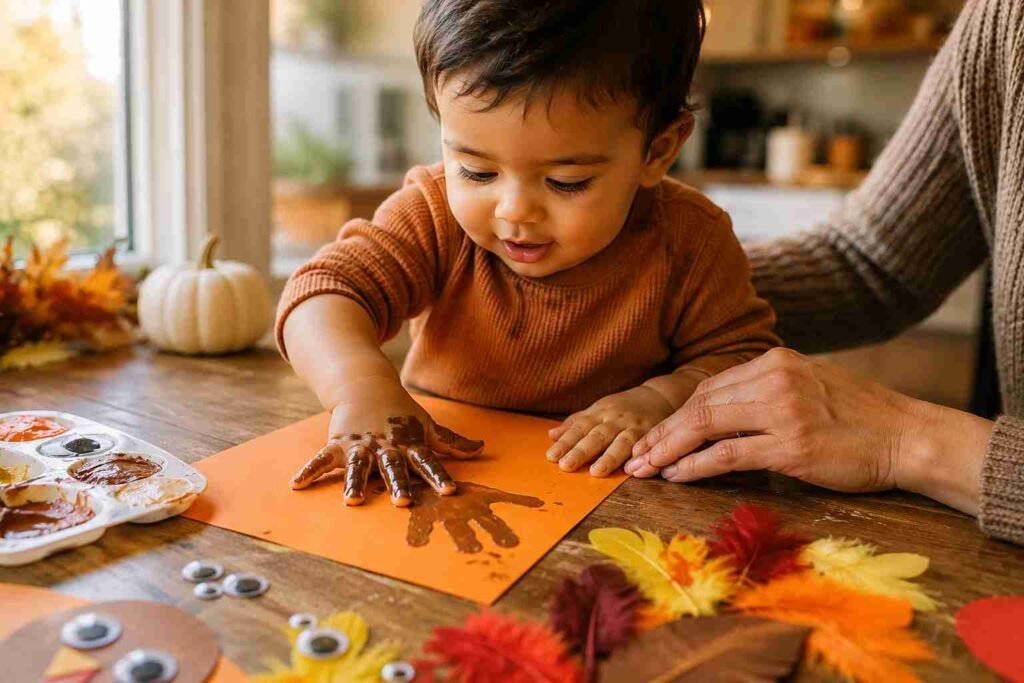
Paint your child’s palm brown and press it onto paper. The thumb becomes the turkey’s head, the fingers become the feathers. Add eyes with a marker or googly eyes. That’s the whole craft. It’s been a Thanksgiving standard for fifty years because it actually works at this age.
Vihaan’s first handprint turkey at fourteen months was made with both hands, which turned it into something more abstract. He was delighted. I was covered in brown paint. We both won. The key: work fast. Under two, the novelty of painted hands lasts about ninety seconds before they start rubbing their face.
If they lose interest: press the hand once and call it done. One print is still a turkey. You don’t need to fill the page.
Footprint turkey [Mess Level: ★★★ Commit to the chaos]
Same concept as the handprint, but with the foot: the heel becomes the body, the toes become the feathers. Works better with two adults – one to hold the child steady, one to do the painting and pressing. The finished product is genuinely charming. The process is genuinely chaotic.
Eeshan was eighteen months for his footprint turkey and found the paint sensation on the bottom of his foot so alarming that he removed the paper and pressed his foot on the table instead. We have a table with a very faint turkey footprint on it. We kept it there for six months before repainting.
If they lose interest: this craft requires full commitment upfront. If they refuse the foot paint, switch immediately to the handprint version. Don’t negotiate.
Leaf tracing turkey [Mess Level: ★☆☆ Clean]
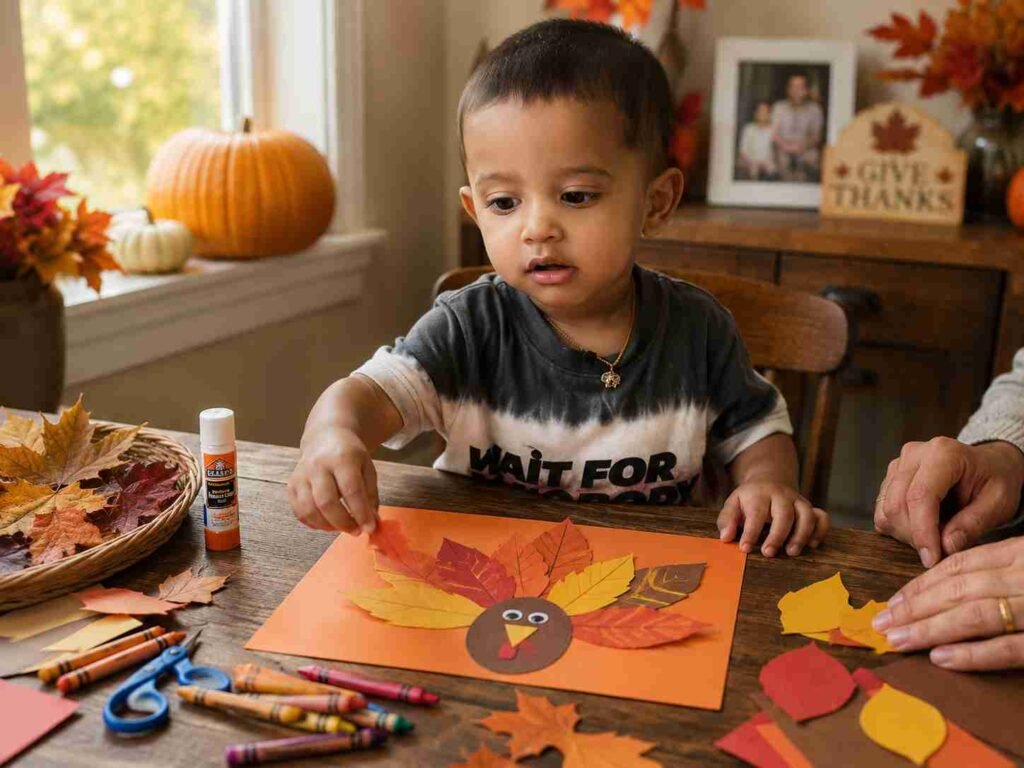
Collect five to eight fall leaves of different sizes. Trace them onto construction paper and cut out the shapes. The leaf shapes become the feathers; a small brown oval becomes the body. Assembly is by glue stick, no paint required. Works for children twelve months and up who can hold a crayon loosely.
This was the craft Eeshan would actually do at two years old when he flatly refused paint. He spent twenty minutes arranging and rearranging the leaf shapes before letting me glue them down. The arranging was more important than the turkey. I let it go on longer than necessary because he was focused and quiet, which at twenty-four months was worth protecting.
If they lose interest: skip the turkey shape entirely and let them glue the leaf tracings onto the paper in any pattern they want. It becomes a fall collage. Just as good.
Torn paper feather collage [Mess Level: ★☆☆ Clean]
Draw a large turkey body on paper or use a printed template. Tear orange, red, and yellow construction paper into small pieces and let the child glue them onto the feather area. Tearing paper is a genuine fine motor activity at this age and most one-to-two-year-olds find it deeply satisfying.
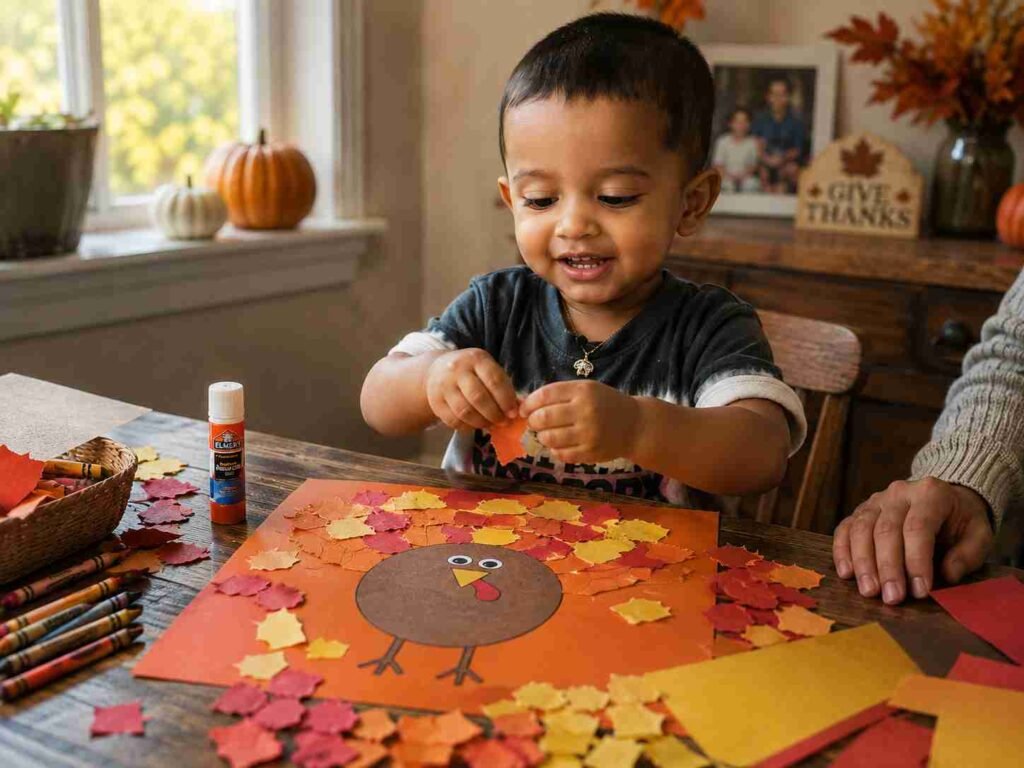
Vihaan at twenty months preferred tearing to sticking and ended up with a pile of colorful confetti and a turkey body that remained completely bare. We declared it a modern art piece and stuck it on the fridge. His grandmother asked if we’d bought it.
If they lose interest: hand them more paper to tear. They’re usually not done with the tearing; they’re done with the sticking. Let them tear for as long as they want and glue the pieces on later yourself.
Paper plate pumpkin [Mess Level: ★★☆ Manageable]
Paint a paper plate orange, let it dry, add green paper stem and curly vine, draw a face with black marker. Simple, season-appropriate, and quick enough to finish before the paint wins. This one pairs well with our pumpkin crafts for kids post if you want to extend the pumpkin theme.
Best for eighteen months and up. Younger than that, the plate tends to become a hat before the paint dries. Both outcomes are acceptable. The drying time is the hardest part of this craft at this age – set up the next activity immediately so they don’t touch the wet plate.
If they lose interest: the painted plate is the finished product. You can add the face and stem later yourself. The child’s job was the orange paint and they completed it.
Thanksgiving crafts for preschool, ages 3-4
Preschoolers can follow simple two and three-step instructions, which opens up significantly more interesting crafts. They still need help with scissors and fine detail, but they can handle watercolors, glue guns (low-temp only), and the basic concept of following a template. The coffee filter turkey in this section was Spandana’s first-week classroom craft three years in a row.
Coffee filter turkey [Mess Level: ★★☆ Manageable]
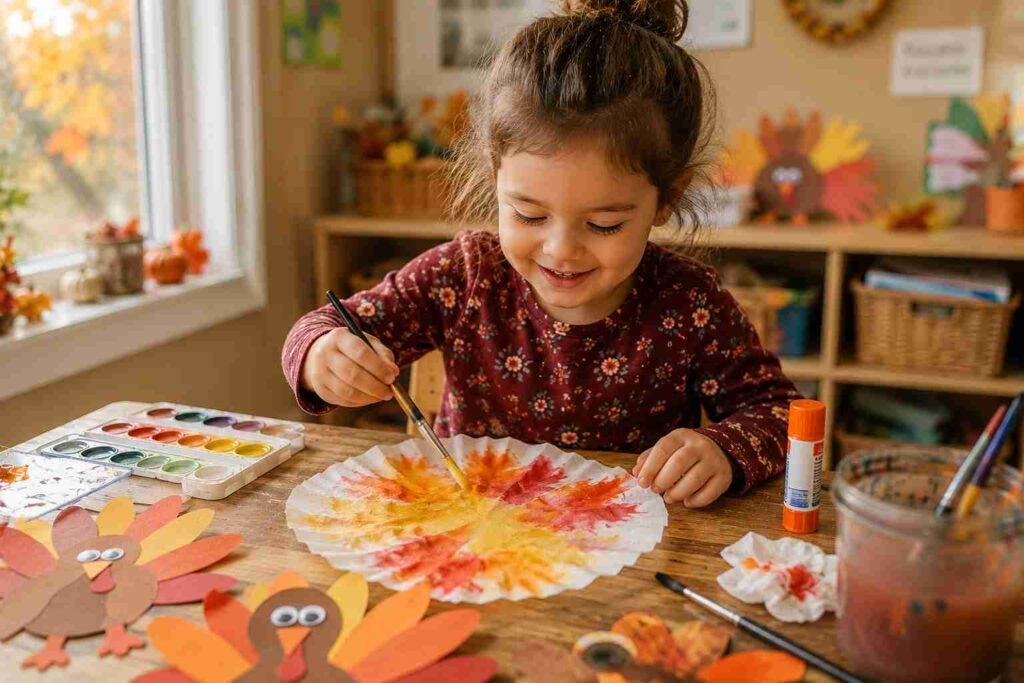
Flatten a coffee filter and let your child paint it with watercolors in fall colors. Let it dry completely. Fold it in half, then fold it in half again so it fans out into a tail-feather shape. Attach it to a simple paper turkey body. The colors spread and blend through the filter in a way that looks genuinely beautiful.
Spandana uses this in her first-grade classroom every November. The spreading color surprises children who are used to paint staying where they put it. Eeshan’s version at age four had such heavy watercolor application that the filter dissolved slightly in the middle. He called this an improvement. The result actually looked like iridescent feathers. He was right.
If they lose interest after painting the filter: the painted filter dries into a beautiful fall decoration on its own. You don’t need the turkey body. Hang it in a window.
Pinecone turkey [Mess Level: ★☆☆ Clean]
Collect a medium pinecone. Push craft feathers into the spaces between the pine scales at the wide end for the tail. Glue a small orange pom-pom or paper beak and googly eyes to the narrow end for the head. Optional: glue a red yarn wattle. Done in under ten minutes, mess-free, and keeps for years.
This was the craft that made Eeshan care about Thanksgiving crafts. At four years and two months, he found a pinecone on a walk, brought it home, and asked what he could do with it. We made this. He named the turkey Gerald. Gerald has appeared at every Thanksgiving table since. Gerald is now three years old and slightly dusty.
If they lose interest: the pinecone with feathers stuck in is already the craft. Let them stop where they are and call Gerald whatever they want.
Toilet paper roll turkey [Mess Level: ★☆☆ Clean]
Paint or wrap a toilet paper roll in brown paper for the turkey body. Cut a fan of feathers from construction paper in fall colors and glue behind the roll. Add googly eyes and a paper beak. The same format as our toilet paper roll Halloween crafts – same materials, same approach, different theme.
Vihaan at three and a half made four of these in one sitting and staged them as a family. He assigned each one a name from our actual family. One of them was called “Daddy Gobble.” I was not consulted on this name but I accept it.
If they lose interest: the plain painted roll is a turkey body. Stick two googly eyes on it and call it minimalist.
Paper bag turkey puppet [Mess Level: ★☆☆ Clean]
Use a brown paper lunch bag. The flat bottom of the bag becomes the turkey’s head when the bag is held vertically with the bottom flap facing outward. Glue paper feathers, eyes, and a beak onto the flap. Slip your hand inside and the flap opens as a beak. Works as a puppet for the rest of the day and doubles as a Thanksgiving table conversation starter.
Eeshan used his to interrogate everyone at Thanksgiving dinner about what they were thankful for, in character as the turkey. His questions were pointed. His grandfather was unprepared for “the turkey” to ask about his life choices. This is a feature, not a bug.
If they lose interest: they have a paper bag with feathers on it. It’s still a turkey even without the puppet element. Put a snack in it.
Thankful feather turkey [Mess Level: ★☆☆ Clean]
Print or draw a simple turkey body without tail feathers. Cut feather shapes from construction paper in fall colors. On each feather, write one thing the child is thankful for (they can dictate, you write). Glue all the feathers onto the turkey body to build the tail. The more thankful, the fuller the tail.
This is the version Spandana uses in her classroom. The feathers get written across the week before Thanksgiving as children think of new things. By Thursday, the turkey has a genuinely full, specific, personal tail. Vihaan’s first thankful turkey at age three included “my socks,” “the ceiling fan,” and “Gerald.” Gerald the pinecone turkey made the list. That felt right.
If they lose interest: two feathers is still a thankful turkey. There’s no minimum requirement on gratitude.
Acorn turkey [Mess Level: ★☆☆ Clean]
Collect acorns with caps still attached. The acorn cap becomes the turkey’s head, the acorn body is the turkey’s body. Use toothpicks to attach tiny craft feathers at the back. Draw a face with a fine marker. Display as a small table decoration. Requires adult help with the toothpicks and works best for ages three and up who won’t eat the supplies.
The acorn turkey is Saidesh’s personal contribution to the craft lineup. This was the one I figured out when we ran out of construction paper on a rainy October afternoon and I had a bowl of acorns from the backyard walk the week before. Four acorn turkeys later, we had a flock. Eeshan called them a “gaggle.” I told him the correct term was a “rafter.” He did not care.
If they lose interest: display the acorn anyway. One tiny acorn turkey on the Thanksgiving table is better than zero.
Thanksgiving arts and crafts for kids, ages 5-8
By first grade, children can use scissors independently, follow multi-step instructions, and write short sentences – all of which opens up the thankful-themed crafts that involve language as well as materials. This age group also benefits from crafts that have a practical function, something they can bring to the Thanksgiving table and use rather than just display.
Thanksgiving placemat craft for kids [Mess Level: ★☆☆ Clean]
Draw or print a Thanksgiving scene on cardstock or heavy paper. Have your child color and decorate it, adding their name and the year. Write one thing they’re thankful for at the bottom. Laminate the finished placemat at a print shop (under $2) or cover with clear contact paper at home. Each family member gets their own placemat for the Thanksgiving table.
This is the craft with the longest shelf life. Spandana has a collection of Eeshan’s Thanksgiving placemats going back to his first Thanksgiving at the table. The five-year-old version and the seven-year-old version side by side show more growth than any school photo. The laminated version holds up through multiple washings. Some families make one every year and use all of them as a set.
If they lose interest: a decorated but unlaminated placemat still works at the table. It just won’t survive the gravy.
Thankful turkey with written feathers [Mess Level: ★☆☆ Clean]
This is the expanded version of the preschool thankful feather turkey, designed for children who can write independently. Each child writes their own feathers, three to five per person, in specific terms rather than general ones. “My dog” beats “my family.” “Saturday mornings” beats “weekends.” The specificity is the point.
Saidesh runs this at the Thanksgiving table itself as a pre-dinner activity. Each person completes their feathers before grace. The turkeys get read aloud before the meal. What Eeshan has written on his feathers has changed every year in ways that tell more about what that year actually was than any summary he’d give if asked. Age six: “my bike, my teacher, pizza.” Age seven: “Vihaan sometimes, Minecraft, the day we went camping.” Age eight: “that one Saturday in July.” That last one required follow-up questions.
If they lose interest after one feather: one specific, honest feather is enough. Don’t fill the turkey. The turkey is only as good as what’s on it.
Popsicle stick turkey [Mess Level: ★☆☆ Clean]
Glue five popsicle sticks in a fan shape for the tail feathers. Add a round wooden bead or paper circle for the head, attach to the center of the fan. Draw on a face and wattle with markers. Color the sticks with markers in fall colors before assembly for more visual impact. Total time: twenty minutes, fully dry in thirty.
This is the craft Eeshan returned to at age seven after years of rejecting craft projects. He made twelve popsicle stick turkeys and distributed them to family members as Thanksgiving gifts. They were received with the level of enthusiasm appropriate for a handmade gift from a seven-year-old. Everyone kept them. Several appeared again the following November.
If they lose interest: the fanned sticks are the finished product. Glue a magnet on the back and it’s a refrigerator decoration.
Hand turkey watercolor [Mess Level: ★★☆ Manageable]
Trace your child’s hand on heavy watercolor paper, not regular paper. Paint the thumb section with brown watercolor for the head and body. Use fall colors on the finger sections for the feathers. Let the colors bleed and blend at the edges – that’s the whole aesthetic. The result looks significantly more polished than the toddler paint-hand version and children this age know the difference.
Eeshan at six revisited the handprint turkey he’d been rejecting for years and found the watercolor version acceptable because, as he explained, it was “more professional.” He spent forty-five minutes on his. He made four of them and ranked them. I was not permitted to see the ranking until the final version was complete.
If they lose interest: let the watercolor dry as-is. An unfinished watercolor hand turkey is still genuinely pretty.
Leaf garland [Mess Level: ★☆☆ Clean]
Collect fall leaves or cut leaf shapes from construction paper in orange, red, yellow, and brown. Punch a hole in each leaf or shape. String them onto twine or yarn, alternating colors. Hang across the Thanksgiving table, mantle, or window as decoration. Each child makes their own section; combine them into one long garland for display.
This is the craft that doubles as table decoration and activity. Set it up an hour before guests arrive and the children are occupied while adults do the cooking. Vihaan at four made a garland that was mostly orange, which he considered appropriate. It hung on our mantle through December before he noticed it was still there and asked if it was a Christmas decoration now. It was not. We took it down.
If they lose interest: they’ve made part of a garland. String what exists and hang it. A short garland is still a garland.
Turkey headband [Mess Level: ★☆☆ Clean]
Measure and cut a strip of brown construction paper long enough to fit around your child’s head and overlap by an inch. Tape or staple the ends together. Cut feather shapes from fall-colored paper and glue or tape them to the back of the headband. Add googly eyes and a beak cutout to the front. Wear to Thanksgiving dinner.
Eeshan wore a turkey headband to Thanksgiving dinner at age five and refused to take it off during the meal. His grandmother took a photograph. The photograph exists and he is aware that it will be brought out at a time of our choosing. This is its primary function now.
If they lose interest: the plain headband is a crown. Declare it a Thanksgiving crown and let them wear it anyway.
For more Thanksgiving activities that don’t involve paint, our Thanksgiving jokes for kids post has 80 themed jokes organized by age, and our daycare crafts for infants and toddlers post covers more craft formats that work for the youngest ages through a different lens.
Frequently asked questions about Thanksgiving crafts for kids
What are easy Thanksgiving crafts for kids?
The easiest Thanksgiving crafts for kids are the ones that require no drying time between steps. The pinecone turkey (feathers pressed directly into the pine scale gaps), the acorn turkey, and the leaf tracing turkey all have no waiting. The paper plate pumpkin and coffee filter turkey require one drying step each. For truly instant gratification at any age, the torn paper collage produces a finished piece in ten minutes with no waiting and no cleanup beyond picking up paper pieces.
What Thanksgiving crafts can toddlers do?
Toddlers from about twelve months can do any craft that involves pressing, tearing, or sticking. Handprint and footprint turkeys, torn paper collages, and leaf tracing all work at this age with adult help. Avoid crafts with small parts (acorn turkeys, popsicle sticks) for children under three. The key with toddlers is setting a very short time expectation – five to ten minutes – and treating whatever they produce in that window as the finished craft, not an in-progress one.
What Thanksgiving crafts can kids make at home for free?
Almost all of the crafts in this list use common supplies already in most homes: paper plates, construction paper, toilet paper rolls, brown paper bags, and leaves from outside. The only supplies that require a purchase are craft feathers, googly eyes, and coffee filters – none of which cost more than a few dollars at a dollar store. The most expensive craft in this list is the laminated placemat, which costs under two dollars to laminate at a print shop. Every other craft costs under one dollar in materials.
How do you make a Thanksgiving placemat craft with kids?
Draw or print a Thanksgiving scene on cardstock. Have your child color and decorate it, then write their name, the year, and one thing they’re thankful for. Take it to a print shop or office supply store and laminate it for under two dollars. It’s ready to use at the Thanksgiving table the same day and holds up through washing for multiple seasons. Families who do this every year end up with a set of placemats that doubles as a visual record of the child’s handwriting and gratitude at each age.
What is the most popular Thanksgiving craft for kids?
The handprint turkey remains the most popular Thanksgiving craft for children across all ages, specifically for children ages one through five who can make one with minimal instruction. The finished product is immediately recognizable, it scales from very simple (one print, add eyes) to more detailed (multiple prints, watercolor feathers, personalized writing), and it produces a keepsake that holds meaning well past the craft session. The footprint turkey is a close second in our house, mostly because Vihaan finds the experience of painted feet more entertaining than the turkey itself.
Gerald the pinecone turkey is still on our Thanksgiving table. He’s joined now by a small flock of acorn turkeys and one very determined popsicle stick turkey that Eeshan made at seven and refuses to retire. Vihaan adds one new piece to the collection every year. Whatever this year’s craft turns out to be, it will be there next November too.
That’s the real reason to do these. Not the turkey. The thing that’s still on the table next year.
Which of these has become a tradition in your house? Drop it in the comments.
Saidesh is a dad of two, Eeshan and Vihaan, writing about what he actually tried, tested, and learned the hard way. CribKind covers baby development, sensory play, and real parenting for the first two years.