40 Winter Children’s Jokes
Winter children’s jokes work best on the days nobody wants to go outside: a snow day, a long car ride, a cold walk to the bus stop. This page has 40 clean ones, sorted into snow, ice, animals, hats and mittens, and knock knock jokes, plus a free printable joke jar with every joke on a cut out strip. Most are short enough for a 5 or 6 year old to repeat, and a few are really for the grown up reading them aloud.
Winter children’s jokes for different ages
These jokes are written for roughly ages 5 to 8, the stretch when kids start telling jokes but do not always get them. An article from The 74 says children do not really understand knock knock jokes and puns until around age 7, though they try them earlier. So a 5 year old may repeat a pun with total confidence and no idea why it works. That is fine. Our page of jokes for 5 year olds goes into the age research, and for toddlers I would skip the pun and use a funny voice instead.
Winter has one advantage over other seasons, which is that the props are everywhere. A mitten on the table or snow outside the window turns any of these children’s winter jokes into a show and tell. Hold up the mitten before you say the line, and the groan gets bigger. The table shows how the 40 are grouped.
| Group | Jokes | Good moment |
|---|---|---|
| Snow and snowman | 1 to 8 | Snow days and the walk to school |
| Cold and ice | 9 to 16 | Frosty mornings and the car |
| Winter animals | 17 to 24 | Bath time and bedtime |
| Hats, mittens and cocoa | 25 to 32 | Getting dressed and snack time |
| Knock knock | 33 to 40 | Waiting rooms and long drives |
Snow and snowman jokes
Snowman jokes are the ones kids ask for first, because a snowman is the easiest winter picture to hold in your head. These eight skip the ones every list repeats, like the snowman in July. Say them slowly and let the last word hang for a second.
- Why did the snowman get a ribbon? He was the coolest one in class.
- Why did the snowman love history class? It was full of cool dates.
- What did the snowflake say to the other snowflake? You are one of a kind.
- Why is snow so good at hide and seek? It covers everything up.
- Why did the snowman stand in front of the window? He wanted to see what the flurry was about.
- How does a snowman get to school? He takes the sled bus.
- Why did the snowman stay away from the campfire? He could not take the heat.
- Why are snowflakes good at math? Their numbers add up fast.
Number 3 is the gentlest of the set, and the one I would read at bedtime. The snowflake line is a nod to the saying that no two flakes look alike, so it also opens a quick chat about snow if your child asks.
Cold and ice jokes
Cold jokes are all about things a child feels, such as a runny nose, frosty windows and a thermometer that goes down. That makes them easy to follow without any explanation. A few lean on a word with two meanings, like degrees and cool, so expect a blank look from the younger kids and a laugh from the older ones.
- Why did the ice cube get a good grade? It was cool under pressure.
- Why did the thermometer get invited to the party? It had a lot of degrees.
- Why was the icicle so calm? It was just hanging around.
- What did the frost say to the window? Let me draw you a picture.
- Why did the ice skater smile? Everything was going smoothly.
- Why did the nose run in winter? It was trying to warm up.
- What kind of music does an ice cube like? Cool jazz.
- Why did the puddle get so stiff? It froze on the spot.
Winter animal jokes
Animal jokes are good for the quiet end of the day, when a child is tired and wants something gentle. Penguins, bears and owls are all easy to picture, and most of these jokes use a plain fact about the animal, such as a penguin that cannot fly. If your child likes animals, a joke is a good way into a chat about where they sleep in winter.
- Why did the penguin take the bus to school? It could not fly there.
- What is a polar bear’s favorite game? Freeze tag.
- What do seals say at a winter party? Let’s seal-ebrate!
- Why do owls like winter nights? They have extra time to hoot.
- What do bears say before their long winter nap? See you in the spring!
- Why did the squirrel work so hard in the fall? It was nuts about being ready for winter.
- Why did the cardinal look so bright in the snow? It was red-y for its photo.
- Why did the fish bring a coat to the lake? It heard the weather would be cod.
The penguin and owl jokes are the first two I would try with a younger child. The cardinal and fish jokes are for older kids who can spell the sound out loud.
Hat, mitten and cocoa jokes
Getting dressed for winter takes ten minutes of hats, boots and zippers, which is the perfect time for a joke. Everything on this list is something your child is holding or wearing. Try one while you zip the coat, and the zipper joke does the work for you.
- Why did the mitten win the award? It always lent a hand.
- Why did the winter hat feel proud? It was always on top of things.
- Why was the winter boot so sad? It had a lot on its sole.
- Why did the scarf win the race? It wrapped up early.
- What do you call hot cocoa that tells jokes? A warm up act.
- What did the fireplace say to the log? You are on fire today.
- What did the blanket say to the cold toes? Come on in, I have got you covered.
- Why did the zipper get promoted? It was always on the up and up.
The cocoa joke is a good one to tell with a mug in your hand. If you are looking for more cozy things to do on an indoor day, our rainy day activities for kids has a few ideas that work for snow days too.
Winter knock knock jokes for kids
Knock knock jokes are the format kids can tell back to you on their own, because the pattern is the same every time. These eight use winter words a child already knows. Let your child be the one who knocks, and answer with the same serious voice each time. A joke that comes out wrong is still a win at this age.
- Knock knock. Who’s there? Snow. Snow who? Snow one is home yet?
- Knock knock. Who’s there? Ice. Ice who? Ice you at the window, so open up.
- Knock knock. Who’s there? Frost. Frost who? Frost things first, open the door.
- Knock knock. Who’s there? Mitten. Mitten who? Mitten you here is a nice surprise.
- Knock knock. Who’s there? Chilly. Chilly who? Chilly out here, let me in.
- Knock knock. Who’s there? Igloo. Igloo who? Igloo my mittens on so I could knock.
- Knock knock. Who’s there? Cocoa. Cocoa who? Co-co-come in, it is freezing!
- Knock knock. Who’s there? Brrr. Brrr who? Brrr-ing me inside, it is freezing!
My favorite of these is the cocoa one, because the punchline is a person shivering. It also works well as a character voice, so shake a little when you say it.
The winter joke jar: a free printable
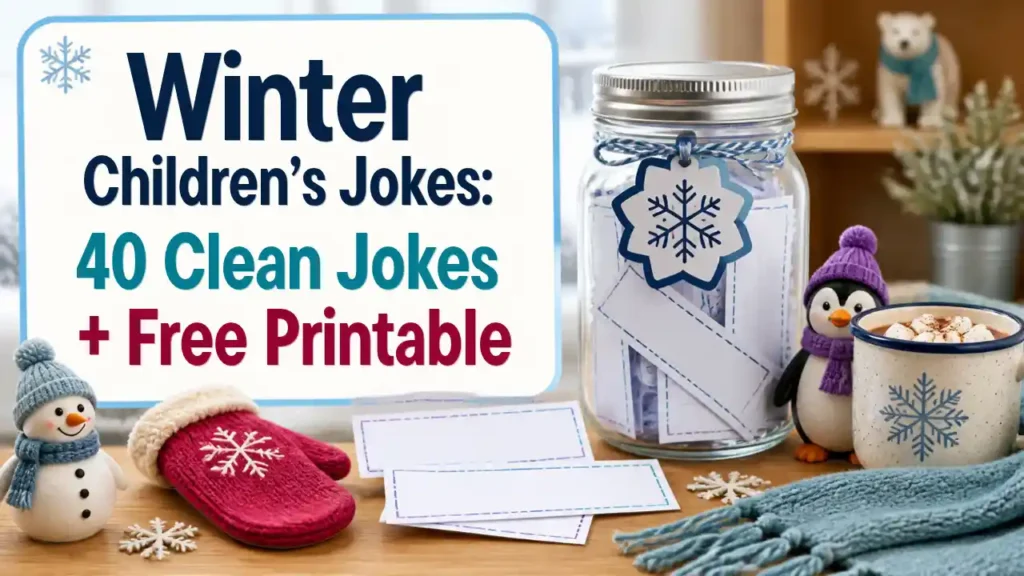
A joke jar turns a list into a daily habit. The PDF has all 40 jokes on cut out strips, ten to a page, with the question in bold and the answer underneath. Cut along the dotted lines, fold each strip in half, and drop them into any jar or mug. Pull one a day, read it out, and let your child try to tell it back.
Free download: Get the winter joke jar PDF with all 40 jokes on cut out strips
If your child likes crafts, the strips can be colored too. Our winter coloring pages make a good rainy afternoon pair. Please do not sell the file or repost it on another site.
How to use winter jokes on snow days and car rides
A few simple habits make these children’s winter jokes work better.
- One a day: A single joke with breakfast is easier to remember than ten at once.
- Lunchbox note: Write the question on a napkin and save the answer for dinner.
- Car ride game: Take turns, and let your child pick which joke comes next.
- Pause first: A half second of quiet before the last word is what makes it a joke.
- Retell it: Ask your child to tell it to someone else. Retelling is how a joke sticks.
On a day when snow keeps everyone inside, pair a few jokes with our winter would you rather questions for kids or set up a winter sensory bin for the little ones. Every joke on this page is clean, so it is safe for a child to repeat at school or at the dinner table.
Frequently asked questions about winter children’s jokes
What are good winter jokes for kids?
Good winter jokes for kids are short and visual, with one clear twist. Snowman, penguin, mitten and cocoa jokes work well because a child can picture each one. Knock knock jokes with winter words are easy for kids to repeat.
What are some clean snow jokes?
Every joke on this page is clean. Snow jokes such as the snowman who stayed away from the campfire, or the snowflake that is one of a kind, are safe for the dinner table and for school.
What age are winter jokes for?
These are written for about ages 5 to 8. Younger children may enjoy the silly voice more than the joke, and puns often click closer to age 7. If you have a toddler, read the joke in a funny voice and skip the explanation.
How do I use winter jokes at home?
Pick one a day and read it with a pause before the last word. You can also use the printable joke jar, take turns on car rides, or tuck a question into a lunch box and give the answer at dinner.
Can I use these winter jokes in the classroom?
Yes. They work as a morning joke of the day, a brain break or a quiet indoor recess activity. The printable strips can go in a jar on the teacher’s desk.
Why do kids like winter jokes?
Winter has strong pictures, such as snowmen, ice and mittens, and jokes about them are easy for a child to follow. A joke also gives a bored child something to do on a snow day.
Where can I print the winter jokes?
Use the free joke jar PDF on this page. It has all 40 jokes on cut out strips, ten per page, and prints on US Letter paper.
Pick one joke tomorrow morning and read it before the coats go on. Eeshan and Vihaan would want the knock knock one again by the time the boots were on, and the answer each time would be the same shivering voice. That is the whole point of a winter joke jar.