Beginning Sounds Worksheets
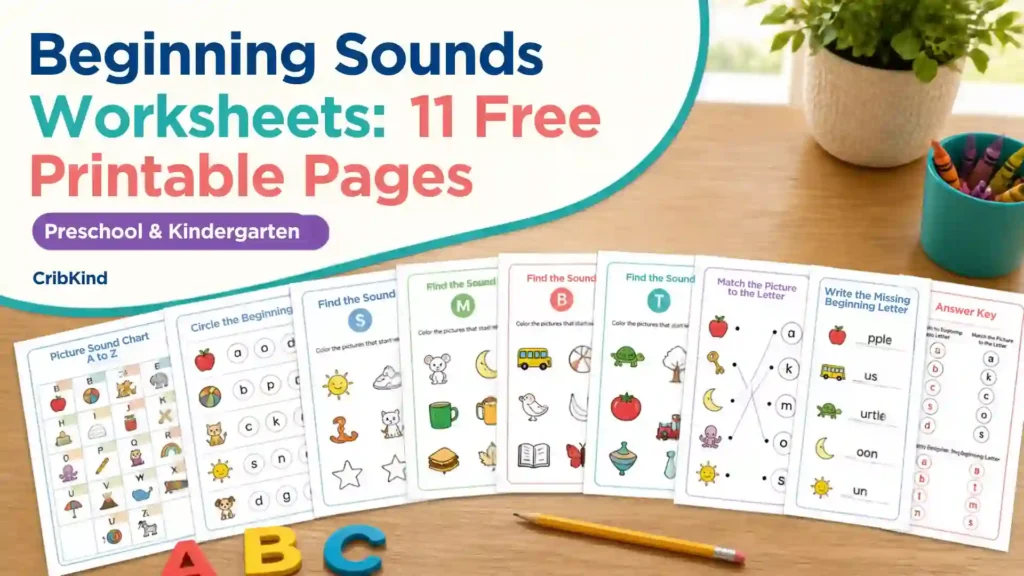
These beginning sounds worksheets give your child 11 free printable pages for practicing the first sound in a word, from preschool through kindergarten. The pack opens with a picture sound chart for A to Z, then moves to letter circling, four sound hunts, a matching page and a writing page. A one page answer key sits at the back for the grown up. Print the whole PDF or only the pages your child needs, and use the short teaching steps below so you are not guessing how to say each sound.
What is in this pack of beginning sounds worksheets
These beginning sound worksheets all use pictures, so a child who cannot read yet can still do the work. The pages get a little harder as you go. Ages are a guide, and you can move a child up or down.
| Page | Worksheet | Age | What your child does |
|---|---|---|---|
| 2 | Picture Sound Chart | 4 to 6 | Looks at one picture for every letter, A to Z |
| 3 to 6 | Circle the Beginning Letter | 4 to 6 | Circles the letter that starts each picture, 6 to 8 pictures a page |
| 7 | Find the Sound: Ss | 4 to 6 | Colors the pictures that start with /s/ |
| 8 | Find the Sound: Mm | 4 to 6 | Colors the pictures that start with /m/ |
| 9 | Find the Sound: Bb | 5 to 6 | Colors the pictures that start with /b/ |
| 10 | Find the Sound: Tt | 5 to 6 | Colors the pictures that start with /t/ |
| 11 | Match the Picture to the Letter | 5 to 6 | Draws a line from 8 pictures to their letters |
| 12 | Write the Beginning Letter | 5 to 6 | Writes the missing first letter of 8 words |
What beginning sounds are and how to teach them at home
A beginning sound is the first sound you hear in a spoken word. Reading Rockets, a well known literacy site, describes this wider skill as the ability to hear, recognize and play with the individual sounds in spoken words. It is about listening, not about seeing letters, which is why a child can practice it in the car or at dinner.
Here is a simple way to run any page in this pack.
- Say the picture’s name out loud. Let your child say it too. If your child is not sure what a picture is, just tell them the word.
- Stretch the first sound. Say ssssun, not sun. Then say just the sound, /s/, short and clean.
- Say the sound, not the letter name. For the letter m, say /m/, the sound you make with closed lips. Skip the extra vowel, so it is /m/ and not “muh”.
- Then find the letter. Ask which letter says that sound. If your child guesses wrong, say the sound again and point to the chart on page 2.
Start with sounds you can hold, like /m/, /s/ and /f/. These are called continuous sounds, and they are easier to hear than short stop sounds like /b/, /t/ and /p/. The sound hunts in this pack follow that order, with /s/ and /m/ first and /b/ and /t/ last.
Letter sounds worksheets: the picture chart and the circling pages
The picture chart on page 2 is the most useful of the letter sounds worksheets in this pack. It shows one picture for each letter, such as apple for A, bus for B and zebra for Z. Keep the chart on the table while your child works on the other pages, and tape a copy to the fridge. Think of the chart and the circling pages as letter sounds printables that a child can finish with just a pencil.
Pages 3 to 6 follow the alphabet in four groups: A to F, G to L, M to R and S to Z. Each row has one picture and three letters. Your child says the picture’s name, listens for the first sound and circles the matching letter. The two wrong letters are chosen so they never sound like the right one, so a child is never asked to choose between c and k, or between s and z.
The vowels use their short sounds: apple, egg, igloo, octopus and umbrella. If your child says “I” for igloo, that is the letter name. Gently say the short sound, /i/, and try again.
Find the sound pages: s, m, b and t
Pages 7 to 10 are four sound hunts. Each page has eight pictures, and four of them start with the target sound. Your child names every picture, says the first sound and colors the box under the ones that match. At the bottom there is a row of big letters to trace and two lines to write on.
I picked these four letters on purpose. The S and M pages use sounds you can hold, so they are the gentlest start. The B and T pages use stop sounds, which are quicker and harder to hear. Do the pages in order. If a child mixes up the sounds on page 9, go back to page 7 for a few days.
Match and write pages for beginning sounds worksheets for kindergarten
The last two worksheet pages are the hardest, so they suit older preschoolers and kindergarteners. On the match page (page 11) your child draws a line from each of eight pictures to the letter that makes its first sound. Use a pencil, so a wrong line can be erased.
On the write page (page 12) each picture comes with the end of its word, such as un for sun. Your child says the whole word, hears the first sound and writes the missing letter in the box. Accept any wobbly letter that you can read. If you want more practice with letter shapes, see our letter tracing worksheets.
A simple week with these printables
You do not need to finish the pack in a hurry. Here is one easy way to spread it out.
- Day 1: Read the chart on page 2 together and say each word.
- Day 2: Do the circling page for A to F.
- Day 3: Do the Ss sound hunt and trace the letters.
- Day 4: Do the Mm sound hunt, or the next circling page.
- Day 5: Play I spy, described below, and skip the paper.
For a game that needs no printing, play I spy with sounds. Say “I spy something that starts with /k/” and let your child look around the room. A sound scavenger hunt works too, where your child brings you three things that start with /b/. If your child is still learning the letters themselves, our alphabet coloring pages are a gentle place to begin, and our list of worksheets for preschoolers has more ideas for ages 3 to 5.
Tricky letters: c, k, x, q and i
A few letters trip up children, and the pack handles them in a plain way. The letters c and k often make the same /k/ sound, as in cat and key, so both appear on the chart for that reason. Then there is x, which is rare at the start of English words. The xylophone on the chart starts with a /z/ sound, so tell your child that x is a sneaky letter.
Igloo and quilt are drawn in code because a clear picture was hard to find for them. If your child cannot see what the picture is, just tell them the word. The point is to hear the first sound, not to guess the picture.
How to print these beginning sounds worksheets free
The pages are US Letter size, 8.5 by 11 inches. In your printer settings, choose actual size or 100 percent so the pictures and boxes stay the right size. Standard paper and a black and white setting work for most pages, but color ink makes the pictures easier to tell apart. Print pages 2 to 12 for your child and keep page 13, the answer key, for yourself.
To use a page again, slide it into a clear sleeve and write with a dry erase marker. This beginning sounds worksheets pdf is free for home and classroom use. Please do not sell the file or post it on another site.
Free download: Get all 11 beginning sounds pages and the answer key as one PDF
Frequently asked questions about beginning sounds worksheets
Are these beginning sounds worksheets free?
Yes. The pack is a free PDF, and there is no email step. Print as many copies as you need for your family or classroom, but please do not sell the file or repost it.
What age are these worksheets for?
They are made for ages 4 to 6, from preschool through kindergarten. The first pages use only a picture and a letter choice, so a child who is just starting can still join in. Move a child up or down if a page feels too easy or too hard.
What is the difference between a beginning sound and a letter name?
A letter name is what you say when you recite the alphabet, such as “em”. A beginning sound is what you hear at the start of a word, such as /m/ in moon. Children match the two, which is why every page here asks for the sound first.
Is there an answer key for the pack?
Yes. Page 13 lists the answers for every page, plus a note about the tricky letters. Keep it for the grown up so a child can check afterward.
Why do some pictures start with a different letter than I expected?
A few words begin with a sound that is not the letter’s usual one. The xylophone starts with /z/, and the letters c and k can make the same sound. The key explains each case, so you can talk about it with your child.
Which beginning sounds should we practice first?
Begin with sounds you can hold, such as /m/, /s/ and /f/. Move to stop sounds like /b/, /t/ and /p/ after that. The sound hunts in the pack follow this order.
Can I use these pages in a classroom or tutoring group?
Yes. Print a set for each child, or slide a page into a clear sleeve and use dry erase markers so the same page can be reused. The answer key page is for the teacher.
Print a page or two tonight and say the picture names out loud together. A few minutes of listening for first sounds does more than a long worksheet session, and the rest of the pack will wait in the PDF.
Saidesh is a dad of two, Eeshan and Vihaan, writing about what he actually tried, tested, and learned the hard way. CribKind covers baby development, sensory play, and real parenting for the first two years.