
Brain Development Toys for 1 Year Old
I started filming Vihaan every week at 11 months, 2 weeks, because I couldn’t tell if the brain development toys for 1 year old I’d bought were actually doing anything or if he was just growing up regardless. Eight weeks of clips later, the answer was obvious: the toy mattered more than the week. The stacking cups he’d ignored were suddenly the thing he reached for first, and the shape sorter I’d bought too early finally got its first real attempt. Circle in. Four tries. Landed it.
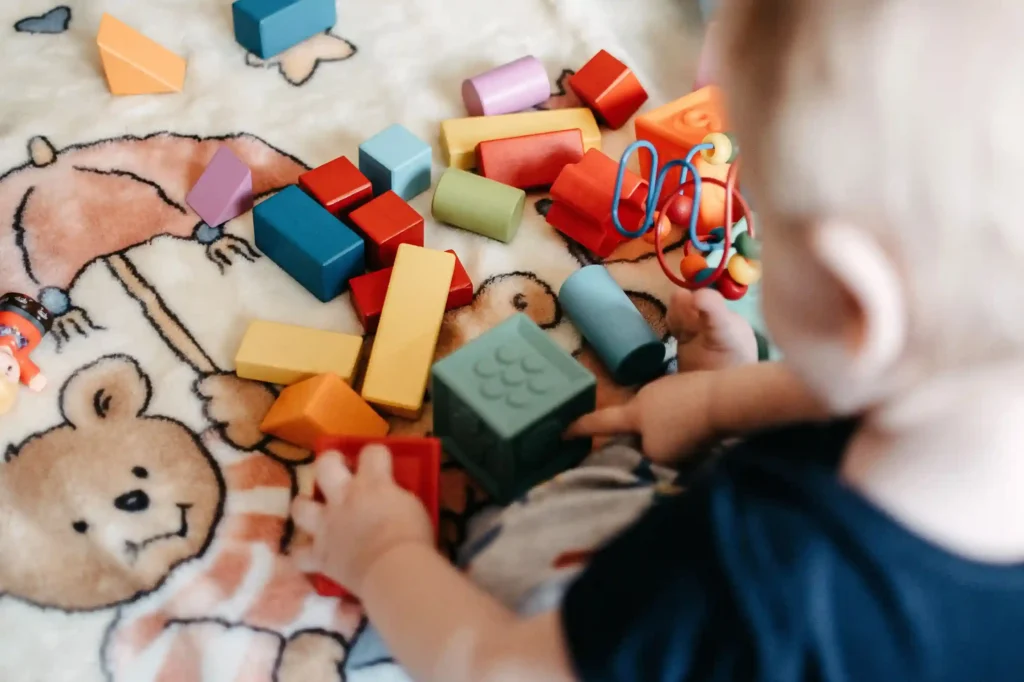
Why toy timing matters more than toy type
I bought a shape sorter for Vihaan at 10 months. He carried it around, banged it on the floor, and occasionally tried to eat the star piece. Exactly three weeks later, he sat down with it and slid the circle in on the first try. Same toy. Different brain.
According to the CDC, 12 month olds are developing object permanence, understanding that actions have effects, and learning to solve small problems, all at once, in a compressed window. The developmental leap between 10 months and 13 months is one of the steepest in the entire first five years. A toy that bores them this week can become the thing they won’t put down in two weeks. I’d come back to a “failed” toy and give it another week before writing it off.
I stopped asking “is this a good toy” and started asking “is this the right toy for this month.” Small difference on paper. Huge in practice. Vihaan’s shape sorter wasn’t a failure at 10 months. It was just three weeks early.
The developmental toys for 1 year old that consistently held both my boys’ attention shared three things: they had one clear action (push this, drop that, pull here), they gave immediate feedback (sound, movement, or a visual change), and they didn’t require my help to work. Independence at this age isn’t stubbornness. It’s exactly what their brain is practicing.
Sensory toys for 1 year olds: what the research actually says
Eeshan went through a phase at 12 months where he would squeeze the same silicone fruit toy for 20 minutes straight. I thought it was a nervous habit. Turns out it was sensory integration, his brain mapping tactile input and building the neural pathways that would later connect to fine motor control.
The AAP notes that sensory play in the first two years directly support language development, motor coordination, and emotional regulation. Not just “enrichment.” Actual structural brain development.
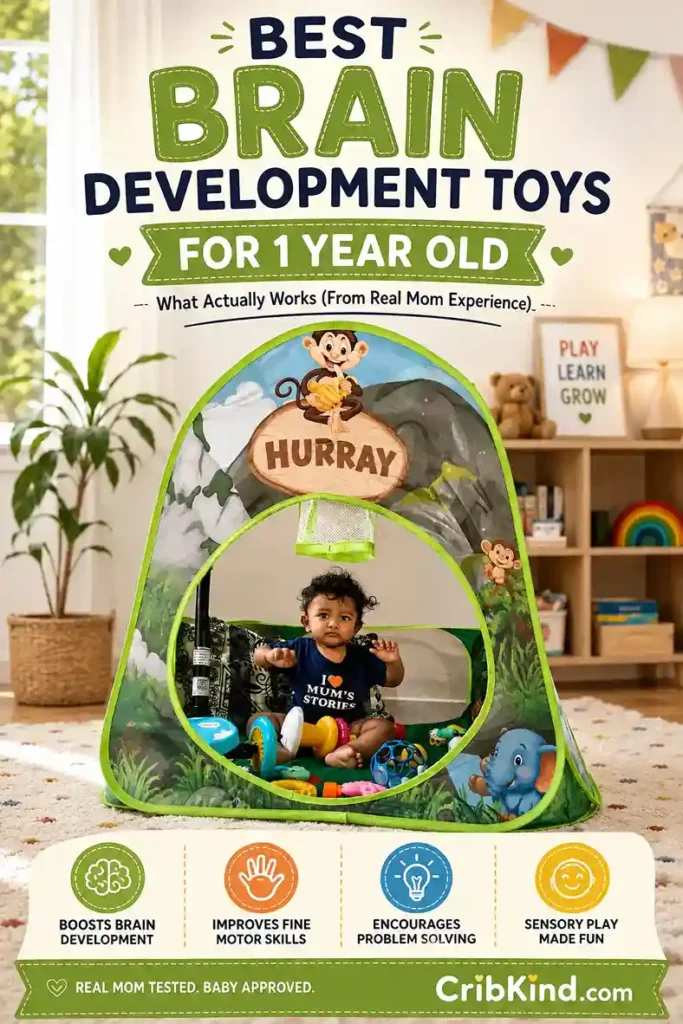
Sensory toys for infants and young toddlers don’t need to be complicated. The ones that worked best for us fell into four categories:
- Texture toys: Soft books with crinkle pages, bumpy silicone teethers, fabric blocks with different surfaces on each side. Vihaan’s favorite had a mirror panel. He’d stare at it and babble, which turned out to be him learning to recognize himself around 12 months.
- Sound toys: Shakers, musical toys for 1 year old that respond to touch, and the classic egg shaker Eeshan dragged everywhere at 13 months. Not all musical toys for 1 year old are equal. Ones with a delay between the action and the sound confused both boys. Immediate response only at this age.
- Water and sensory play: A plastic bin and a cup. That’s it. Hours of sensory input, zero batteries. We did this on the porch from about 11 months onward. Outdoor play for a 1 year old doesn’t need a price tag.
- Resistance toys: Things to push, pull, or squeeze. Walking toys for 1 year olds, especially push walkers, belong here. The physical effort of pushing something that moves but resists is doing motor and cognitive work simultaneously.
- Baby tent:
For a full breakdown of what worked before 12 months, see our guide to sensory toys for infants 0 to 12 months; that’s where the under 10 month window gets covered in detail.
The age breakdown: 10 months vs 12 months vs 15 months
The difference between toys for a 10 month old and toys for a 15 month old is bigger than most toy labels acknowledge. Most boxes say “6 to 18 months” and call it done. That range covers three completely different developmental stages.
Here’s what we actually observed across both boys, backed up by what the research describes:
| Age window | What the brain is doing | Best toy types | What we used |
|---|---|---|---|
| 10 to 11 months | Object permanence solidifying, pincer grasp developing, beginning to understand that actions have repeatable effects | Toys that pop up, soft stacking rings, sensory balls, simple toys that respond when you press or pull them | Infantino squeeze and teethe set, plastic stacking rings. Vihaan carried the green ring for 3 weeks straight. |
| 12 to 13 months | Solving problems starts to click, walking begins for many babies, sequences with two steps become possible, recognizing themselves starts to emerge | Shape sorters, push walkers, stacking cups, mirrors, simple wooden puzzle with knobs | Melissa and Doug shape sorter, HABA push walker. Eeshan pushed it across the living room at 13 months and looked back to see if we’d noticed. |
| 14 to 15 months | Imitation learning accelerates, sustained attention grows to 3 to 5 minutes, pretend play begins, building starts to make sense | Pretend play sets, building toys for 1 year olds, toys you ride on, outdoor play equipment | A toy phone and 4 wooden blocks. Vihaan at 15 months would stack two blocks, knock them over, and start again. He did this for 18 minutes. I counted. |
The 15 month old toys window is where interactive toys for 1 year olds start paying off visibly. Before 14 months, interaction is mostly solo exploration. After it, they start watching you play and copying. That shift is worth knowing before you buy.
Push walkers and walking toys: what actually works
Eeshan learned to walk at 12 months, 3 weeks. Vihaan was 13 months, 1 week. Both used a push walker in the weeks before it happened, and both abandoned it the week they started walking independently. Which is fine. That’s exactly what it’s for.
Walking toys for 1 year olds work best when they offer real resistance. A toy that skids across the floor at the first push teaches nothing. It gives no useful feedback about balance. Walkers with adjustable resistance, or heavier wooden models, held attention longer and genuinely helped. The VTech Sit to Stand Learning Walker was the one Vihaan used most (check current price on Amazon). It stayed in front of him for about five weeks before he didn’t need it anymore.
One thing I’d push back on: not every 1 year old needs a push walker to learn to walk. Eeshan used a laundry basket. He pushed it down the hallway, fell once, got up, and kept going. The goal is learning to balance, not the specific toy. Keep that in mind before spending $40.
After they’re walking, a rocking horse for a 1 year old that converts to a toy you can ride spans both phases decently. We had a basic wooden one Eeshan used from 12 months to about 20 months.
Do boys need different toys than girls
A lot of parents search specifically for toys for one year old boy, and I get why. Marketers have spent decades sorting the toy aisle by color. But the developmental needs of a 1 year old boy and a 1 year old girl are essentially identical at this age. The research doesn’t support different toy types by sex at 12 months.
What does differ slightly is temperament, and that comes down to the child, not their sex. Vihaan wanted everything louder, faster, and more resistant. Eeshan was methodical, happy to spend 10 minutes with the same puzzle piece. Educational toys for 1 year old boys, girls, or any baby are effective based on how they match that individual child’s sensory threshold, not their gender.
That said, if you’re browsing toys for one year old boy recommendations online, you’ll mostly see vehicles, tools, and construction themes. These aren’t wrong. Building toys for 1 year olds and stacking sets are equally developmental and good for any baby who shows interest in this kind of responsive play. Vihaan had a toy kitchen from 14 months. Eeshan had a toy truck. Both were equally engaged.
For how these early play patterns connect to later development, our post on fine and gross motor skills examples covers what’s actually being built during these sessions.
Outdoor toys for 1 year olds: simpler than you think
We live in an apartment. Our outdoor play for 1 year olds was a 6 foot section of balcony, a plastic bin, water, and cups. That was it for Vihaan from 11 to 18 months. The outdoor play research consistently finds that unstructured sensory environments, dirt, water, sand, grass, produce more developmental engagement per minute than structured outdoor toys for 1 year old kids.
If you do want specific outdoor toys for 1 year olds, the ones worth getting:
- A soft grippable ball (one of the best and cheapest toys for an 11 month old through age 2). Rolling and chasing a ball is gross motor work that also teaches spatial reasoning. Vihaan went through three before we found one he could actually hold at 12 months.
- A bubble machine or wand. Visual tracking, reaching, cause and effect, and genuine delight. Eeshan used ours until the motor burned out at 16 months.
- A sand and water table if you have the space. Not necessary, but if you’re outside frequently, it earns its footprint from about 12 months onward.
Skip: plastic vehicles you ride on before 18 months (most 1 year olds don’t have the leg coordination to use them properly) and anything requiring adult assembly every session. You won’t use it consistently enough to matter.
Wooden and Montessori toys for 1 year olds
I’ll be direct: I was skeptical. Wooden Montessori toys are expensive, they look simple, and a part of me thought we were paying for aesthetics. Then Eeshan at 12 months spent 25 minutes with a plain wooden shape cylinder, and I stopped questioning it.
The principle behind Montessori developmental toys for 1 year old use is straightforward: one skill per toy, feedback that tells them immediately if they got it right, no batteries or electronic rewards. The child figures it out or doesn’t, and the toy responds the same way every time. That feedback loop is exactly what brain development at this stage runs on.
Among montessori toy brands worth knowing at different price points: PlanToys for a middle price point in wooden sets, Grimm’s for stacking (expensive, but nearly indestructible), and the Melissa and Doug wooden range for a more accessible budget. We didn’t go fully fully Montessori. Plenty of plastic and toys that ran on batteries lived alongside the wooden ones. But the wooden pieces lasted longer, got used differently, and held attention in a quieter, more sustained way.
If you want to add sensory texture to this category without buying anything, our full list of sensory activities for infants has DIY options that work alongside any toy set and cost nothing.
Our real toy list: what we bought, what got used, what didn’t
This is the list I wish someone had given me before Eeshan turned one. Not aspirational. Just honest.
Used constantly: VTech Sit-to-Stand Walker, Melissa and Doug wooden shape sorter, stacking cups (the cheap set from Target, not the expensive silicone ones), a fabric crinkle book with a mirror panel inside.
Used for a season, then done: Vihaan was obsessed with a toy where farm animals popped up from 10 to 13 months, then stopped touching it completely. The rocking horse for a 1 year old phase lasted from 12 to about 18 months for both boys, then it became furniture. A set of 4 wooden blocks (see above, 18 minutes, Vihaan stacking and knocking, stacking and knocking.
Barely touched: A learning table someone gave us that ran on batteries as a gift. Both boys preferred to push it over rather than use it properly. It has a lot of buttons, plays a lot of sounds, and in retrospect I understand the problem: too many inputs, no single clear action. The 1 year old learning toys that actually worked gave them one thing to do and let them do it.
For more activities that use what you already have, the DIY busy board guide has a full setup walkthrough that’s cheap and genuinely developmental from about 14 months onward.
Frequently Asked Questions
What toys are good for a 1 year old’s brain development?
Shape sorters, push walkers, stacking cups, simple wooden puzzles, sensory balls, and cause and effect toys that pop up are the strongest options at this age. They match what a 1 year old’s brain is actively building: object permanence, understanding that actions have effects, and learning to solve small problems. The best ones have a single clear action and give immediate, consistent feedback without requiring an adult to operate them.
What developmental toys are best for a 10 month old?
At 10 months, the brain is solidifying object permanence and developing the pincer grasp. Best options are soft stacking rings, sensory texture toys, simple toys that pop up and respond right away, and crinkle fabric books. Avoid toys with too many steps. A 10 month old needs one clear action per toy, immediate sensory feedback, and nothing that requires adult operation to produce a result.
When should I introduce a shape sorter?
Most babies are ready for a basic shape sorter between 12 and 15 months, though interest often arrives before ability. Introduce it early without pressure. Let them explore it as a physical object first, and figuring it out comes naturally when the brain is ready. Vihaan showed interest at 10 months and didn’t succeed consistently until 13 months. Three weeks of “failing” first was normal.
Are wooden Montessori toys actually better for brain development?
Not categorically better, but the design principles support brain development well at this age: one skill per toy, feedback that tells them immediately if they got it right, no electronic rewards. What Montessori toys do particularly well is remove distraction. No lights, no sounds, just the task. Whether that’s worth the price depends on your budget. A $4 stacking cup set works on the same principles and does the same developmental work.
How long should a 1 year old play with one toy before I switch it?
A 1 year old’s sustained attention runs roughly 2 to 5 minutes per activity. If they’re returning to the same toy across multiple sessions, that’s a good sign. If it’s been untouched for a full week, try a different toy type, not necessarily a different toy entirely. We kept a rotating basket of 4 toys and swapped every 10 days. Having fewer choices out at once extends engagement more than adding new toys.
Do boys and girls need different developmental toys at age 1?
No. Developmental needs are essentially identical at 12 months regardless of gender. What differs is individual temperament: sensory threshold, activity level, attention style. Match the toy to the child in front of you, not the marketing on the packaging. Vihaan used a toy kitchen from 14 months. It was one of his best developmental toys that year.
What outdoor toys are worth buying for a 1 year old?
A soft grippable ball, a bubble wand or machine, and a simple water play container cover most of the developmental bases outdoors at this age. Vehicles you ride on work better after 18 months when leg coordination catches up. Unstructured outdoor sensory play (sand, water, grass) produces more developmental engagement per minute than most outdoor toys for 1 year olds, and it costs nothing.



3 Comments