Kindergarten Math Worksheets
If your child can count to ten out loud but loses track once the apples are scattered across a page, the gap is often matching one number to one object, not counting itself. That is why the first two of these kindergarten math worksheets put every object in its own tidy row, and why the set then builds toward comparing, adding, subtracting and shapes. There are 19 free printable pages plus an answer key, all on plain letter paper, so you can print only what your child needs this week.
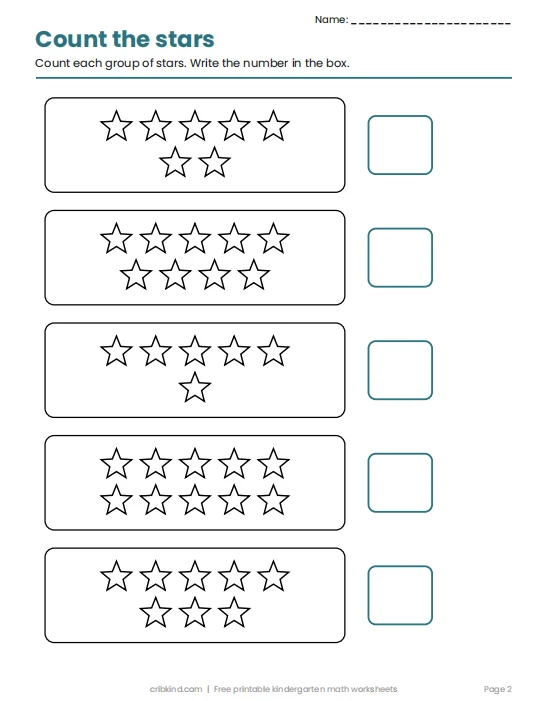
Each page is letter size (8.5 by 11 inches) with big boxes for writing, so a pencil or a chunky crayon both work. Print at 100 percent scale on regular paper, and make as many copies as you need for your own family or classroom.
What kindergarten math worksheets should cover
Most US kindergarten math programs, including the Common Core standards many states build on, center on the same few ideas: counting, comparing numbers, simple adding and subtracting with small numbers, and recognizing shapes. I built the pages in that order, so each group leans on the one before it. A child who can count five apples reliably will find “which group has more” easy, and a child who finds that easy is ready for adding two small groups together.
These math worksheets for kindergarten are for ages 5 to 6, which is older than most CribKind readers. If a younger sibling is hanging around, Vihaan would probably want a pencil too, and I would hand him a crayon and a scrap of paper rather than a worksheet. Under age 3, blocks, stairs and counting songs do the same job without a page in sight.
| Page group | Pages | Skill practiced | Good first page |
|---|---|---|---|
| Counting and tracing | 1 to 5 | Counting objects, writing numbers 1 to 10 | Page 1 |
| Comparing and number order | 6 to 10 | More and fewer, missing numbers, ten frames, counting to 20 | Page 8 |
| Addition and subtraction | 11 to 15 | Adding and subtracting within 10 | Page 11 |
| Shapes, patterns and measuring | 16 to 19 | Naming shapes, patterns, graphs, longer and shorter | Page 16 |
Counting and number tracing worksheets
Counting is where every other page starts, and it is where most math worksheets kindergarten teachers send home begin too, so these five come first. Each group of pictures sits inside its own box, which gives a child a place to point and a clear edge to stop at. Eeshan would probably count with his finger on every apple and lose the thread at six, and a finger on the page is exactly right at this age. If the pencil is the hard part, our list of fine and gross motor skills examples has easy hand strength games to play first.
- Count the apples. Five boxes hold groups of one to five apples, and your child writes each total in a box beside it.
- Count the stars. The same idea with six to ten stars, laid out in two rows so nothing is crowded. Counting row by row is a trick worth teaching early.
- Trace the numbers 1 to 5. Each number is dotted twice for tracing, then there is an empty box for writing it alone. A small group of dots sits at the side so the number and the amount stay together. Start each number at the top.
- Trace the numbers 6 to 10. The same layout, with the bigger numbers that tend to get written backward.
- Match the number to the dots. Numbers 1 to 5 are on the left, shuffled groups of dots are on the right, and your child draws a line between each pair.
Comparing and number order worksheets
Once counting is steady, these five ask a child to think about numbers instead of just saying them. Which group has more, which has fewer, and what number is missing from the line are the questions behind most early math. Page 9 uses ten frames, the two row grids teachers lean on because a child can see how close a number is to ten at a glance. A tired child tends to rush these pages, so I would print one at a time. Vihaan would probably finish the missing numbers page fast and then claim the pencil for the rest of the day.
- Which group has more? Four pairs of groups, and your child circles the bigger one in each pair. Hearts, flowers, balloons and apples keep it varied.
- Which group has fewer? The same four pairs, flipped to ask for the smaller group, which trips up more children than you might expect. The question changes but the counting does not.
- Fill in the missing numbers. Five rows run from 1 to 10 with different boxes left empty, so a child cannot just copy the pattern from the row above. Counting out loud helps.
- Ten frames. Six frames are labeled 3, 6, 8, 5, 10 and 7, and your child colors that many squares. A good page for a crayon.
- Count to 20. Numbers 11 to 20 with gaps to fill, and the last two rows run backward from 20, which is harder than it looks.
Addition and subtraction worksheets
Here the pages move from “how many” to “how many altogether” and “how many left”. The first and the fourth are picture based, so a child can count the pictures instead of holding numbers in their head. By the time the plain number sentences arrive on pages 12 and 15, there are rows of small dots to count if a child needs them. Eeshan would probably prefer the pages with pictures and ask why the others look so plain. That is a fair question, and I would answer it by sliding the dots over. For a quick follow up with the same skills, the rainy day activities for kids include simple counting games.
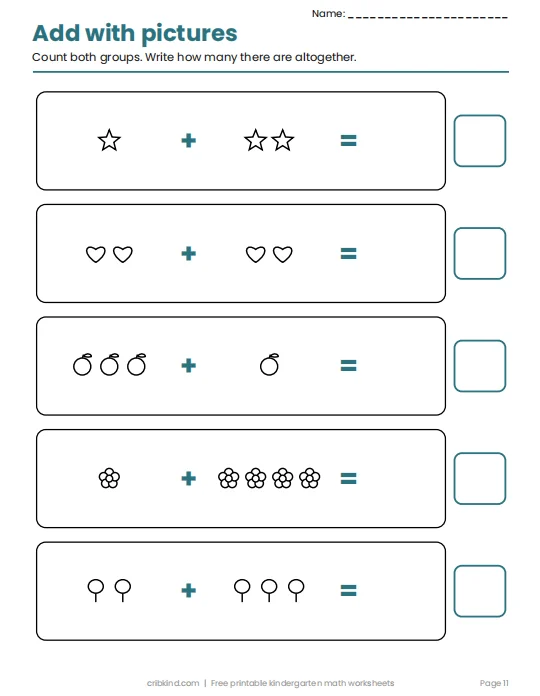
- Add with pictures. Five problems show two small groups with a plus sign between them, and the totals never go above five.
- Add within 10. Eight number sentences such as 4 + 3 and 2 + 8, each with a row of ten small circles to count on.
- Make 10. Six ten frames are partly filled with dots. Your child draws the missing dots to fill each frame, then writes how many were added. It is the most useful page in the set for later math, and it is easy to skip.
- Subtract with pictures. A group of objects with a problem beside it, such as 5 minus 2. Your child crosses out the ones taken away and writes what is left.
- Subtract within 10. Eight plain number sentences with a dotted box under each one for drawing dots or tally marks.
Shapes, patterns and measuring worksheets
These last four step away from numbers and toward noticing. Page 16 asks a child to color by shape and then count each kind, which combines two skills in one sitting. Patterns follow, then a simple graph, then a page about longer and shorter. Some kindergarten worksheets math packs mix several skills on one page, which can overwhelm a beginner, so each page here practices one idea. They tend to feel like play after the number pages, so they make a good reward. If your child loves them, the back to school checklist for parents has more ideas for the first weeks of the year.
- Color the shapes. Circles, squares, triangles and rectangles are scattered on the page, and a legend says which color goes with which shape. Under it, your child counts each shape and writes the number.
- What comes next? Five shape patterns, and your child draws the next two shapes in the empty boxes. The first row is the easy circle and square pattern.
- Count and graph. Eighteen pictures are mixed in one box. Your child counts each kind and colors that many squares in a bar graph, then says which picture appears the most. A graph is a big idea for a five year old, and this one stays simple.
- Longer or shorter? Six pairs of pencils, and each question asks for either the longer one or the shorter one.
How to print and use the answer key
Free download: Get all 19 kindergarten math worksheets and the answer key as one PDF
Print only the pages you plan to use that day, one or two at a time. Start with page 1, and move on only when your child can count to five without help, because everything after it assumes that. If a page feels hard, go back one page rather than pushing ahead, and nobody is hurt by repeating page 1 three times. Page 20 is the answer key, so print it once and keep it away from the table. If you want a calm sight word break between math pages, our sight words flash cards guide fits the same age.
Keep each session short. A pencil with a good eraser helps, since a child who fears mistakes slows down. I would sit beside the child for the first page and then step back, answering questions instead of correcting answers. Check the work together afterward with the key, and let your child be the one who marks a wrong answer. Eeshan would probably enjoy being the person with the answer key far more than doing the page.
Safe practice with pencils and young siblings
Pencils are fine for a kindergartner, but a short stub is hard to grip. Use a full length pencil with an eraser, and sharpen it before you start rather than in the middle of a page. Wash hands afterward, especially if crayons were also out.
Frequently asked questions about kindergarten math worksheets
What math should a kindergartener know?
Most kindergarten programs focus on counting objects, comparing groups, writing numbers to 10, adding and subtracting within 10, and naming basic shapes. These worksheets follow that order, but your child’s school sets the exact goals.
Where can I find kindergarten math worksheets free?
This post has 19 kindergarten math worksheets free to print, plus an answer key. Download the PDF with the button near the top and print as many copies as you need.
Do these math worksheets for kindergarten include answers?
Yes. Page 20 is an answer key for pages 1 to 19, so you can check your child’s work together. The tracing pages have no answers to check, only numbers to form.
How many worksheets should a kindergartener do in a day?
One or two is plenty for most children, and five to ten minutes per page is a reasonable plan. Stop when your child is tired, since frustration teaches less than a short, easy page.
Can a preschooler use these preschool math worksheets?
A child who is nearly five and counts steadily may be ready for pages 1 to 5. Younger children usually learn more from blocks, songs and counting real objects than from a worksheet.
What if my child gets the answers wrong?
Go back one page and try again another day. Count the pictures together with a finger on each one, and let your child find the mistake using the answer key.
If I were setting up the first page for Eeshan or Vihaan, I would print page 1, hand over a sharp pencil, and count the first apple out loud myself. Then I would let the pencil do the work and keep my mouth shut until the last box was filled. The other pages can wait in the folder for another day.