4th Grade Math Worksheets
Fourth grade is where math starts to feel like real work. Numbers get bigger, long division shows up, and fractions stop being only pictures. These 4th grade math worksheets give you 18 free printable pages and an answer key, in an order where each skill leans on the one before. I would print the times tables review first, because almost every page after it needs a multiplication fact. Vihaan would probably ask why 12 times 7 is the one fact that never sticks.
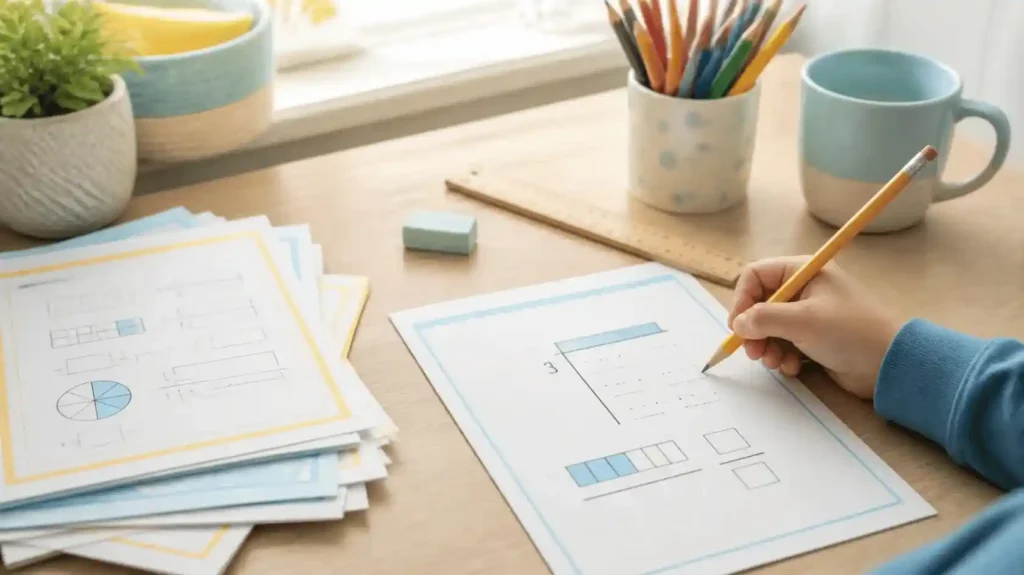
Each page is letter size (8.5 by 11 inches) with roomy boxes and blank space for showing work, so a regular pencil works fine. Print at 100 percent scale on plain paper. These printable 4th grade math worksheets are for home or classroom use, so make as many copies as you need.
What 4th grade math worksheets should cover
Most US fourth grade programs, including the Common Core standards many states build on, spend the year on a handful of big ideas. Children multiply and divide larger whole numbers, work with factors and multiples, round big numbers, and compare fractions. They also add and subtract fractions with matching bottoms, meet decimals through tenths, and measure angles, area and perimeter. I built the pages in that order, so the times tables come before long division and fractions come before decimals. If you searched for math worksheets for 4th grade and your child is shaky on the basics, our 3rd grade math worksheets are a good step back.
This set is written for ages 9 to 10, which is well past most CribKind readers. If a younger brother is hanging around the table, Eeshan would probably want a pencil too, and I would hand him a crayon and a scrap of paper. For children under 3, stacking blocks and counting stairs do the same job without a page in sight.
| Page group | Pages | Skill practiced | Good first page |
|---|---|---|---|
| Multiplication | 1 to 5 | Times tables review, multiplying by 10 and 100, 2 digit and 3 digit times 1 digit, 2 digit times 2 digit | Page 1 |
| Division, factors and multiples | 6 to 9 | Division with remainders, long division, factors, multiples | Page 6 |
| Big numbers | 10 to 12 | Rounding to 1,000 and 10,000, adding and subtracting big numbers, comparing big numbers | Page 10 |
| Fractions and decimals | 13 to 15 | Equivalent fractions, adding and subtracting fractions, tenths as decimals | Page 13 |
| Geometry and word problems | 16 to 18 | Area, perimeter, angles, multi step word problems | Page 16 |
Multiplication worksheets and times tables
Multiplication gets five of the eighteen pages, because the rest of the year leans on it. Page 1 is a warm up with facts up to 12 times 12, and page 2 shows the zero pattern behind multiplying by 10 and 100. Pages 3 and 4 multiply by a single digit, and page 5 asks for two digit times two digit, the biggest jump in the set. Our rainy day activities for kids are handy for a break between pages. Eeshan would probably sail through page 2 and then slow down when he reaches the carries on page 4.
- Times tables review. Twelve facts from 6 times 7 up to 12 times 6, mixed so the order gives nothing away. Skip counting out loud helps with the stubborn ones.
- Multiply by 10 and 100. Twelve problems such as 23 times 10 and 75 times 100, where the zeros just move over.
- 2 digit times 1 digit. Twelve stacked problems such as 36 times 5 and 94 times 3. Your child multiplies the ones first, carries, and then does the tens, which is the habit the next pages depend on.
- 3 digit times 1 digit. Nine problems in a 3 by 3 grid, from 214 times 3 to 607 times 4.
- 2 digit times 2 digit. Six problems such as 23 times 14 and 78 times 16, with a lot of blank space under each one. Your child writes the two partial products there and then adds them. Neat columns matter more here than speed.
Division, factors and multiples
I put division straight after multiplication because it is the same facts run backward. Page 6 is division with remainders, such as 17 divided by 5 equals 3 with 2 left over, and it uses two boxes so the leftover gets its own spot. Page 7 is real long division with a bracket, an answer box on top and plenty of room below for the steps. Pages 8 and 9 look at the numbers themselves, with every factor of a number on one page and the first five multiples on the other. Vihaan would probably call a factor a number that fits in evenly, which is a fine way to say it.
- Division with remainders. Twelve problems from 17 divided by 5 to 59 divided by 9. Each one leaves a remainder, so your child writes the whole number part and then the leftover.
- Long division. Six problems such as 96 divided by 3 and 252 divided by 9. Every one divides evenly, so a child can check by multiplying back. The space under each bracket is meant for the steps. Use it.
- Factors. Six numbers from 12 to 36 with a line beside each. Your child lists every factor in order, starting with 1 and ending with the number itself.
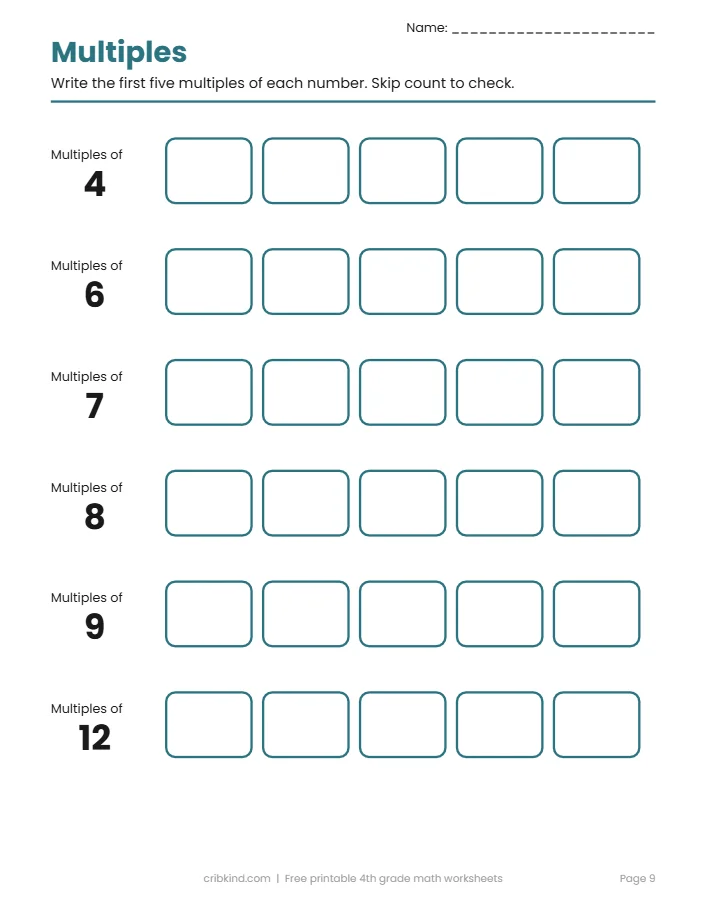
- Multiples. Six numbers, each with five boxes for its first five multiples.
Big numbers: rounding, adding and subtracting
Fourth graders work with whole numbers up to 1,000,000, which sounds big until you see that the method is the same as with small numbers. Rounding to the nearest 1,000 and 10,000 is on page 10, and halfway numbers such as 8,500 and 47,500 round up, which is the rule most classes teach. Four adding and four subtracting problems with up to five digits fill page 11, including a trade across zeros in 50,000 minus 26,314. Which of two big numbers is larger? That is the question on page 12, answered with the symbols for less than, greater than and equal to. The back to school season is a good time to check these skills, and our back to school checklist for parents has a few other things worth a look. Eeshan would probably get the first row right and then lose a trade in the second.
- Rounding big numbers. Twelve numbers in two columns, six rounded to the nearest 1,000 and six to the nearest 10,000. Numbers such as 34,999 are there on purpose, to see if your child looks at the right digit.
- Add and subtract big numbers. Eight stacked problems with commas, so your child can see the places. Line up the digits first, because a crooked column causes most of the mistakes.
- Compare big numbers. Twelve pairs, including some that look alike, such as 36,218 and 36,128, and some with different lengths, such as 9,999 and 10,001. Two pairs are equal. A child who reads from the left will do well here.
Fraction and decimal worksheets
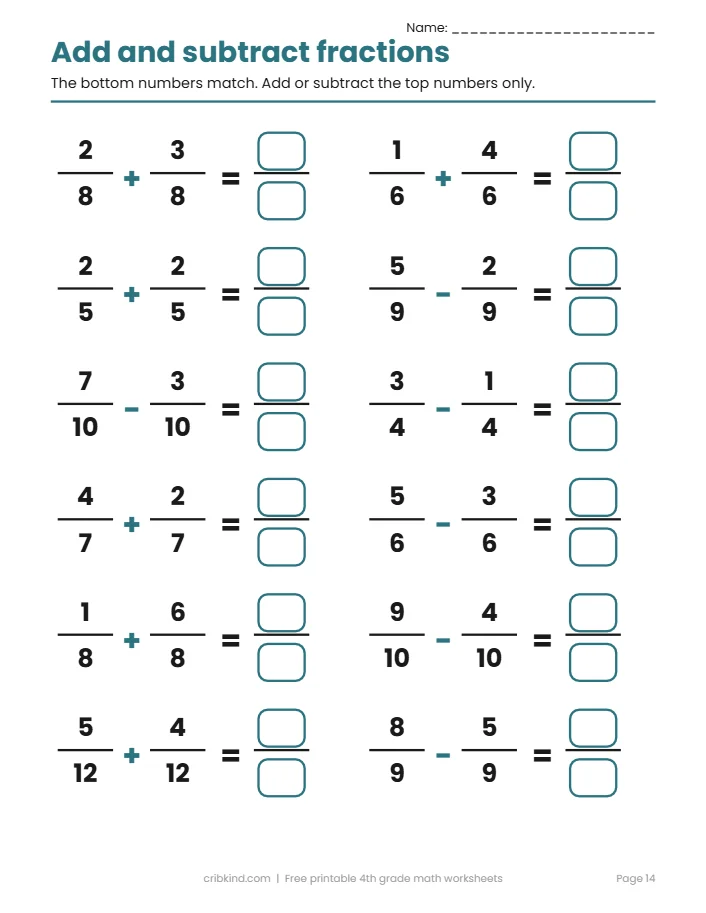
Fractions get harder in fourth grade, because the pictures start to fade. Equivalent fractions come first on page 13, so 1 half equals 3 sixths, and the missing number is sometimes on top and sometimes on the bottom. On page 14 the fractions share a bottom number, and the rule is to work on the tops only. A bar cut into ten parts links fractions to decimals on page 15, so a child sees that 3 out of 10 is also 0.3. If a child struggles to hold a pencil for longer pages, our list of fine and gross motor skills examples has easy hand strength games. Vihaan would probably want to cut a real chapati into tenths, which is a messier way to learn the same idea.
- Equivalent fractions. Twelve pairs such as 1 half and 3 sixths, or 3 fourths and 6 eighths. Your child multiplies the top and the bottom by the same number.
- Add and subtract fractions. Twelve problems such as 2 eighths plus 3 eighths and 9 tenths minus 4 tenths. The answers are not simplified, so 4 tenths is fine as it is. The key says to accept the simplified form too.
- Tenths and decimals. Six shaded bars, each cut into ten equal parts, where your child writes the fraction and the decimal for the shaded part.
Area, angles and word problems
The last three pages bring the year together. Page 16 gives six rectangles with the length and width written on them in centimeters, so your child uses the formulas for area and perimeter. Many children swap the two, which is why each has its own box and label. Page 17 shows six angles, and your child writes A for acute, R for right or O for obtuse. A corner of the page makes a handy right angle to compare against. Page 18 has six word problems that mix several operations. I would ask your child to say each one in their own words before touching a pencil. Eeshan would probably underline the numbers and then miss the question at the end.
- Area and perimeter of rectangles. Six rectangles from 8 by 5 to 10 by 8. Area is length times width, and perimeter is all four sides added up.
- Angles. Six angles to label as acute, right or obtuse. Two are right angles turned in different directions, because a right angle does not always sit flat on the page. Hold a corner of paper against each one.
- Word problems. Six problems, such as 7 boxes of 24 crayons and 5 friends sharing 23 marbles. The last one has a remainder, so your child has to decide what to do with the leftovers. A dotted box on each leaves room to show the work, and the answer box is wide enough for a short phrase. Ask your child to explain the answer back to you.
How to print and use the answer key
Parents who search for a 4th grade math worksheet usually want pages they can print tonight, and nothing here needs a login. Print only the pages you plan to use that day, one or two at a time. Begin with the group that matches what the class is doing now, and go back a page if it feels too hard. Nobody is hurt by repeating the times tables, and free 4th grade math worksheets like these cost nothing to reprint. Page 19 is the answer key, so print it once and keep it away from the table.
Keep each session short, about 15 minutes. A pencil with a good eraser helps, since a child who fears mistakes slows down. I would sit beside the child for the first page and then step back, answering questions instead of correcting answers. Check the work together with the key afterward, and let your child mark a wrong answer. For long division and the two digit multiplication page, ask to see the steps and not only the answer, because the steps show where a mistake began. Vihaan would probably enjoy holding the key far more than doing the page.
Safe practice with pencils and younger siblings
A fourth grader can handle a regular pencil, but a short stub is hard to grip. Use a full length pencil with an eraser, and sharpen it before you start instead of in the middle of a page. Wash hands afterward, especially if crayons or counters were also out. A sharp pencil point is also something to keep away from a curious sibling, so clear the table when the session ends.
Free download: Get all 18 fourth grade math worksheets and the answer key as one PDF
Frequently asked questions about 4th grade math worksheets
What math should a 4th grader know?
Most fourth grade programs focus on multiplying and dividing larger whole numbers, factors and multiples, rounding, fractions with matching bottoms, tenths as decimals, angles, and area and perimeter. These worksheets follow that order, but your child’s school sets the exact goals.
How do you do long division in 4th grade?
Long division works through the number one place at a time: divide, multiply, subtract, then bring down the next digit. Page 7 has six problems that divide evenly, with room under each bracket for the steps, and multiplying the answer back is a quick check.
What is a factor in 4th grade math?
A factor is a whole number that divides another number evenly, so the factors of 12 are 1, 2, 3, 4, 6 and 12. Your child lists every factor of six numbers on page 8.
Where can I find free 4th grade math worksheets?
This post has 18 free printable pages plus an answer key. Use the download button near the top and print as many copies as you need for home or class.
Do these worksheets include answers?
Yes. Page 19 is an answer key for pages 1 to 18, so you can check your child’s work together. The answers were generated from the same numbers used to build the pages.
How many worksheets should a 4th grader do in a day?
One or two is plenty for most children, at about 15 minutes per page. Stop when your child is tired, because frustration teaches less than a short, steady page.
If I were setting up the first page for Eeshan or Vihaan, I would print page 1, hand over a sharp pencil, and tell them to start with the 6s. Then I would keep quiet until the last box was filled and ask which fact felt trickiest. My guess is it would be 12 times 7, and I would save that one for the next day. The rest of the pages can wait in the folder.