Star coloring pages: 12 free printables sorted by age
If you need star coloring pages that a toddler can actually color, skip the busy ones with forty tiny stars and start with a single big star. A child who is just learning to scribble needs one large shape and thick lines to aim at. This set has 12 free printables, starting with one huge star for beginners and ending with a detailed star mandala for older kids and grown-ups. The thick-lined pages are the ones I’d print first for anyone under three; the mandala is for the grown-up sitting next to them.

Matching star pages to your child’s age
A star shape looks easy until you watch a small hand try to color into one of its points. Each point narrows to almost nothing, and filling that tip takes far more control than filling a circle or a square. So I sorted this set by how wide the points are, which matters more than how cute the star looks.

The CDC’s milestone checklist lists scribbling at 18 months and drawing a circle, once an adult shows how, at 3 years. Drawing a five-pointed star freehand comes a lot later than either of those. Coloring inside a printed star is a different job, though, and a 2-year-old can enjoy it as long as the star is big and the outline is thick enough to work like a soft fence.
| Age | What their hands are doing | Pages to start with |
|---|---|---|
| 18 months to 2 years | Scribbling with the whole arm, crayon held in a fist | One big star, smiling star |
| 2 to 3 years | Scribbles land inside a large shape some of the time | One big star, smiling star, shooting star |
| 3 to 4 years | Starting to aim at one area of the page | Stars in three sizes, blank stars for cutting, S is for star, Christmas star |
| 4 to 6 years | Following a simple color key | Color by number, night sky, planets and stars, real star colors |
| 7 years to adult | Fine detail and shading | Star mandala, 3D shading on any star |
Treat the ages as a loose guide. A careful 3-year-old might sit happily with the night sky page, and plenty of 5-year-olds still want the giant smiling star because it’s quick and satisfying. Put two or three pages in front of them and let them choose. Their pick will tell you more than the table can.
12 free printable star coloring pages
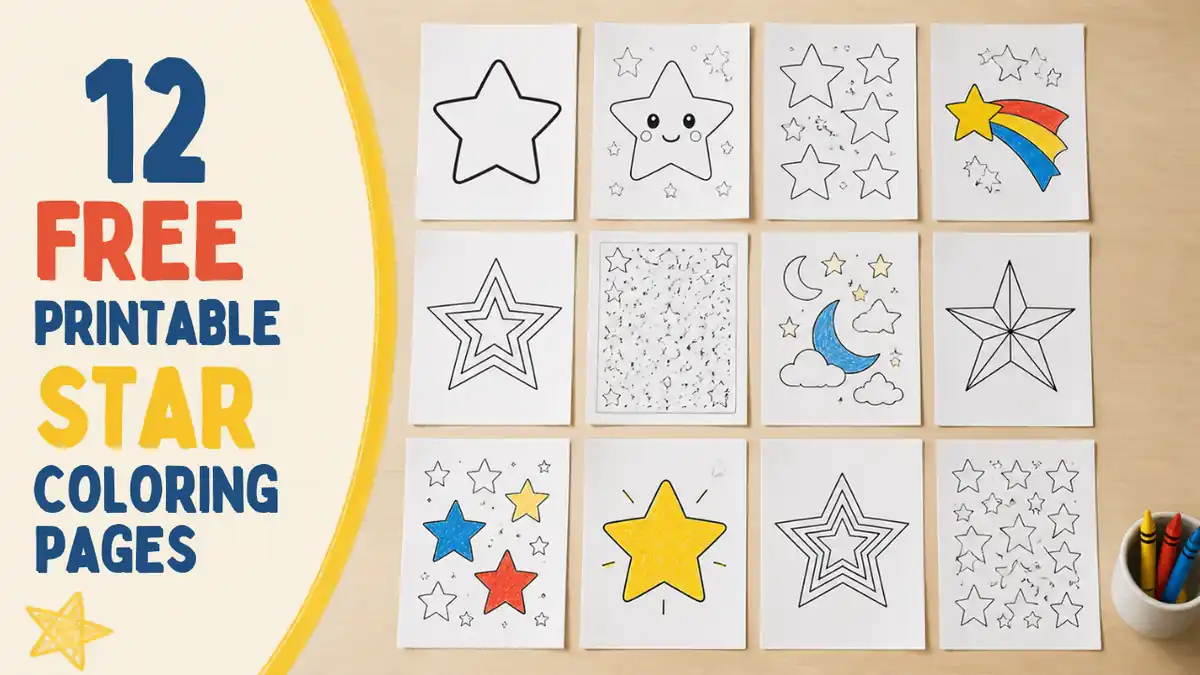
These star pictures to color all print on standard US letter paper (8.5 by 11 inches), one design per page. The full set is also in one star coloring pages PDF, so you can print everything in a single go. The outlines are boldest on the early pages, and the detail builds as the list goes on. A family with a toddler and an older sibling can print from both ends of the list at once.
1. One big star (18 months and up)
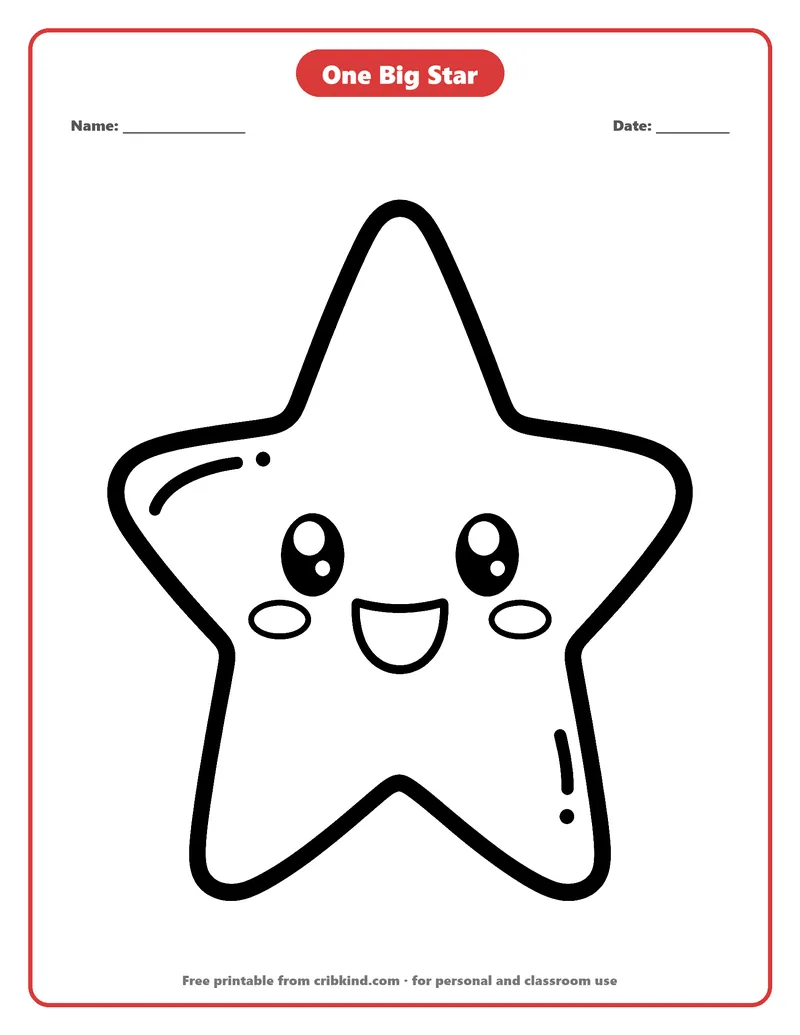
A single star fills the whole page, outlined with a line about a quarter inch thick, and nothing else is printed. That’s on purpose. A first-time scribbler gets one big target, and the wide points take a chunky crayon or a dot marker without much fuss. If you only print one large star coloring page for a toddler, make it this one.
2. Smiling star (2 years and up)
It’s the same big star, now with a round face, two eyes and rosy cheek circles. This is the cute star coloring option in the set. I think a face gives a reluctant colorer a reason to start, because suddenly there’s a character to talk about: is the star sleepy, silly or happy today?
3. Stars in three sizes (3 years and up)
Twelve stars share the page, four big, four medium and four small. It works as a sorting game (“color all the small stars yellow”) and as a printable page of stars to cut up once they’re colored. The small stars are the hardest to fill, so expect a quick scribble on those and a lot more care on the big ones.
4. Blank stars for cutting (3 years and up)
Six blank star outlines sit on this page, each inside a dotted square. Cutting into the inner corners of a star is hard with kid scissors, so younger kids can cut along the square while older ones try the points. If scissor practice is the real goal, our cut and paste worksheets are a gentler place to start.
5. S is for star (3 to 5 years)
A capital S, a lowercase s and a star sit side by side, with the word STAR in hollow letters underneath for tracing or coloring. It slots into a letter of the week plan, and the hollow letters give preschoolers a reason to slow down a little.
6. Star color by number (4 years and up)
The star is split into sections numbered 1 to 4, with a small color key at the bottom. I stopped at four colors on purpose. Past that, reading the key becomes the hard part and the coloring stops being fun. It also doubles as a simple star coloring worksheet for number recognition.
7. Shooting star (3 years and up)
Three long, curved tail lines stream out behind a single star. The tail is a wide open space for rainbow stripes, which suits kids who would rather scribble big than stay inside small shapes.
8. Christmas star (3 years and up)
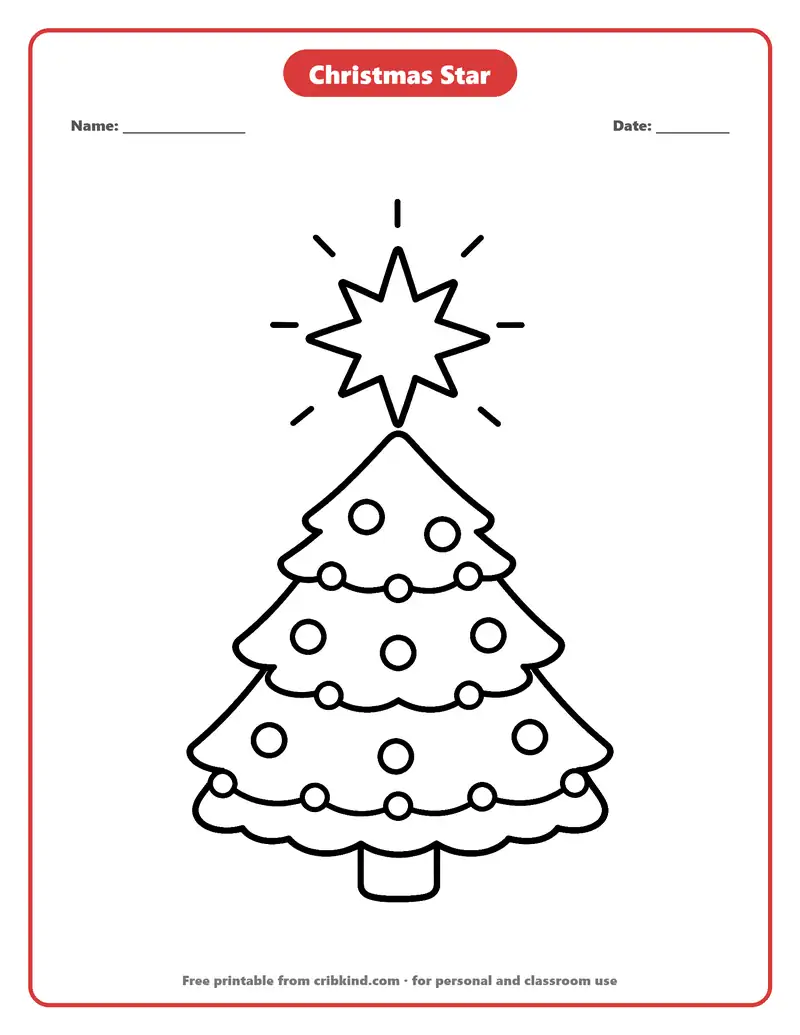
An eight-pointed star with soft rays sits above the top of a simple tree. It’s our Christmas star color page for December, and it pairs with the Christmas tree outline templates if you’d like to color the tree and the star together. Fair warning: the yellow and gold crayons will run out first.
9. Night sky with moon and stars (4 years and up)
A crescent moon, two clouds and about twenty stars of different sizes fill the page. Most kids reach straight for dark blue or black for the sky. For a 5 or 6 year old who wants a challenge, try leaving the stars white and coloring only the sky around them, which is harder than it sounds.
10. Planets and stars (5 years and up)
A ringed planet, a small round planet and a cluster of stars run across the top of the page. Of all the space pages, this one is for the kid who already knows the planet names and wants to color them in “the right colors.”
11. Real star colors (5 years and up)
Five stars sit in a row, labeled blue, white, yellow, orange and red, with the Sun marked as the yellow one. It’s half coloring page and half science lesson. The real star colors section further down explains what the labels mean.
12. Star mandala (8 years to adults)
Stars sit inside stars, ringed with petals, dots and tiny triangles. This is the fancy one, and it works as an adult coloring page as much as a kids’ page. Fine-tip markers or colored pencils suit it best, and it gives a parent something calm to color at the same table while a toddler works on page one.
Getting a toddler started with a star coloring sheet
With kids under 3, the setup matters more than the page. Tape the coloring sheet of a star to the table at all four corners with painter’s tape, because a sliding page is the fastest way to end a coloring session. Then offer two crayons, not the whole box. A big choice tends to turn into dumping crayons on the floor, which is a different activity altogether.
A fist grip is normal at this stage. Toddlers usually hold a crayon in the whole hand and color with big arm movements, and the finer finger grip comes later. Chunky crayons, egg-shaped crayons and dot markers all suit that fist. At this age a few minutes of focus counts as a win, and the page can come back out after lunch.
Don’t correct the coloring. A toddler who scribbles straight across the star and off the page is doing exactly the right thing for 18 months. Staying inside the lines is a skill for 4 and 5 year olds, and no amount of reminding at 2 brings it any sooner.
How to color a star so it looks 3D
This trick makes a flat star look folded, like a paper ornament. It works on any star in the set, and kids from about 7 can usually manage it on their own after one demonstration.
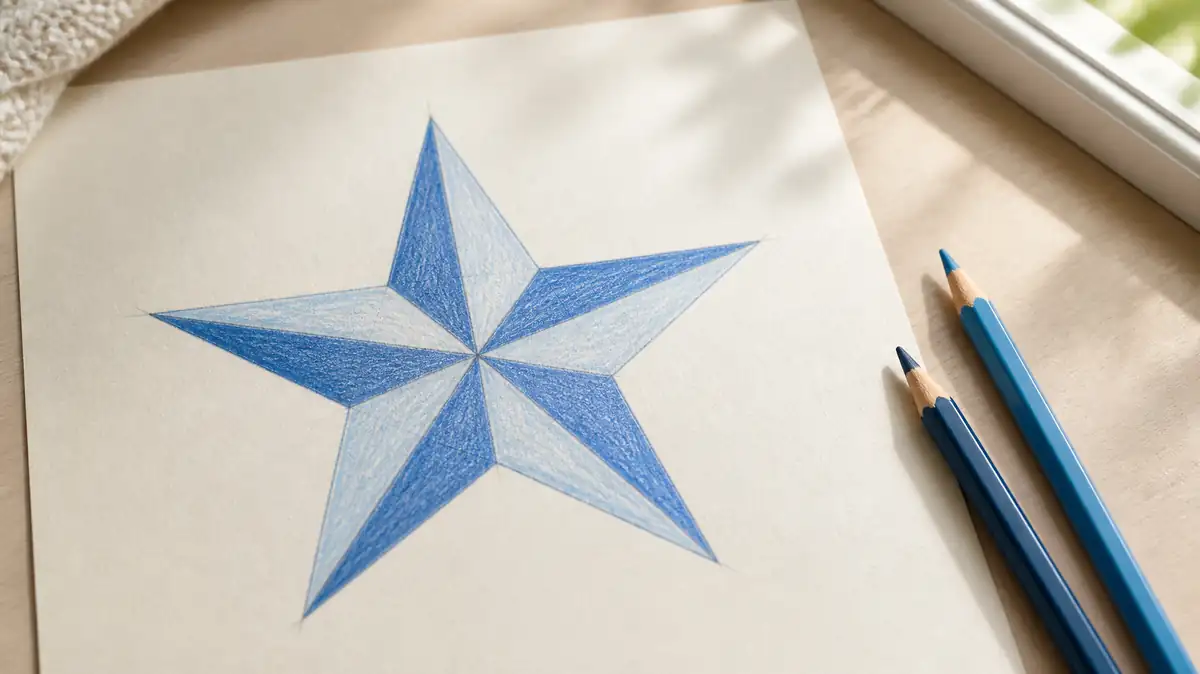
- Draw a light pencil line from the tip of each point to the center of the star.
- Draw another line from each inner corner (the dip between two points) to the center. The star now has ten skinny triangles.
- Pick one color and fill every other triangle with a light shade of it.
- Fill the rest with a darker shade of the same color, or press harder with the same crayon.
Each point now has a light side and a dark side, as if a lamp were shining on it from one direction. For younger kids, skip the pencil lines and try rainbow points instead, one color per point. Five points means five colors, and naming each one out loud as you go is half the fun.
Real star colors for a space coloring page
Stars aren’t all yellow, and that bit of science is what makes page 11 worth printing. A star’s color comes from how hot it is. According to NASA, the hottest stars glow blue or blue-white, stars like our Sun (a yellow dwarf) sit in the middle, and the coolest stars glow orange or red.
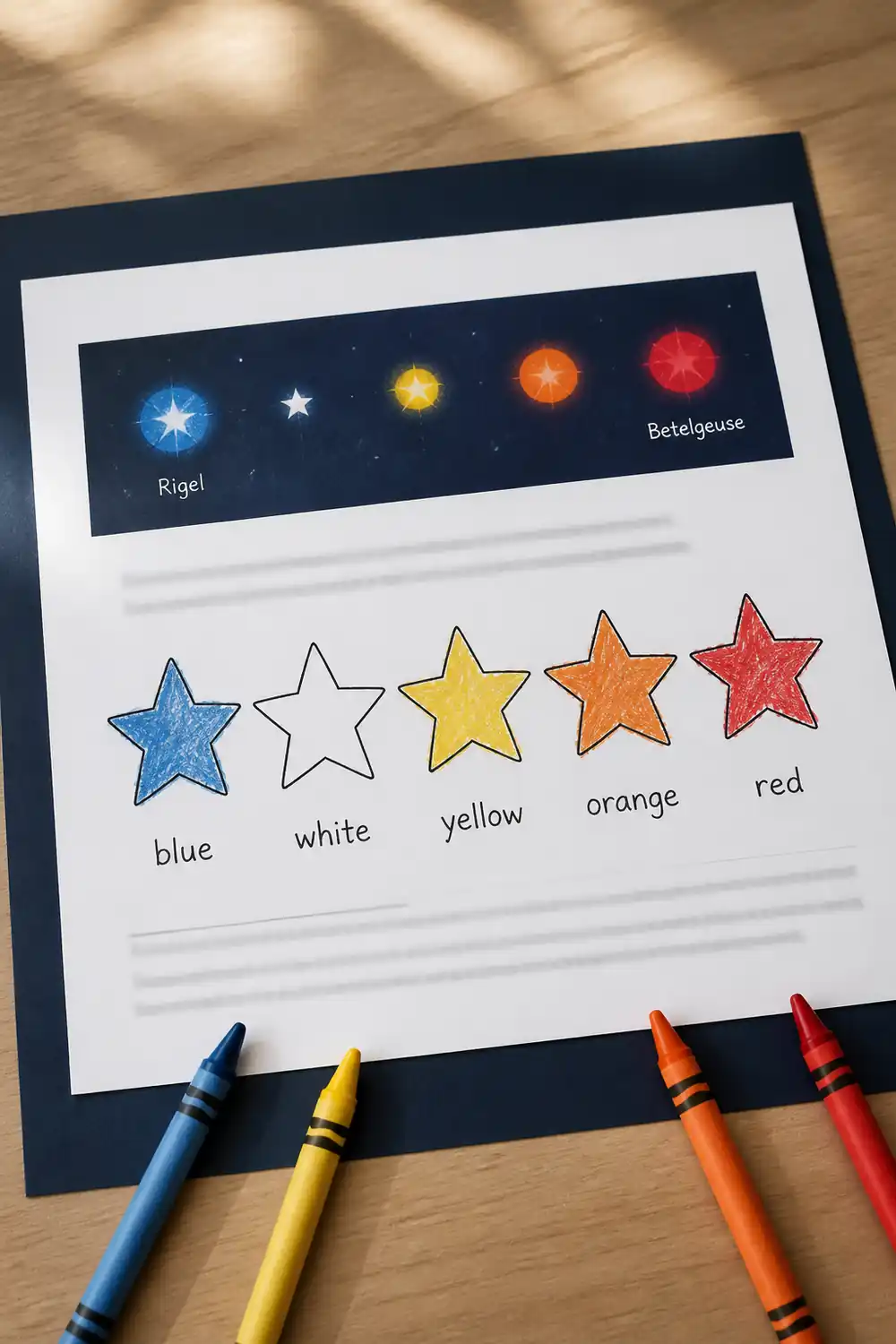
Which is the opposite of the kitchen tap, where red means hot and blue means cold. I’d bet that mix-up is the part kids remember. For real examples, find Orion on a clear winter evening: Betelgeuse, the star at Orion’s shoulder, is red, and Rigel, down at his foot, is blue-white.
So on the real star colors page the blue star still gets a blue crayon and the red star gets red, but the lesson underneath runs backward from everyday life. For a kid who loved the night sky page or the planets and stars page, this is the natural next step.
Ways to use colored stars around the house
A finished star doesn’t have to go straight onto the fridge. Cut out the stars from page 3 or page 4, punch a hole near the top of each one, and thread them into a paper garland for December. Glued along a strip of paper, the same stars become a simple reward chart, one star per good bedtime. Small colored stars also look lovely taped to a sunny window.
Babies too young to color can still enjoy the stars a big sibling made. Drop a few cut-out paper stars into a clear plastic bottle of dry rice and you have an easy look-and-shake toy, as long as you glue the lid shut first. The sensory bottle ideas post has more fillers to try.
Printing tips for paper, ink and crayons
Plain copy paper is fine for crayons and colored pencils. For markers, paint or dot markers, switch to cardstock (65 lb is a good everyday weight), because markers bleed through thin paper and paint makes it wrinkle. Set the printer to “fit to page” so the outlines don’t get clipped at the edges.
All the printable stars to color here are black line art, so black and white printing is enough and they use very little ink. If you’re printing for a group (a playdate, a preschool class, the kids’ table at Christmas), I’d print extras of the big star and the smiling star, since every age can do something with those two.
When the stars run out, the flower coloring pages and the zoo animal coloring pages are good next stops for kids who want more to color.
Free download: Get all 12 star coloring pages as one PDF
Common questions about coloring stars
How do you color a star?
For toddlers, pick one color and fill the whole star, starting with the points while their hands are fresh. For older kids, draw a line from every point and every inner corner to the center, then color the ten triangles in alternating light and dark shades of one color. The star ends up looking folded and 3D.
Where can I find free printable star coloring pages?
All 12 free star coloring pages in this post are free to print for home and classroom use, one at a time or as a single PDF. They’re sized for US letter paper and print cleanly in black and white.
What age is right for a star color page?
A toddler can start on a big single star with thick outlines around 18 months, which is when the CDC lists scribbling as a milestone. Color by number pages usually suit 4 and 5 year olds, and detailed star mandalas work better from about 8 years old.
How do I draw an easy star for kids to color?
Draw a five-pointed star in one stroke: start at the bottom left, go up to the top point, down to the bottom right, up to the far left, straight across to the far right, and back to where you started. Then trace only the outer edge in thick marker and erase the pencil lines inside, and you have your own coloring picture of a star.
What paper is best for printing coloring pages?
Regular 20 lb copy paper works for crayons and colored pencils. For markers, watercolors or dot markers, 65 lb cardstock holds up much better and is far less likely to bleed through to the table.
What colors are real stars?
Real stars range from blue and blue-white through white and yellow to orange and red. The color depends on temperature: blue stars are the hottest and red stars are the coolest. Our Sun is a yellow star, sitting in the middle of that range.
The page I’d print first
If you’re standing at the printer with a toddler tugging at your leg, print page one. One big star, two crayons and tape on the corners sounds almost too simple, and that simplicity is exactly what a child needs when they’ve only just figured out that a crayon leaves a mark.
Keep the mandala for yourself. Coloring beside a small child, quietly and without steering their hand, is one of the better ten minutes a day can offer, and a star that ends up purple, scribbled and half off the page is still a star.