
10 Best Toys for 6 Month Old Babies
Six months was the month everything changed in our house. Eeshan had been a lovely, mostly horizontal baby until then. He slept, fed, stared at things, and occasionally graced us with a smile. Then somewhere around week 24 he learned to sit with support, and it was like a switch flipped. Both his hands were suddenly free. His field of vision doubled. He started looking at objects with actual intent and reaching for them with something that resembled a plan.
The pile of newborn toys we had accumulated over the previous five months became almost entirely irrelevant overnight. He needed something different now. So did we, because a baby who can sit up and use both hands also has significantly higher expectations of what you are going to put in front of him.
Here is what actually worked, tested across two boys and refined into the ten toys that earned their place on the floor at six months. If your baby is younger, our guide to the best toys for 3 month old babies covers the previous stage.
What is happening developmentally at 6 months
Six months is one of the most significant developmental leaps in the entire first year. The sitting milestone changes everything physically. When your baby can sit with support, both hands are free for the first time, and exploration becomes genuinely two-handed. They can pass objects between hands, examine something closely before mouthing it, and begin transferring toys from one side of their body to the other.
Object permanence is also beginning at this stage. Your baby is starting to understand that things continue to exist even when they cannot see them. This is why peekaboo suddenly becomes interesting rather than confusing. It is also why stacking cups and nesting toys become so engaging , hiding something inside something else and revealing it again maps directly onto this developing understanding.
Cause and effect play is genuinely rewarding now too. If your baby knocks something over and it makes a sound, they will try to knock it over again. If they press something and it moves, they will press it repeatedly. That is not chaos. That is experimental science conducted by someone with very small hands.
10 best toys for 6 month old babies that actually support development
| Toy | Best for | Key skill |
|---|---|---|
| Bright Starts OBall Classic Ball | Sitting play and rolling | Grasp, roll, crawling prep |
| Fisher-Price Baby’s First Blocks | Shape sorting and stacking | Object permanence, fine motor |
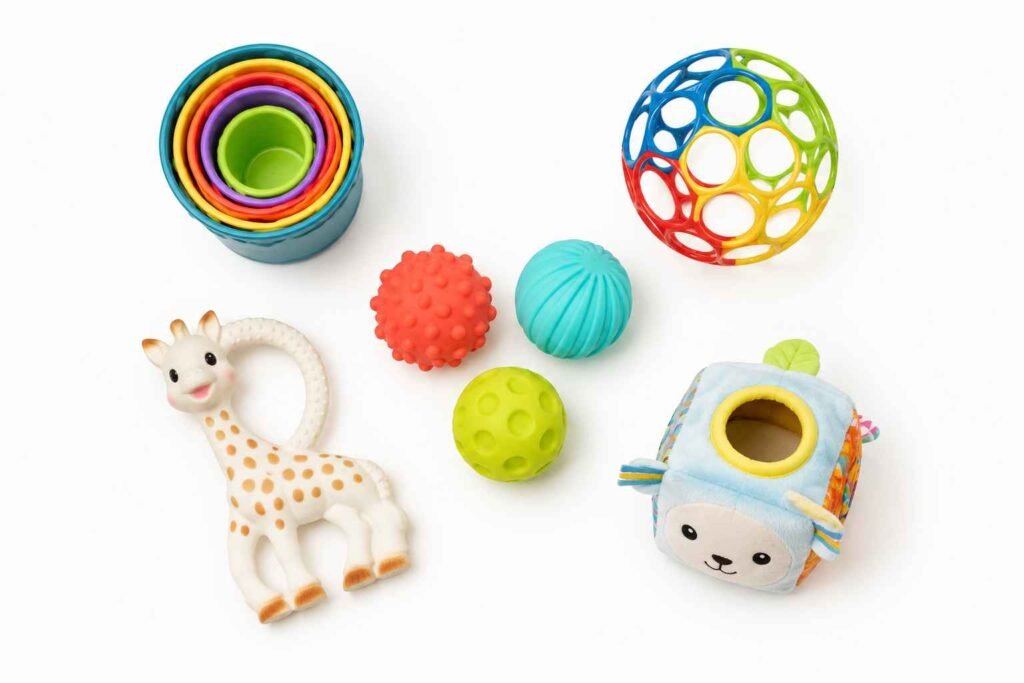
| Sassy Stack and Count Stacking Cups | Nesting and cause and effect | Hand-eye coordination, stacking |
| Fat Brain Toys Dimpl | Sensory finger play | Tactile discrimination, fine motor |
| Infantino Textured Multi Ball Set | Sensory and mouthing exploration | Tactile development, grasp variety |
| Sophie the Giraffe | Teething and tactile | Oral sensory, hand strength |
| Melissa and Doug Soft Taco Fill and Spill | Hand-eye coordination | Grasping, transferring, sorting |
| hahaland Tissue Box Toy | Object permanence play | Pulling, hiding, Montessori exploration |
| Plan Toys Roller Classic | Reaching and crawling prep | Gross motor, reaching |
| Indestructibles Peekaboo Book | Language development | Receptive language, bonding |
1. Bright Starts OBall Classic Ball
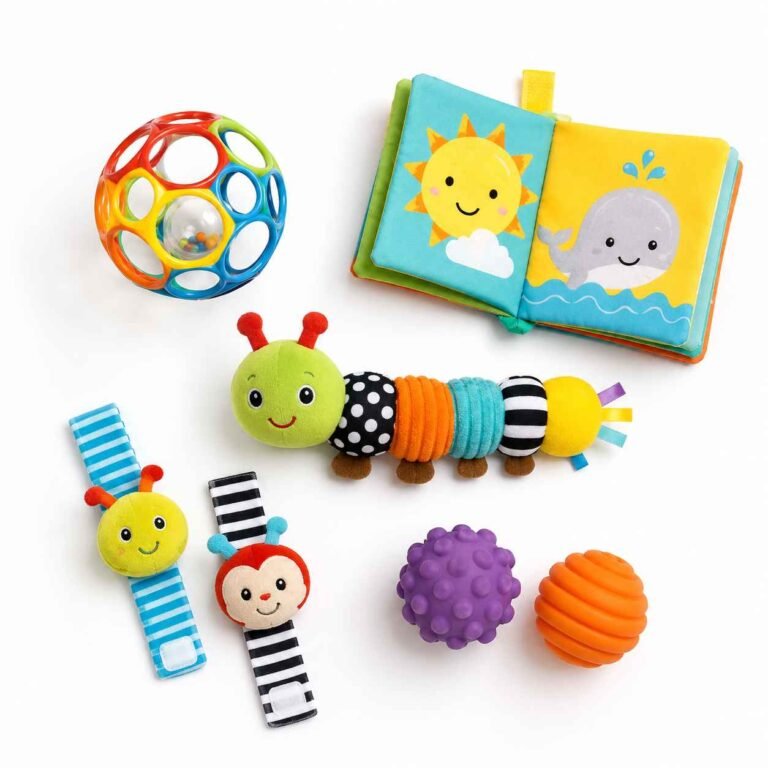
The same OBall that worked as a rattle for your 3-month-old becomes a completely different toy at six months. Now your baby can sit and hold it with both hands simultaneously, examining it from multiple angles, passing it hand to hand, and eventually batting it away and watching it roll. That rolling action is important: at 6 months, a toy that moves away from your baby and invites them to reach and eventually lunge for it is also building the gross motor motivation for crawling.
With Vihaan at six months this was the toy he reached for first every morning during floor time. He would hold it in both hands, turn it over several times, and then drop it on the floor and look at me like I was supposed to do something about it. The cause and effect understanding that dropping objects produces a result was building. At four inches it is also the right size for two-handed seated play without being awkward to manage.
2. Fisher-Price Baby’s First Blocks
Ten colorful shapes with a bucket to sort them into and a lid with matching holes. At 6 months your baby is not sorting them through the holes yet , that comes closer to 12 months. What they are doing is pulling the shapes out of the bucket, examining them, mouthing them, banging them together, and watching you put them back inside. That last part is object permanence work. Something goes in the bucket, disappears from sight, and then comes back out. Your baby is building the understanding that things continue to exist when they are not visible.
The shapes are also sized well for 6-month-old hands. Not too small to be a choking hazard, not too large to grasp. The different shapes mean each one feels different in their palm, which is tactile learning happening passively during what looks like simple mouthing.
3. Sassy Stack and Count Stacking Cups
Stacking cups are one of the most versatile toys in the first year because they grow with your baby. At 6 months the appeal is almost entirely about taking them apart , every cup nested inside another is an invitation to pull them out one by one. The removing and separating motion builds hand strength and coordination. The cups also stack into a tower your baby will delight in knocking down, which is cause-and-effect play in its most satisfying form.
These specific cups have a rattle element in one of them, holes in the base that produce water play when used in the bath, and numbers and patterns on the sides that become interesting to older babies. You will get at least two years of use out of a set of stacking cups, which makes them one of the best value purchases in the entire first year.
4. Fat Brain Toys Dimpl
A flat silicone board with six colored domes that pop in and out when pressed. It sounds simple because it is simple. That is entirely the point. At six months your baby is building tactile discrimination , the ability to distinguish objects and surfaces by feel. The Dimpl gives them five different colored domes that all feel slightly different in resistance, a satisfying popping sensation when pushed through, and a safe surface that can be mouthed without concern.
What I noticed with both boys was that the Dimpl held their focused attention in a way that noisier toys did not. There is something about a toy that requires you to apply pressure and feel a specific response that keeps a 6-month-old genuinely engaged rather than passively stimulated. It also introduces the concept of pushing something through a surface, which is early spatial reasoning.
5. Infantino Textured Multi Ball Set
A set of small balls in different textures, colors, and surface patterns , spiky, bumpy, ribbed, smooth. At six months your baby is doing the majority of their sensory learning through their hands and mouth, and having multiple different textures in one set means every ball in their hand feels like new information. The different sizes also mean each ball challenges their grip differently, building hand strength through variety rather than repetition.
These also work well for simple floor play where you roll a ball toward your baby from a short distance. At 6 months they will attempt to roll it back, or at minimum reach for it, which is the earliest form of back-and-forth interactive play. That social reciprocity is building communication foundations even before words arrive.
6. Sophie the Giraffe
Made from natural rubber with a soft squeaker, multiple different textures across the body, ears, and horns, and a high contrast giraffe print that remains visually interesting. Sophie has been around since 1961 and the reason she keeps appearing on best-of lists is straightforward: she is exactly the right size for a 6-month-old hand, easy to mouth from multiple angles, and safe enough to hand over without monitoring.
The different parts of her body offer different things to chew , the firmer horns for back gum pressure, the softer ears for front gum comfort, the squeaky body for cause-and-effect play. Eeshan used this from about 4 months and kept reaching for it specifically at 6 months when his first teeth were coming through. It was genuinely the thing that got us through that phase with minimum protest.
7. Melissa and Doug Soft Taco Fill and Spill
A soft plush taco shell with twelve colorful ingredient pieces to pull out, examine, and stuff back in. At six months the appeal is almost entirely in the extraction , pulling each piece out one by one, feeling the different textures of each ingredient, and handing them to you or dropping them on the floor. The transfer from container to floor and back again is hand-eye coordination work happening inside what looks like very disorganized playtime.
Two of the ingredient pieces are teethers and some have crinkle fabric, so there is genuine multisensory variety across a single toy. The taco shell also stays upright when placed on the floor, meaning your baby can access it easily in a seated position, which matters at six months when sitting stability is still developing and you want toys that do not require your baby to reach awkwardly to interact with them.
8. hahaland Tissue Box Toy
A soft fabric box filled with crinkle scarves that your baby pulls out one at a time. This is a Montessori-inspired toy based on the observation that babies are endlessly fascinated by the act of pulling things out of containers, which is exactly what they do with actual tissue boxes given the opportunity. The difference is that this version is baby-safe, the scarves have different textures and colors, and the pulling motion builds the fine motor precision and hand strength that will later support more complex manipulation.
The object permanence element is also present here. Each scarf disappears into the box and reappears when pulled. At six months this is genuinely captivating. Vihaan would sit with this for six or seven minutes at a stretch, which at six months is a genuinely long independent play session. When the scarves were all out, the box became a container to stuff them back into, which is the reverse motion and a different fine motor challenge.
9. Plan Toys Roller Classic
A small wooden roller with beads inside that rattle when it rolls. The real purpose of this toy at 6 months is motivating your baby to reach, lean, and eventually lunge. Place it just beyond their reach during floor time and watch them work for it. That reaching and weight-shifting is building the shoulder strength, core stability, and spatial awareness that will lead to crawling. The rattle sound rewards the effort and tells them something interesting happened.
This is one of the few toys on this list that is more about what it makes your baby do than what the toy itself does. Simple, sustainably made, and it will last for years. The small size also means it fits in a pocket or a nappy bag easily for out-and-about distraction.
10. Indestructibles Peekaboo Book
A chew-proof, rip-proof, waterproof fabric book with bold colorful illustrations and a peekaboo theme. At six months your baby cannot turn pages independently yet, but they can hold the book, examine the images, and respond to you reading it aloud. The act of sharing a book at this age , pointing to images, naming them, watching your baby’s eyes track the pages , is building receptive language. They are absorbing vocabulary before they can produce it.
The indestructible format matters because it means you can hand this over without concern during feeding time, in the pram, or at the changing table without worrying about torn pages or wet pulp. Both boys had versions of this book in heavy rotation from about five months. The peekaboo theme also maps onto the object permanence development happening at this exact stage, so the content and the cognitive work your baby is doing align naturally.
Why sitting up changes everything at 6 months
Before your baby could sit, even with support, play happened mostly on their back or their tummy. Both hands were needed to manage their own position and balance. Reaching and grabbing were one-handed activities requiring significant concentration.
When sitting arrives, that changes completely. Both hands are free simultaneously. Your baby can hold one object in each hand and bring them together. They can examine something in one hand while reaching for something else with the other. Play becomes genuinely two-dimensional in a way it could not be before.
This is also when the developmental pace visibly accelerates, because sitting opens up a whole new category of play that simply was not physically possible before. Stacking, nesting, filling, transferring, banging things together , all of this becomes accessible within a few weeks of your baby sitting with support. The right toys at this stage are the ones that take advantage of that new capability rather than continuing to serve the lying-down version of your baby.
How long should a 6 month old play independently
At 6 months, five to ten minutes of engaged independent play is realistic and good. It will extend gradually over the coming months as attention windows develop, but do not measure success by duration. What matters is quality of engagement. A six-minute session where your baby is genuinely absorbed in the tissue box toy is developmentally more valuable than twenty minutes of unfocused mouthing of whatever is nearby.
Signs your 6-month-old is done playing: pushing toys away, looking toward you repeatedly, getting fussy, rubbing eyes. When you see these, the session is over. Put toys away and respond to the signal. There will be three or four more awake windows in the day.
Frequently asked questions
What toys are best for a 6 month old who can just starting to sit?
Toys that work in a seated position and reward two-handed play. Stacking cups, fill-and-spill toys, textured balls, and soft books are all ideal. Avoid toys that require your baby to be fully upright without support before they are stable enough.
How many toys does a 6 month old need?
Three to five in rotation at any given time. More toys does not mean more learning at this age. It means less focused engagement with any single object. Rotate toys every few days so each one feels novel when it reappears.
When should a 6 month old start playing with stacking toys?
They will not stack independently until closer to 12 months, but engaging with stacking cups by pulling them apart, nesting them, and mouthing them is completely appropriate at 6 months. The stacking comes later. The exploring starts now.
Are wooden toys safe for 6 month olds?
Yes if they are finished with non-toxic paint or left natural, are large enough to not be a choking hazard, and have no sharp edges. The Plan Toys Roller on this list is a good example of appropriately sized and finished wooden toy for this age.
From one dad to another
Six months felt like the first time both boys really became themselves. The weeks before that were beautiful but also a little one-sided. You give everything, they absorb it, and the feedback is limited to smiles and the occasional coo if you are lucky.
At six months Eeshan started handing things back to me. Vihaan started reaching for my face with both hands and examining it like it was the most interesting object in the room. Both of them started having preferences about which toy they wanted next and making that preference clear.
The toys on this list are not magic. But they are the right level of challenge and variety for a brain that is suddenly ready to do a lot more than it could last month. Start with the stacking cups and the OBall. Watch what your baby reaches for. That is always your best guide.
Saidesh is a dad of two, Eeshan and Vihaan, writing about what he actually tried, tested, and learned the hard way. CribKind covers baby development, sensory play, and real parenting for the first two years.

One Comment