
7 Good Toys for Kindergarteners
A new class of kindergarteners shows up every August, and every August the classroom toy shelf gets sorted the same way: things that survive twenty five five year olds sharing them, and things that get put away within the first week because they only work for one child at a time or fall apart the moment two kids grab the same piece. After years of watching what actually earns its shelf space in a real kindergarten classroom, a short, honest list has emerged, and it looks nothing like a typical toy aisle display.

Why classroom tested is a different bar than home-tested
A toy that works great for one child at home does not always work in a room with twenty five kids sharing it. Durability matters more. So does whether a toy can be picked up and put down in under a minute when a transition bell rings. A lot of toys marketed for this age group fail one or both tests almost immediately.
The toys that earn a permanent spot on the shelf tend to share a few traits: they invite more than one child to play at once, they survive being dropped, stepped on, and shared roughly, and the child can see whether they got it right without needing an adult to check.
The National Association for the Education of Young Children points to the same basic idea for this age: toys that support cooperative play and problem solving tend to outperform toys built around a single scripted activity.
What actually separates a good kindergarten toy from a forgettable one
- Group-friendly. More than one child can play at once, or take turns without a long wait.
- Genuinely durable. It has to survive daily group handling, not gentle solo play.
- Self-checking. The child can tell whether they solved it correctly without an adult confirming every step.
Cooperative games and group play
Peaceable Kingdom Hoot Owl Hoot : Best cooperative board game
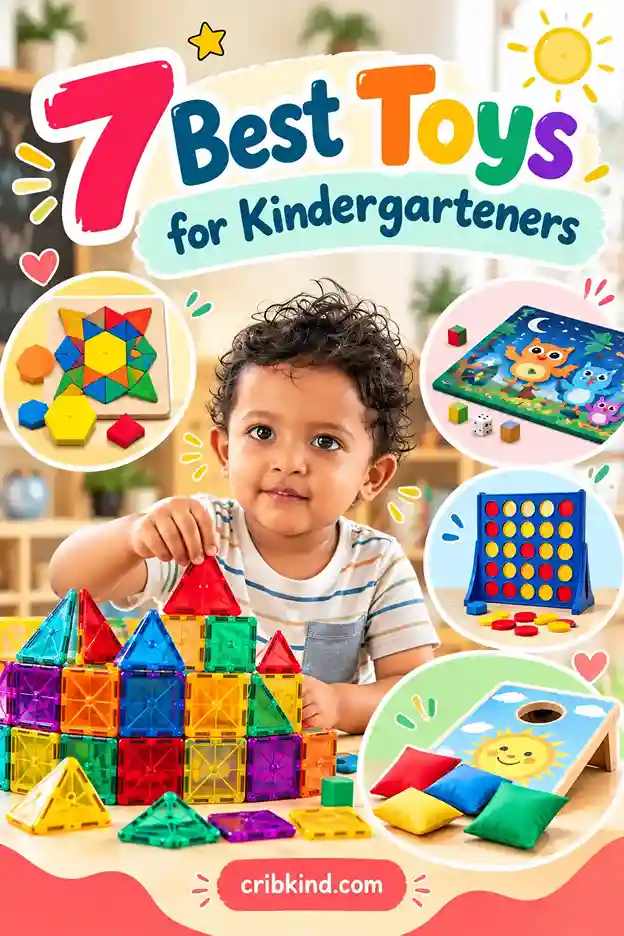
A cooperative game where the whole group works together to get the owls home before sunrise, so there is no losing player and no one left out. This is one of the most requested games in a kindergarten classroom, since the win or lose outcome belongs to the whole group, not one child.
Honest downside: the cooperative format means a confident five year old sometimes wants to make every decision for the group. Some light adult guidance helps the first few plays.
Hasbro Connect 4: Best classic connect game
A simple two player game that has survived essentially unchanged for decades, and it still works because the rules take thirty seconds to learn and the challenge scales with the opponent. Kindergarteners play this against each other constantly once they understand the win condition.
Honest downside: it is strictly a two player game, so it does not scale to a full group the way a cooperative game does. Expect a waiting line during free choice time.
Melissa & Doug Sunny Patch Bean Bag Toss: Best group active game
A simple bean bag toss game that moves easily between indoor group time and outdoor recess. What makes this one last is that several kids can play in rotation without a long setup, and the scoring is visual enough that a five year old can track it themselves.
Honest downside: the fabric bean bags wear out faster than the wooden board itself, and replacement bags are not always sold separately.
Fine motor and independent work toys
Melissa & Doug Pattern Blocks and Boards: Best pattern and fine motor toy
Wooden shape pieces that fit onto pattern cards ranging from simple to genuinely complex. This one works equally well as a solo quiet-time activity or as something two kids sort through together, and the pattern cards give a clear sense of progress without an adult grading anything.
Honest downside: pieces go missing fast in any shared classroom bin. Expect to be down a handful of shapes within a semester.
Best sequencing puzzle: Melissa & Doug Flip Sequencing Puzzles, Getting Dressed
Chunky puzzle pieces that have to be arranged in the correct order to show a full sequence, in this case a child getting dressed step by step. It sounds simple, but ordering steps correctly is a real early logic skill, and kids notice immediately when a piece is out of order.
Honest downside: once a child memorizes the correct order, the puzzle stops being challenging. It has a shorter shelf life than the other items on this list.
Dramatic play and creative toys
Melissa & Doug Wooden Play Food Grocery Set
A set of wooden play food pieces meant for pretend grocery shopping, cooking, or restaurant play. This holds up in a group setting because multiple kids can build a full pretend scenario together, taking on different roles rather than competing for one object.
Honest downside: wooden play food is heavier and pricier than plastic equivalents, and a full set takes up real storage space.
Do A Dot Art Washable Dot Markers
Chunky dot-style markers that make a clean colored circle with a light press, no drawing skill required to get a satisfying result. This is the art supply that survives group table time because every child gets a visible, complete result immediately, without needing fine motor precision yet.
Honest downside: the markers dry out faster than standard markers if the caps are not replaced properly, which happens often in a shared classroom set.
Safety note: Small game pieces (connect-four discs, board game tokens, pattern block pieces) are a choking hazard for younger siblings still mouthing objects, per CPSC guidance. Keep these toys stored separately if a crawling baby or toddler shares the home.
Please pin this for later so you can come back when you’re choosing toys for your kindergartener
The one that never survives past week one
A large battery-powered talking learning tower shows up in classroom donation boxes almost every year. It looks impressive on a shelf, but the moment two kids reach for the buttons at once, or the batteries die mid-lesson, it stops getting picked up. Toys that need constant power and a queue of one at a time simply do not survive group use for long.
The pattern holds across every category on this list: a toy that lets a group share it, survives being dropped and re-shared, and gives a child a way to see their own progress will always outlast a toy that only impresses on a store shelf.
Frequently asked questions about good toys for kindergarteners
What toys are best for a kindergarten classroom versus home use?
Classroom toys need to survive group sharing and quick transitions between activities, so durability and simple setup matter more than they do at home. Cooperative games, pattern and sequencing toys, and mess-controlled art supplies tend to hold up in both settings.
What skills do kindergarteners develop through play?
Early logic and sequencing, fine motor control, turn-taking and cooperation, and independent problem solving are the main skills that show up consistently through the toys that hold attention at this age.
Are board games appropriate for kindergarteners?
Simple board games with short turns and clear win conditions, cooperative or otherwise, generally work well starting around age five, when children can hold a basic rule set in mind for the length of a game.
How do I know if a toy will hold up to group or classroom use?
Watch whether more than one child can engage with it at once and whether it survives being dropped, shared, and handled roughly. A toy that only works for gentle solo play at home often fails quickly in a shared setting.
What is a good first cooperative game for a five year old?
Games where the whole group wins or loses together, rather than one child against another, tend to work best as a first cooperative game, since there is no losing player to manage emotionally at this age.
The talking learning tower is still sitting in a donation box somewhere, unopened past the first week most years. The pattern blocks and the bean bag toss are the ones that get pulled out again and again, not because they are flashy, but because they actually hold up to the way twenty five kindergarteners really play.
Spandana teaches elementary school and has spent years watching which toys actually hold up in a real kindergarten classroom versus which ones look good on a shelf. This post reflects her professional classroom observations, reviewed and confirmed by her before publishing.
Related reading: toys for 5 year old boys, educational toys for 4 year olds, wooden educational toys we tested, and fine and gross motor skills examples.

One Comment