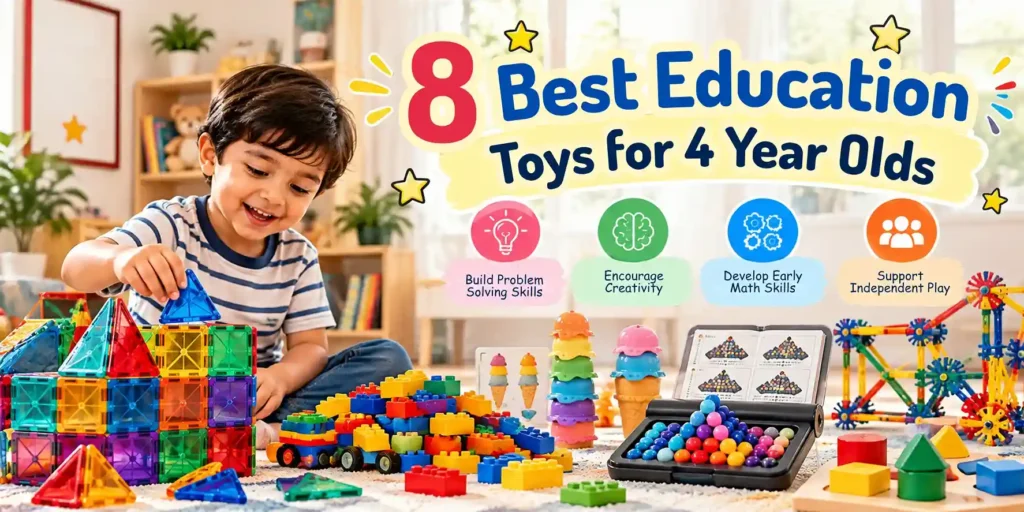
8 Best Educational Toys for 4 Year Olds
Every fall, a new batch of four year olds walks into Spandana’s classroom, and every fall the toy shelf gets restocked with things marketed as “educational” for that exact age. Some of it holds a child’s attention for a full free-play period. A lot of it gets touched once and abandoned. After several years of watching which toys actually get picked up again and again versus which ones sit untouched after the novelty wears off, a pattern became obvious that has nothing to do with what the packaging claims.
Why “educational” on the box does not mean much by itself
Almost every toy aimed at this age claims to build some skill. Fine motor, early math, letter recognition, it is printed on nearly everything. Kids ignore most of it. What actually holds attention is whether the toy gives a child something to figure out on their own, not whether the box uses the right vocabulary.
The toys that stick around a classroom shelf have one thing in common: a puzzle built into the object itself. Shapes that only fit one way, a sequence that has to happen in order, a pattern that has to be matched. Nothing on the packaging predicts this. Only actually watching a child use the toy does.
The National Association for the Education of Young Children makes a similar point: toys that let a child direct the play, rather than following one fixed script, tend to hold up better than toys with a single scripted outcome, whatever label is on the box.
What actually separates a good educational toy from a labeled one
- A real puzzle, not a script. If the toy only works one way and that way is obvious in ten seconds, the educational part is gone by day two.
- Room to fail and retry. The best ones let a child get it wrong, notice, and try again without needing an adult to correct them.
- Something to build toward. Four year olds want progress they can see, not a fixed toy that plays the same every time.
Building and construction toys
Magna-Tiles Clear Colors 32 Piece Set
These magnetic tiles are consistently the most-used toy on the classroom shelf. Kids build towers, houses, and increasingly elaborate ramps for toy cars, and the fact that they connect from any angle means there is no wrong way to start.
Honest downside: the price per piece is steep, and a 32 piece set runs out fast once a child wants to build anything ambitious. A single set gets crowded quickly with more than one child using it.
LEGO Classic Creative Bricks Box
A plain box of bricks in assorted colors and shapes, no instructions, no set model to build. Kids tend to build the same few things at first (a car, a tower, a “robot”) and then start combining ideas into things that stop matching any single category, which is usually the point.
Honest downside: loose bricks end up everywhere within days. A dedicated storage bin is not optional in a classroom setting, it is required.
K’NEX Imagine Building Set
Rods and connectors that snap together at angles, aimed more at structures and moving parts than stacking blocks. This one takes more patience to get started with than Magna-Tiles, but once a child understands the connection system they build things that actually hold their shape and move.
Honest downside: the pieces are small and fiddly for four-year-old hands at first. Expect some frustration in the first week before the motor skill catches up.
Early math and logic toys
[Best pattern and sequencing toy] Learning Resources Smart Snacks Counting Cones
Stacking cones with a pattern card system, matching colors and counting scoops in a specific order. Kids treat it as a straightforward stacking toy for the first few tries, then start actually following the pattern cards once they notice the cards make the activity harder in a way they like.
Honest downside: without the pattern cards it is just a stacking toy, and the cards are thin cardstock that does not hold up to repeated classroom handling for long.
[Best early logic puzzle] SmartGames IQ Puzzler Pro
A grid-based puzzle with plastic pieces that have to be arranged to fit a specific pattern, with a booklet of challenge cards ranging from easy to genuinely hard. This is the toy that surprises the most, since kids often ask for it by name after the first try and keep coming back for the harder challenge cards on their own.
Honest downside: the early challenge cards are almost too easy and the difficulty jump partway through the booklet is steep. Some kids will need help bridging that gap.
Letter and early reading toys
[Best letter recognition toy] LeapFrog LeapReader Reading and Writing System
A stylus-based system that reads words aloud from specially printed books and activity sheets. In a classroom setting this gets used mostly for the writing practice sheets, tracing letters and hearing the sound spoken back, more than for the reading function itself.
Honest downside: it requires the compatible books and cartridges separately, and the base system alone does not do much without them. Check what is actually included before buying.
[Best physical alphabet toy] Melissa & Doug See and Spell Wooden Puzzle
Picture puzzle boards where wooden letter tiles fill in a word beneath an image. Kids typically start by just matching the letters to the outline shapes, which is fine motor practice more than reading, but within a month or two several start sounding out the words as they place them.
Honest downside: it only comes with a fixed set of words, so once those are memorized there is a ceiling on how long it stays challenging.
Science and sensory exploration
[Best physical science kit] Learning Resources Primary Science Lab Set
A kid-sized set of magnifying glasses, tweezers, and containers meant for exploring by hand, bugs, leaves, dirt, whatever a child finds interesting on a given day. This one holds up because the “activity” is whatever the child decides it is, not a fixed lesson.
Honest downside: several of the small plastic tools are genuinely fragile and tend to crack within the first month of regular use.
The one that looks perfect on the box and gets ignored
A large electronic “learning tablet” toy shows up on the classroom shelf almost every year, promising letters, numbers, shapes, and songs all in one device. It gets real attention for a few days, then sits untouched. The problem is the toy does all the work itself, press a button, hear a scripted response, nothing left for a child to actually solve or build.
The pattern across everything on this list holds the same way it does across ages: a real problem to work through beats a feature list, every time, whatever age is printed on the box.
Frequently asked questions about educational toys for 4 year olds
What skills should educational toys for 4 year olds focus on?
At four, the most useful skills tend to be early math and pattern recognition, fine motor control through building and puzzles, and early letter or word recognition, though letting a child direct their own play matters just as much as any single labeled skill.
How much screen-based learning is appropriate at 4?
The American Academy of Pediatrics generally recommends limiting screen time and prioritizing physical, interactive play at this age. A device-based educational toy is not automatically worse, but it should not replace physical building and puzzle play entirely.
Are STEM toy kits worth it for a 4 year old?
Many are designed for slightly older children and can be frustrating at four without an adult helping through most of the steps. Look specifically for sets marketed at ages 3 to 5, not general “STEM” sets aimed at early elementary.
How do I know if a toy is actually educational or just marketed that way?
Hand it over and watch what happens without prompting. If the child has to figure something out to keep playing, it is doing real work. If pressing a button produces the same scripted result every time, the educational claim is mostly packaging.
What is a good first building toy for a 4 year old?
Magnetic tiles or classic building bricks without a fixed model to follow tend to hold attention longest, since there is no single correct way to use them and a child can return to the same toy at increasing levels of complexity over months.
The tablet promising to teach every skill at once is usually the toy that goes untouched by spring. The puzzle grid a child keeps coming back to on their own, working through harder cards at their own pace, is the one that was actually doing the job.
Related reading: brain development toys for a 1 year old, toys for 5 year old boys, wooden educational toys we tested, and fine and gross motor skills examples.


2 Comments