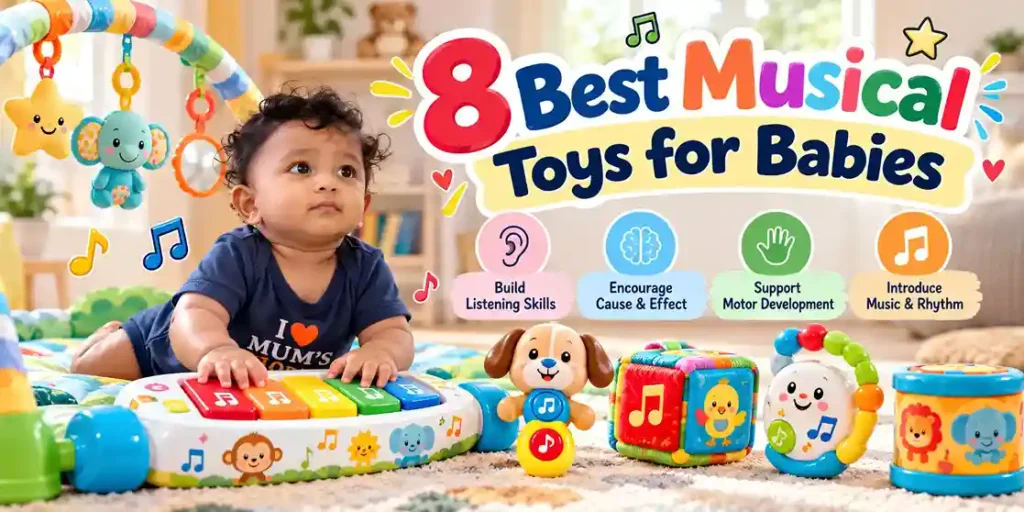
8 Best Musical Toys for Babies
Vihaan didn’t react to a single one of his rattles until he was almost 4 months old. Not the black and white ones, not the ones that shook, not the expensive wooden one we’d been given at the baby shower. Then, at 4 months and 2 weeks, a cheap plastic piano toy with five oversized keys made him kick both legs and turn his whole head toward the sound. Same living room, same toy category, completely different reaction than everything we’d tried before.
Why musical toys work differently than other baby toys
I assumed musical toys were mostly about soothing, something to play in the background while a baby settled down. What actually happened with both boys was closer to the opposite. The toys that worked best weren’t ambient background noise. They were toys where the baby caused the sound directly and could feel that connection immediately.
The American Academy of Pediatrics notes that this kind of responsive, action driven play supports early language and motor development more than passive listening does. A mobile that plays a tune on its own is a different category of toy than one a baby can trigger themselves, even if they look similar on a store shelf.
Eeshan went through his own version of this around 5 months, obsessed with a toy that rang a bell only when he grabbed and shook it in a specific direction. He’d get frustrated when it didn’t ring, then visibly satisfied the moment he figured out the motion again. That loop of trying, failing, and adjusting is the actual developmental work, and the music is just what makes the feedback obvious enough for a baby to notice.
Musical toys for early infancy, 0 to 6 months
[Best for early cause and effect] Fisher-Price Kick and Play Piano Gym
This was the toy Vihaan reacted to at 4 months and 2 weeks, after ignoring every rattle we’d tried before it. The piano panel sits at the foot of a play mat, low enough that a kicking baby hits the keys by accident at first, then on purpose within a couple of weeks.
Honest downside: once a baby starts pulling up to sit or crawl, the floor based design becomes less useful fast. This is squarely a lying down phase toy, not one that grows with them long term.
[Best portable stroller toy] Baby Einstein Take Along Tunes Musical Toy
A small clip on toy that attaches to a stroller or car seat handle, playing short classical clips when squeezed or shaken. This became our actual go to for car rides with Vihaan around 3 months, since it was small enough to stay clipped on and never fell out of reach the way loose toys did.
Honest downside: the volume isn’t adjustable on most versions, which matters more than it sounds in a small car interior on a long drive.
[Best first rattle with music] VTech Baby Rattle and Sing Puppy
A soft rattle with a built in speaker that plays a short tune when shaken, which gave Eeshan a middle step between a plain silent rattle and a full musical toy. He could grip and shake it well before he had the coordination for buttons or panels.
Honest downside: the tune is short and repeats constantly. If you’re within earshot all day, expect it to get genuinely tiresome by week two.
Musical toys for sitting and early mobility, 6 to 12 months
[Best classical music toy] Munchkin Mozart Magic Cube
A soft cube with color coded sides, each playing a different classical instrument when pressed. What made this one stick around longer than expected was the color sorting element layered on top of the music, giving it a second job once the novelty of the sound alone wore off around 8 months.
Honest downside: the buttons require a fair amount of finger pressure, which frustrated Vihaan before about 7 months. It’s more of an 8 month and up toy despite some marketing suggesting earlier.
[Best crib mobile with music] Manhattan Toy Musical Mobile
We hung this over Vihaan’s crib starting around 6 weeks, well before he could reach anything, purely for the visual and auditory calming effect during the early sleep training months. It became genuinely useful again around 5 months once he started reaching up and swiping at the hanging pieces himself.
Honest downside: it needs to come down once a baby can pull to stand in the crib, which happened for both boys earlier than the box’s suggested age range implied.
Musical toys for older babies and early toddlers, 12 months and up
[Best musical pull toy] Melissa & Doug Bee-Bop Band
A pull along wagon with xylophone style bars that play notes as the wheels turn, which we’ve written about before in our push and pull toys roundup. It earns a spot here too because it’s genuinely one of the few toys that bridges the musical toy category and the walking toy category at the same time.
Honest downside: it’s larger than most musical toys on this list and takes up real floor space. Not a great fit for a small living room.
[Best hands on instrument toy] Hape Pound and Tap Bench with Slide-Out Xylophone
Also covered in our push and pull toys post, but worth repeating here specifically for the xylophone side, which Vihaan used independently well past his first birthday, banging out his own patterns rather than just triggering a pre-set tune.
Honest downside: it is genuinely loud, with no volume control at all on the wooden xylophone side.
[Best all in one musical activity table] LeapFrog Learn and Groove Musical Table
A standing activity table with piano keys, spinning gears, and light up buttons, usable flat on the floor for a younger sitting baby or upright once a toddler is pulling to stand. Eeshan used the flat version around 7 months and the standing version past his first birthday, which is a genuinely long useful window for one toy.
Honest downside: it runs through batteries fast with the lights and sound running together, and the volume can only be turned down, not off entirely, on most versions.
The musical toy that never got used
We were given a wooden musical shape sorter as a gift, one that played a note for each correctly placed shape. It sat untouched for months. The problem wasn’t the concept, it was that the shape sorting skill and the musical reward arrived at completely different ages. By the time Vihaan could actually sort the shapes, around 13 months, the built in music felt babyish to him, and by the time the music would have been genuinely novel, around 6 months, he had no ability to sort anything yet.
The lesson that stuck with us: a musical toy needs to match the skill a baby actually has right now, not the skill the box assumes they’ll grow into. Buying ahead of the developmental curve on a musical toy specifically tends to waste the purchase entirely, more so than with quieter toys.
Frequently asked questions about musical toys for babies
Are musical toys good for babies?
Musical toys that respond directly to a baby’s own action, a kick, a squeeze, a shake, support early cause and effect understanding and motor development. Toys that just play music on their own timer, without the baby triggering it, offer less of that developmental benefit.
What age should you introduce musical toys?
Simple rattle style musical toys work from birth onward, but toys requiring a specific action, pressing a button, shaking in a direction, tend to click somewhere between 3 and 5 months, once a baby has enough hand control to trigger them on purpose.
Can musical toys be too loud for a baby?
Yes. Check for a volume control before buying, especially for toys likely to end up close to a baby’s face or ear. Several toys on this list, including ones we still use, do not have a mute option, only a volume dial at best.
Do musical toys help with speech development?
Toys that respond to a baby’s own sounds or actions, rather than playing a fixed tune regardless of what the baby does, tend to support early language and turn taking skills more than passive musical toys do.
What is the best musical toy for a newborn?
A soft rattle with a gentle built in sound tends to work best in the earliest months, before a baby has the hand control for button presses or panel toys. Save the more interactive musical toys for closer to 4 months.
How many musical toys does a baby actually need?
One or two at a time tends to work better than a large rotation. Both boys engaged more deeply with a smaller set of musical toys they returned to repeatedly than with a large bin they never fully explored.
That piano gym is long gone now, packed away for whenever we have another baby in the house. But I still think about the exact moment Vihaan’s legs kicked that key and his whole head turned toward the sound, four months and two weeks old, the first time a toy actually got a reaction out of him. Every musical toy since has been measured against that one moment, whether I meant it to be or not.
Related reading: brain development toys for a 1 year old, sensory toys for infants 0 to 12 months, wooden educational toys we tested, and fine and gross motor skills examples.