Organic Baby Food: What a Dad of 2 Actually Used
Here’s what I figured out across two kids, a lot of organic baby food pouches, one genuinely failed homemade batch cooking experiment, and one baby Vihaan who refused every single green vegetable pouch he ever encountered across four straight months. Every brand. Every flavor. Not one exception: organic baby food is absolutely worth buying. But the organic label alone doesn’t tell you what you actually need to know.
What Organic Baby Food Actually Means
USDA Certified Organic means the food was produced without synthetic pesticides, synthetic fertilizers, GMOs, hormones, or antibiotics. For an infant whose brain and organs are still developing, lower pesticide exposure is genuinely meaningful babies process environmental toxins differently than adults because their detoxification systems aren’t fully mature yet.
Solid food at this stage is complementary nutrition breast milk or formula stays the primary feed through 12 months, with purées sitting alongside it, not replacing it. That context matters when you’re deciding how much time and money to invest in the food itself.
What USDA Organic does NOT cover: naturally occurring heavy metals. Arsenic, lead, cadmium, and mercury get into food through the soil and water supply not through any farming practice that organic certification controls. Two label terms worth knowing:
- USDA Certified Organic seal the actual government-verified certification. Specific, independently verified, means something.
- Made with organic ingredients means at least 70% organic content. The rest doesn’t have to be. Different thing. Check the back label, not just the front.
Organic Baby Food Stages What They Mean in Practice
Stage numbers tripped me up with Eeshan for longer than I’d like to admit. I kept treating them like strict age rules. They’re not they’re texture guides. Your baby’s readiness matters more than the number printed on the front of the pouch.
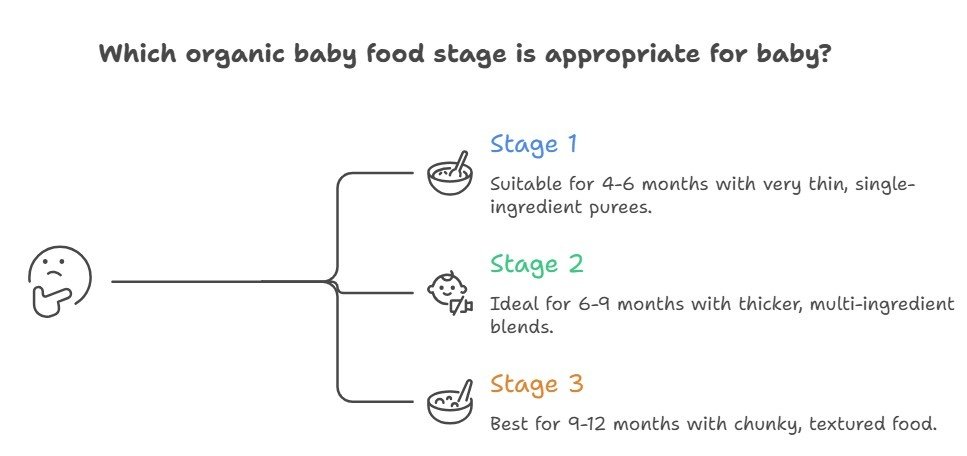
| Stage | Age Range | Texture | What We Actually Used |
|---|---|---|---|
| Stage 1 | 4–6 months | Very thin, smooth, single ingredient almost watery | Earth’s Best single-ingredient jars. Just apple, just pear, just sweet potato. Non-negotiable for the 4-day allergen waiting rule no blends, no guessing which ingredient caused a reaction. |
| Stage 2 | 6–9 months | Thicker, multi-ingredient blends | Happy Baby Clearly Crafted pouches. Banana sweet potato accepted by both boys, every time. Every green blend rejected by Vihaan, every time, without exception, for four straight months. |
| Stage 3 | 9–12 months | Chunky, textured, small soft pieces | Mix of pouches for travel and tired evenings; mashed table food at home. Banana with a fork, avocado, soft cooked carrot. Stage 3 pouches started feeling expensive compared to just mashing whatever we were eating. |
With Eeshan we moved from Stage 1 to Stage 2 at around 6.5 months he started pushing the spoon away and turning his face, which I eventually figured out was boredom rather than actual food refusal. With Vihaan we moved a little earlier, at around 5.5 months, because the thin purees clearly weren’t satisfying him. Different kids, different timelines. The stage number is a starting point, not a rule.
Best Organic Baby Food Brands What We Tried
Not a top-ten list with affiliate links. Just what we actually bought, what both kids accepted, and what I’d buy again.
Happy Baby Organics Most Used
- Most-used brand across both boys, by a significant margin. The Clearly Crafted pouches have a transparent window so you can see the actual contents before opening. Sounds minor. After the 11 PM label-reading phase, being able to visually check what was going into a baby felt worth something.
- USDA Certified Organic, non-GMO, short ingredient lists throughout. The Stage 2 banana and sweet potato was the single food most consistently accepted by both Eeshan and Vihaan across the entire pouch phase.
- The green vegetable blends pea, spinach, zucchini, apple and broccoli Vihaan refused completely from about 6 months onward. We tried six different brands. He didn’t care. Same result every time. Eeshan was less opinionated and ate most flavors without protest.
Earth’s Best Organic Best for Stage 1 Introductions
The most practical choice for the allergen introduction phase. When you’re doing the 4-day waiting rule one new food, four days, watch for any reaction before adding the next single-ingredient jars are essential.
Earth’s Best delivers this simply: just apple, just pear, just sweet potato. No blends. No wondering which of three ingredients caused the rash on day three. Good quality, correct watery texture for Stage 1, gets boring by Stage 2. We moved away from them at around 7 months with both boys.
Plum Organics Consistently Recommended
Came up repeatedly in conversations with other parents and is well-rated in independent testing. Thicker consistency than Happy Baby at Stage 2, which worked well for Eeshan around 7 to 8 months when he wanted more substance per pouch. Like all brands, best used as part of a rotation across multiple options rather than a daily staple that rotation advice applies across the board, not just to this brand.
Beech Nut Organics Best Value
Most affordable USDA Certified Organic option we regularly bought. Genuinely useful for the high-volume months Vihaan was going through two to three pouches a day at peak Stage 2 and the cost of premium brands adds up fast at that pace. The Organics Jars variety pack apple, pear, carrot, pumpkin, sweet potato is solid quality and significantly cheaper per unit than most alternatives. Eeshan accepted apple and pear immediately from the first try.
What We Skipped
We didn’t try Little Spoon or Once Upon a Farm. Both come up constantly in parent recommendations and both test for heavy metals and contaminants beyond standard organic certification. Both are subscription-based and more expensive than shelf brands. We were running on Amazon Subscribe & Save and that routine worked well enough that we never switched. If budget allows, both are worth considering particularly for the heavy metals testing transparency.
Heavy Metals in Organic Baby Food The Truth
This is the section that came out of that 11 PM kitchen moment. Most organic baby food posts either skip this entirely or bury a single vague sentence about it near the end. Here’s what I actually learned.
The 2019 Healthy Babies Bright Futures report peer-reviewed, not a forum post found detectable levels of at least one heavy metal (arsenic, lead, cadmium, or mercury) in most of tested baby foods. That included organic and conventional products. Heavy metals get into food through the soil and water where crops are grown. Organic certification has no mechanism to control that.
What that means practically and what actually changed how we shopped:
- Rotation is the strategy no single ingredient appearing more than two or three times across a week of meals. Vary across sweet potato, apple, pear, banana, squash, mango, pea, green bean. The variety is what reduces cumulative exposure, not the brand.
- Limit rice based foods as a staple rice cereal was the standard first food recommendation for decades. It carries significantly higher arsenic levels than oat or multi-grain alternatives. We used oatmeal-based cereals with both boys from the start.
- Root vegetables and rice carry the most risk sweet potato, carrot, rice. Still fine to include. Not every meal, every day.
- Rotate across brands too same reasoning as ingredient rotation. Don’t make any single pouch brand the only option in the weekly rotation.
Homemade Organic Baby Food Honest Take
We tried it. Here’s what actually happened not the aspirational version.
With Eeshan I bought a dedicated baby food maker, spent a Sunday afternoon steaming organic sweet potatoes, blended them smooth, filled an ice cube tray, and labelled each section with masking tape: “sweet potato week 12.” Felt like an excellent parent.
Eeshan ate exactly four of those cubes over two days. Then I forgot to cover the tray, the cubes got freezer burn, and we quietly went back to pouches. Total additional batches I made across Eeshan’s entire first year of solids: three.
With Vihaan I skipped the baby food maker entirely. Pouches for the first five months of solids, no guilt about it. Around 9–10 months right around the same time he was discovering his feet and generally becoming more physically engaged with everything homemade actually became the easier option. Mashed banana, avocado with a fork, soft cooked carrot, small bits of lentil. At that stage it’s not really “baby food” anymore, it’s just mashed table food that takes five minutes.
The honest version: Homemade is better in ingredient control and cost. It’s harder in practice at Stage 1 and 2. From around 9 to 10 months it becomes the obvious choice. Pouches are expensive convenience. Some weeks that convenience is everything. Both approaches work fine you don’t have to pick one.
What We Actually Spent Real Monthly Numbers
Nobody in these posts ever publishes real numbers. Here’s ours, unedited.
- Peak pouch phase 6 to 9 months, 2 to 3 pouches per day: $150–180 per month. Buying Happy Baby and Earth’s Best on Amazon Subscribe & Save at roughly $1.80–2.50 per pouch. Vihaan’s highest-volume stretch pushed one month to $200.
- Homemade equivalent for the same volume: roughly $30–40 per month in organic produce. True on ingredient cost. Doesn’t account for 60–90 minutes of weekly batch prep on a night when you might have had three hours of broken sleep the night before.
- Mixed approach what we actually landed on: pouches for weekday meals, commutes, and any evening where one of us was solo parenting. Mashed table food from 9–10 months for relaxed dinners at home. Roughly $80–100 per month plus produce costs. Stage 1 is also right when you’re still figuring out the post-feed burp routine here’s exactly when you can stop burping after feeds, which is one less thing to track as solids ramp up.
The “homemade saves money” math is real on ingredients alone. It doesn’t account for time and energy with a baby who may not be sleeping. Pouches exist for those nights. Use them.
When to Start Organic Baby Food
The AAP recommends introducing solid foods at around 6 months for most babies based on developmental readiness signs, not a calendar date. That 4–6 month window is genuinely busy all at once; babies are discovering their feet for the first time around the same weeks you’re introducing that first spoonful of puree. Here’s what to watch for:
- Holds head steady and sits upright with support can’t safely swallow without this
- Shows interest in food watching your fork, reaching toward your plate, opening mouth when they see you eat
- Lost the tongue-thrust reflex no longer automatically pushes food back out with the tongue
- Has roughly doubled birth weight and weighs at least 13 pounds
With Eeshan we started at exactly 6 months textbook. With Vihaan our pediatrician noticed all four readiness signs at his 5-month checkup and said we could start. We waited until 5.5 months. Both boys handled the transition well. Your pediatrician’s read of your specific baby beats any fixed date on a calendar.
Frequently Asked Questions About Organic Baby Food
What is the best organic baby food?
Across two kids, Happy Baby Organics Clearly Crafted and Earth’s Best single ingredient jars were our most-used and most consistently accepted options. More important than picking one “best” brand: rotate across multiple brands and ingredients. Variety is the actual strategy for reducing cumulative heavy metal exposure not brand loyalty.
Is organic baby food safe from heavy metals?
Not automatically. Heavy metals get into food through soil, not farming practices so organic and non-organic foods carry similar heavy metal levels. The 2019 Healthy Babies Bright Futures report found detectable heavy metals in 95% of tested baby foods, including organic. Rotating ingredients and brands across the week is the protective strategy.
Is Happy Baby organic food good?
Yes it was our most-used brand by a significant margin. The Clearly Crafted line has transparent packaging, short ingredient lists, and USDA Organic certification. The banana sweet potato blend was accepted by both our boys consistently. Every green vegetable variety was rejected by Vihaan for four straight months. Flavor acceptance varies dramatically by baby.
What are organic baby food stages?
Stage 1 (4 to 6 months): thin, smooth, single-ingredient purees. Stage 2 (6–9 months): thicker, multi-ingredient blends. Stage 3 (9–12 months): chunky textures with small soft pieces. The numbers are texture guides, not strict age rules. Your baby’s developmental readiness matters more than the number on the pouch.
What is organic baby food Stage 1?
Stage 1 is thin, smooth, single-ingredient purees just apple, just pear, just sweet potato. Designed for babies just starting solids at 4–6 months. The single-ingredient format is also ideal for the 4-day allergen waiting rule: introduce one new food, wait four days, watch for any reaction before introducing the next.
Is Plum Organics baby food safe?
Plum Organics is USDA Certified Organic and well-regarded in independent testing. Like all brands, it’s best used as part of a rotation across multiple brands and ingredients not as a daily staple. The rotation strategy applies across every brand for the same reason: variety reduces cumulative heavy metal exposure.
Is Earth’s Best organic baby food safe?
Yes Earth’s Best is USDA Certified Organic and one of the best Stage 1 options specifically for allergen introductions. Their single-ingredient line (apple, pear, sweet potato, squash) is ideal for the 4-day waiting rule. The same rotation advice applies here as with all brands.
Is Gerber organic baby food safe?
Gerber Organic carries USDA Certified Organic certification and the same general safety profile as other certified organic brands. It’s widely available and affordable. Rotate it as part of your weekly brand and ingredient mix rather than using it as the sole daily option.
Is Beech Nut organic baby food safe?
Yes Beech-Nut Organics is USDA Certified Organic and the most cost-effective option we found for the high volume Stage 2 months. Solid ingredient quality, good variety pack options, and noticeably cheaper per unit than premium brands at equivalent certification level.
How do I buy organic baby food in bulk?
Amazon Subscribe & Save is the most cost-effective bulk option for most shelf brands we used it for Happy Baby and Earth’s Best throughout both boys’ pouch phases. Costco carries Plum Organics multipacks periodically. Subscription services like Little Spoon and Once Upon a Farm offer repeat-order discounts for higher-volume households.
What Two Kids Taught Me About Organic Baby Food
Organic is worth it lower pesticide exposure matters for a developing baby, and the USDA Certified Organic seal means that’s been independently verified. But it’s the starting point, not the whole answer. The heavy metals reality, the rotation strategy, the honest truth about homemade versus pouches those are the things that actually shaped how we fed both boys through the first year of solids.
And if some weeks the rotation plan falls apart and the same three pouches are holding everything together that’s just parenting on a Tuesday. Both kids ate a lot of banana sweet potato pouches. Both turned out fine.
What brand did your baby accept without a fight and what did they refuse every single time? Drop it in the comments. Especially if green vegetables were the enemy.