
8 Wooden Montessori Toys
Vihaan’s pediatrician mentioned Montessori toys almost in passing at a checkup, something about real materials teaching real feedback better than plastic ever could. I did not think much of it until I started noticing how differently he handled a wooden object versus a plastic one, more careful, more focused, less likely to fling it across the room within thirty seconds. Eeshan’s toddler years turned this into an actual pattern I could test, not just a nice idea from a pediatrician appointment.
Why Montessori toys are wooden in the first place
This was the question that sent me looking for an actual answer instead of just trusting the pediatrician’s comment. Wood carries weight and texture that plastic cannot fake. A wooden block feels different in the hand than a plastic one of the same size, and that difference is not decoration, it is information a toddler’s hands and brain are actively using.
Real materials also fail differently. Vihaan dropped a heavy wooden bead and it thudded and stayed put. He dropped a light plastic version and it skittered across the floor and rolled under the couch, teaching him nothing except that plastic objects vanish unpredictably. The wooden version gave him consistent, honest cause and effect every time.
The Montessori method itself is built around this idea, that children learn best through real sensory experience with real materials, not simplified or artificial substitutes. That is the actual answer to why Montessori toys are wooden, not a marketing preference.
What actually separates a genuine Montessori toy from a wooden toy with the label added
- Shows its own mistakes. A real Montessori toy shows the child immediately when something is wrong, a piece that only fits one way, a tower that topples if stacked incorrectly.
- One clear purpose per toy. Genuine montessori learning toys tend to isolate a single skill, sorting, stacking, threading, rather than combining five features into one busy object.
- Real weight and texture. If it feels the same as a plastic version except for the color, the wood is doing nothing functional.
Montessori toddler toys for stacking and sorting
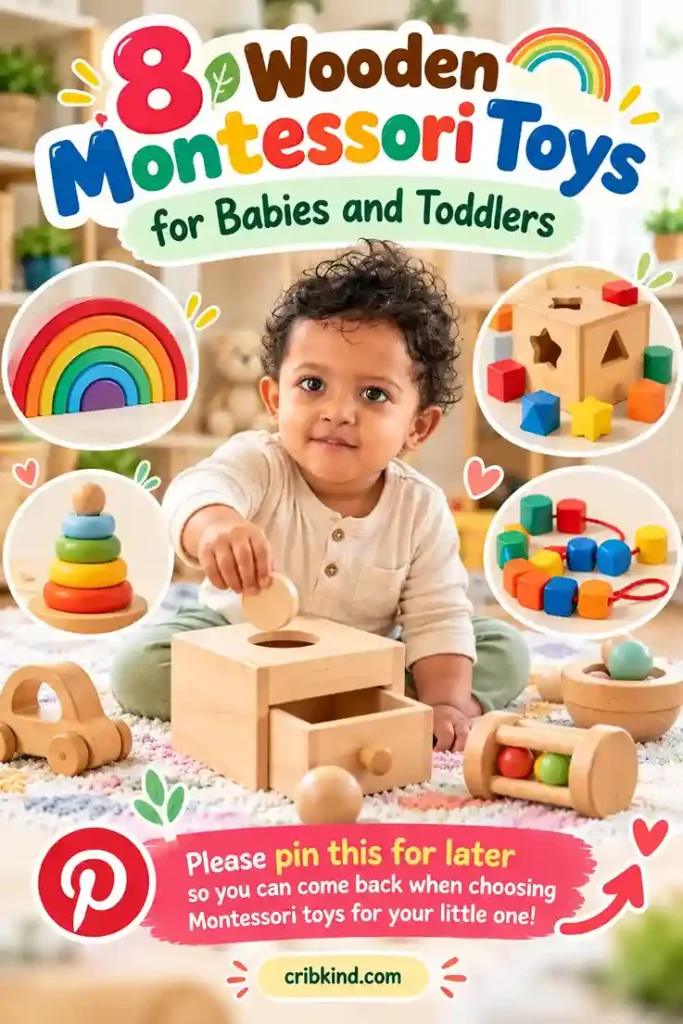
Best classic stacking toy: Grimm’s Wooden Rainbow Stacker
Solid wooden arcs that nest and stack in dozens of configurations, tunnels, rainbows, towers, whatever a toddler decides to build. Eeshan used this constantly between about 15 and 24 months, and it is one of the few toys that got more interesting as he got older rather than less.
Honest downside: it is genuinely expensive for what is, at its core, a set of wooden arcs. The price surprises people the first time they see it.
Melissa & Doug Shape Sorting Cube: Best sorting toy with instant feedback
A classic wooden cube where each shaped block only fits through its matching hole. This is about as textbook an example of instant feedback as a Montessori toy gets, since a toddler gets honest results with zero adult involvement needed.
Honest downside: once a toddler memorizes which shape goes where, the sorting challenge itself is gone. It becomes a simple stacking cube after that.
Melissa & Doug Wooden Lacing Beads: Best fine motor threading toy
Chunky wooden beads in assorted shapes and colors, threaded onto a lace by hand. Vihaan started with just mouthing and handling the beads around 10 months, and by 18 months was actually threading a few onto the lace himself.
Honest downside: the beads are a genuine choking hazard for a younger sibling still mouthing objects. Keep them stored away from crawling babies entirely.
Montessori sensory toys for infants
Wooden Object Permanence Box with Drawer
A simple wooden box where a ball drops through a hole and disappears, then reappears in a drawer the baby pulls open. This is a genuine Montessori sensorial classic, and Vihaan’s fascination with it around 8 to 10 months matched exactly what the object permanence research predicts for that stage.
Honest downside: it only holds real interest for a fairly narrow window, roughly 7 to 11 months. Past that, most babies move on quickly.
Best grasping and texture toy: Wooden Sensory Balls Set
A set of wooden balls with varied textures, grooves, ridges, smooth patches, meant for early grasping practice. Vihaan preferred the ridged ball over the smooth one by a wide margin, which matched what I read about texture variation mattering for early sensory development.
Honest downside: they roll, constantly, and tend to end up under furniture within the first play session. Not a toy for hard floors without supervision.
Practical life and everyday skills toys
Best practical life toy: Wooden Pouring and Transferring Set
Small wooden bowls, tongs, and a pitcher meant for pouring and transferring practice, the kind of activity a real Montessori classroom uses for practical life skills. Eeshan spent an unreasonable amount of time transferring dried beans between bowls around 20 months, far longer than any battery powered toy held his attention.
Honest downside: this one requires direct supervision the entire time, since small transferable materials are a choking hazard if left unattended.
Hape Pound and Tap Bench
A wooden pounding bench where pegs get hammered through with a mallet, then flipped and pounded back the other way. It bridges practical life and cause and effect, and it is one of the few toys we cross-reference constantly across both boys’ toy rotations at different ages.
Honest downside: it is loud, genuinely loud, and not a toy for early morning play if anyone else in the house is still asleep.
The one that got the Montessori label but not the Montessori design
We bought a wooden “Montessori activity cube” with buttons, a maze, a clock face, and a shape sorter all built into one large block. It looked exactly like what search results call a Montessori style toy, but it combined five unrelated skills into one busy object with nothing that showed him whether he got it right or wrong. Neither boy engaged with it for more than a few minutes at a time.
The pattern held the same way it does elsewhere: the actual Montessori principle, one clear skill, honest material feedback, a design that shows its own mistakes, mattered far more than whether the word “Montessori” appeared on the box.
Frequently asked questions about wooden Montessori toys
Why are Montessori toys wooden?
Wood carries real weight and texture that gives a child honest, consistent sensory feedback, which is central to the Montessori method’s emphasis on learning through real materials rather than artificial or simplified substitutes.
What is a Montessori toy, exactly?
A genuine Montessori toy isolates one clear skill and is self-correcting, meaning the child can see immediately whether they did it right without an adult checking. A toy with the Montessori label but five combined features and no built-in feedback is not really following the method.
What age should you start with Montessori toddler toys?
Montessori materials are often introduced from around 6 to 8 months with simple object permanence and grasping toys, moving into sorting, stacking, and practical life activities through the toddler years from roughly 12 months onward.
Are Montessori sensory toys different from regular sensory toys?
The main difference is intention: Montessori sensory toys are designed around one isolated sensory experience, texture, weight, or sound, rather than combining multiple sensory features into a single busy toy.
Do wooden Montessori toys need to be expensive?
Not necessarily. Some genuine Montessori materials, like a simple sorting cube or a set of textured balls, cost far less than elaborate branded activity sets that carry the label without the actual design principles.
Vihaan still goes straight for the object permanence box some mornings, dropping the ball through and pulling the drawer open, over and over, long past the point I expected the novelty to wear off. Eeshan has moved on to more elaborate building, but he still reaches for the pouring set on quiet afternoons. The label on the box never predicted either of those things. The material and the design did.
Related reading: wooden educational toys we tested, brain development toys for a 1 year old, sensory toys for toddlers 12 to 24 months, and push and pull toys we tested.

2 Comments