Sensory Bottles for Autism: How They Help Kids Self-Regulate
I don’t have an autistic child myself, so I want to be upfront about that before anything else. What I do have is years of watching a close friend use sensory bottles with his son, and enough curiosity to actually look into why they work the way they seem to. Here’s what the research says, and what I’ve seen work in practice.
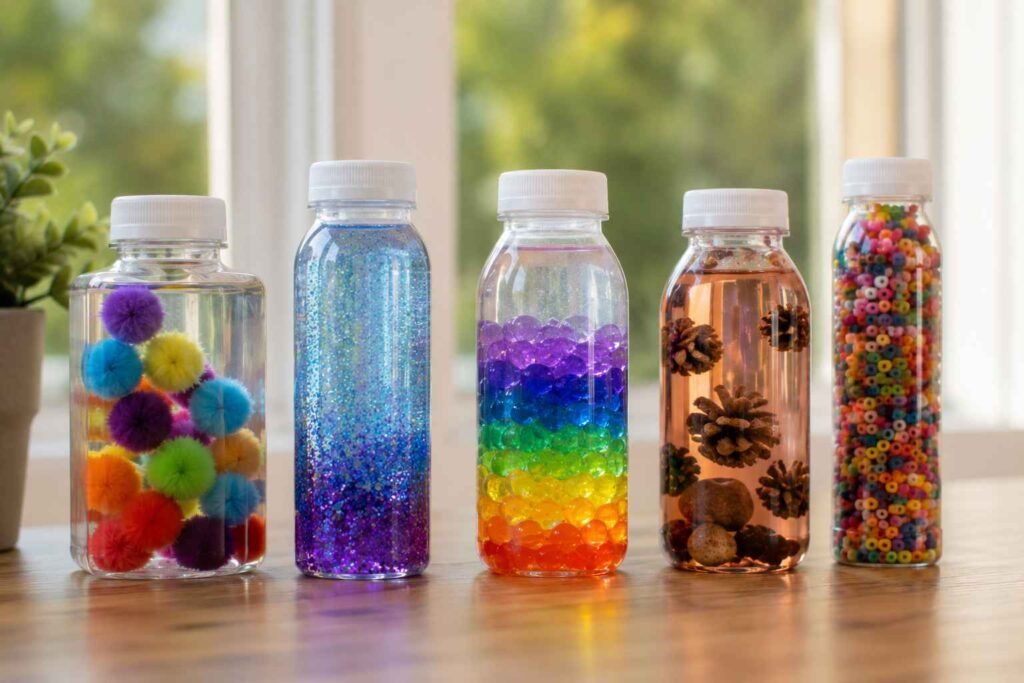
Why sensory bottles can help with self regulation
Watching my friend’s son use his bottle, the pattern was always the same. Something would get loud or chaotic, and the bottle came out, and a few minutes later things had settled. I didn’t understand why at the time. It turns out there’s real occupational therapy theory behind it.
Sensory bottles offer what therapists call a single, contained, predictable visual input. For a nervous system that’s getting overwhelmed by too much input at once, watching one slow, repetitive motion (glitter falling, oil swirling) can give the brain one simple thing to track instead of everything at once. According to the Autism Speaks resource on DIY sensory bottles, the visual tracking and slow movement are part of why occupational therapists often suggest them as a calming tool. It’s not magic. It’s just one less thing for an overloaded system to process.
That doesn’t mean every autistic child responds the same way. Some kids find the visual stimulation soothing. Others might find it overstimulating, especially if it’s glittery or fast-moving. The fit really depends on the individual child.
How is this different from a regular sensory bottle?
Mechanically, not much. The bottle-making process is the same one used for any DIY sensory bottle. What’s different is the intent and the design choices behind it.
A general “fun craft” sensory bottle is built to be interesting and visually busy. A bottle meant to support self-regulation is usually built the opposite way: slow, simple, predictable. One color instead of five. Glitter and a little glue to slow the movement instead of fast-floating beads. The goal isn’t novelty, it’s repeatability, since a child often returns to the same bottle specifically because they already know what it does.
My friend’s son had one bottle he came back to constantly. Not a rotation of new ones, just the same one, over and over. That’s apparently common. The predictability is the point, not a limitation.
What to put in a calming sensory bottle for autism
Simpler is almost always better here. A few starting points that occupational therapists commonly recommend:
- Water, glitter, and a small amount of clear glue, to slow the glitter’s fall and make the motion gentler.
- Water and a few drops of food coloring, kept to one or two calm colors rather than a rainbow mix.
- Hair gel or clear glue with small, soft items embedded, like sequins or pom-poms, for a thicker, slower-moving effect.
- Oil and water with a single drop of color, for a slow-separating, predictable visual.
What to be careful with: avoid anything that rattles loudly if your child is sound-sensitive, avoid very small loose parts for any child who mouths objects, and avoid heavily scented additives, since some autistic kids are sensitive to smell as well as sight and sound.
Safety basics worth getting right
Sensory bottles are simple to make, but for a tool that may get used daily, a few safety steps matter more than usual.
- Use a sturdy, clear plastic bottle, not glass.
- Glue or hot-glue the lid shut so it can’t be twisted open, especially for children who explore with their mouths regardless of age.
- Check the seal regularly. A bottle that’s used daily for months will wear down faster than one used occasionally.
- If your child tends to throw or drop things during dysregulated moments, choose a soft plastic bottle over a rigid one to reduce injury risk if it’s dropped or thrown.
When to involve an occupational therapist
A sensory bottle is a simple, accessible tool, not a substitute for professional guidance. If your child is showing significant sensory-seeking or sensory-avoiding behaviors that affect daily life, an occupational therapist can help build a fuller sensory diet specific to your child, not just one tool in isolation.
According to the American Speech-Language-Hearing Association, sensory regulation tools work best as part of a broader, individualized plan, not as a standalone fix. If you’re already working with an OT, it’s worth asking them directly whether a sensory bottle would complement what you’re doing, and what kind of input (visual, auditory, tactile) might suit your child best.
Frequently Asked Questions
Are sensory bottles only for autistic kids?
No. They’re used broadly for any child who benefits from a calm, predictable visual focus, including kids with ADHD, sensory processing differences, or simply a need to settle during a hard moment. Autistic children are one group who often benefit, not the only group.
How long does it take for a sensory bottle to help?
It varies a lot by child. Some children respond within a minute or two. Others may need repeated, calm exposure before the bottle becomes a reliable tool they reach for on their own.
What if my child doesn’t respond to the bottle at all?
That’s common too, and it doesn’t mean something’s wrong. Not every sensory tool fits every child. Some kids prefer tactile input, deep pressure, or movement over visual tools. An occupational therapist can help identify what type of input your child actually responds to.
Can I buy a pre made sensory bottle instead of making one?
Yes, several autism focused retailers and therapy supply companies sell pre-made versions. A DIY version works just as well mechanically, and lets you adjust the contents based on what you learn works for your specific child.
Is glitter safe to use, or should I avoid it?
Glitter is generally fine when the bottle is sealed properly. If your child is highly visually sensitive, a plainer option (clear oil and water, for example) may be a gentler starting point than glitter.
What I’d say to another parent
I’m not going to pretend I know what it’s like day to day. I don’t. What I can say is that watching someone use a simple, three-dollar bottle to help his son find calm taught me something about how much a small, well-chosen tool can matter. If you’re considering trying one, it costs almost nothing to test, and the worst case is it just doesn’t end up being your child’s thing.
If you’ve found something that works for your family, whether it’s a sensory bottle or something else entirely, I’d genuinely like to hear about it in the comments.