Sensory Bottles for Infants: Safe, Simple Ideas by Age
Vihaan was six months old the first time I handed him a sensory bottle, and I got the ratio completely wrong. Too much glitter, too much movement, and he just stared at it like it was too much information. The fix wasn’t a better bottle. It was a much simpler one.
Why infants need a different bottle than toddlers
I made this mistake with Vihaan before I’d made it with Eeshaan, which tells you it’s an easy one to repeat. I assumed any sensory bottle was a sensory bottle. It isn’t, not at this age.
A baby’s vision is still developing. High contrast (black, white, bold primary colors) is much easier for young infants to track than soft pastels or busy multi-color mixes. A bottle that looks dull to an adult can be exactly right for a 4 month old. Once Vihaan hit closer to a year, the same simple bottle started boring him, and that’s when more color and movement actually helped.
What age can babies start using sensory bottles?
There’s no hard rule, but most parents and early childhood resources point to somewhere around 3 to 4 months, once a baby can hold reasonably steady eye contact and start visually tracking movement.
| Age | What works | What to avoid |
|---|---|---|
| 0–3 months | High-contrast black and white bottles, very slow movement | Bright multi-color mixes, fast motion, loud rattling fillers |
| 3–6 months | One or two bold colors, gentle floating objects | Glitter that moves too fast, anything with a strong smell |
| 6–12 months | Oil and water, slow glitter, simple themed bottles | Small loose parts, breakable containers |
| What we saw with Vihaan | A plain black and white bottle held his attention longest around 4 months | A glitter rainbow bottle that overstimulated him at the same age |
Eeshaan’s pattern was almost the opposite. He liked color earlier, around 5 months, and lost interest in the plain black and white version faster than Vihaan did. Two kids, two completely different preferences, same basic rule about starting simple.
What to put inside a baby-safe sensory bottle
The materials list for infants is shorter than the one for toddlers, on purpose. Less can go wrong, and there’s less to overstimulate a younger nervous system.
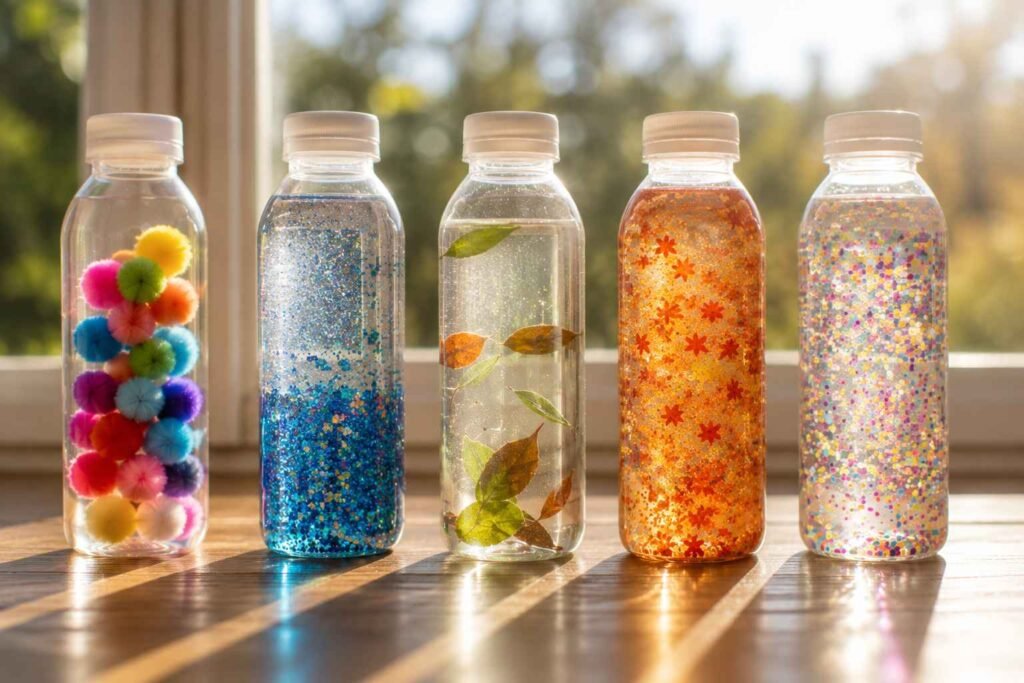
- Water with black and white high-contrast shapes or stickers on the inside of the bottle.
- A single drop of food coloring in water, kept to one calm color.
- Oil and water with one drop of color, for a slow-separating visual.
- A small amount of glitter with clear glue added, to slow the fall significantly.
What I’d skip entirely for this age group: small beads or sequins, anything with a strong scent, and rice or pasta, since the rattling sound can be too sharp for very young ears. Save those for closer to the toddler years.
Safety rules that matter more for babies
This is the part I’d genuinely call non-negotiable. A toddler can sometimes self-correct if a bottle starts to leak or crack. A baby just puts everything in their mouth.
- Use unbreakable plastic only, never glass.
- Glue the lid shut completely, every time, no exceptions.
- Check the seal weekly if it’s a daily-use bottle. Heat and repeated handling weaken the glue faster than you’d expect.
- Skip anything with small, loose parts entirely until well past the mouthing stage.
We had one bottle’s lid loosen slightly after a few weeks of daily use. Nothing happened, but it scared me enough that I started checking every bottle’s seal on Sunday nights, same routine every week.
How to actually use it (it’s not just hand it over)
The first few times, Vihaan didn’t know what to do with it at all. He just held it. That’s normal, and it’s worth not rushing.
What worked for us: holding the bottle ourselves first, slowly rolling it side to side at his eye level, narrating a little (“look, it’s moving”), then letting him take it once he was already interested. Handing a baby a sensory bottle cold, with no demonstration, often gets a flat reaction the first time. A little modeling goes a long way. If you want more ideas in this same age range, our guide to sensory activities for infants covers a lot of what worked alongside the bottles.
Frequently Asked Questions
What’s the youngest age for a sensory bottle?
Around 3 months is a reasonable starting point, once a baby can track movement with their eyes. Before that, the bottle won’t mean much to them yet, and that’s completely normal too.
Can a 6 month old use a sensory bottle unsupervised?
We never left Vihaan alone with one, even sealed and glued. Supervised use only, every time, at any age under 2.
What colors are best for young babies?
Black and white, or one or two bold primary colors. High contrast is easier for developing vision to track than soft or mixed colors.
Is glitter safe in a baby’s sensory bottle?
Yes, sealed properly with the lid glued shut. Add a little clear glue to slow the glitter’s movement, since fast-falling glitter can be too visually busy for younger babies.
How long should a baby play with a sensory bottle?
However long they’re interested, which at this age is often just a few minutes. There’s no benefit to pushing it longer than their attention actually lasts.
Can sensory bottles help with infant sleep or fussiness?
Sometimes, as a calming tool during a fussy stretch, similar to how it works for older toddlers. It’s not a sleep aid and shouldn’t go in the crib.
What I’d tell another parent
Start simpler than feels necessary. That’s the one thing I’d go back and tell myself before Vihaan’s first bottle. The fancy, colorful version is for later. At this age, the plainest bottle in the house is usually the one that works best.
If you’ve found a combination that worked well for your baby, I’d love to hear what it was in the comments.