3rd grade math worksheets
Third grade is the year math stops being mostly adding. Multiplication, division and fractions all arrive at once, and a child who skipped a step in 2nd grade feels it fast. These 3rd grade math worksheets give you 18 free printable pages and an answer key, in an order where each skill leans on the one before. I would print the times tables first, because almost everything after them uses a multiplication fact. Vihaan would probably ask why 7 times 8 is the one fact that never sticks.
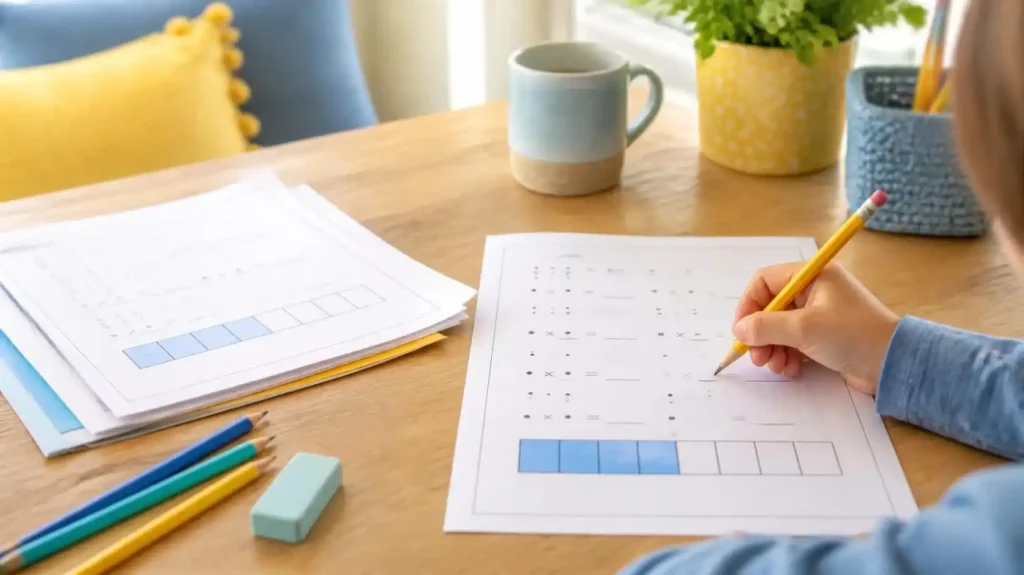
Each page is letter size (8.5 by 11 inches) with roomy boxes for writing, so a regular pencil works fine. Print at 100 percent scale on plain paper. These free printable 3rd grade math worksheets are for home or classroom use, so make as many copies as you need.
What 3rd grade math worksheets should cover
Most US third grade programs, including the Common Core standards many states build on, spend the year on a short list of big ideas: multiplication and division within 100, fractions as parts of a whole, adding and subtracting within 1,000, rounding, telling time to the minute, and area and perimeter. I built the pages in that order. A child who knows 6 times 7 can solve a word problem about boxes of pencils, and a child who can read a shaded bar is ready to compare fractions. Children who need a step back can try our 2nd grade math worksheets first.
This set is written for ages 8 to 9, which is well past most CribKind readers. If a younger brother is hanging around the table, Eeshan would probably want a pencil too, and I would hand him a crayon and a scrap of paper. For children under 3, stacking blocks and counting stairs do the same job without a page in sight.
| Page group | Pages | Skill practiced | Good first page |
|---|---|---|---|
| Multiplication | 1 to 7 | Equal groups, arrays, times tables, the multiplication grid, missing numbers | Page 1 |
| Division | 8 to 10 | Sharing equally, division facts, multiplication and division fact families | Page 8 |
| Adding, subtracting and rounding | 11 to 13 | Three digit adding and subtracting, rounding to the nearest 10 and 100 | Page 11 |
| Fractions and time | 14 to 16 | Naming fractions, comparing fractions, telling time to the minute | Page 14 |
| Area and word problems | 17 to 18 | Area, perimeter, multiplication and division word problems | Page 17 |
Multiplication worksheets and times tables
Multiplication gets seven of the eighteen pages, because the rest of the year depends on it. Pages 1 and 2 show it as pictures, with equal groups of dots and rows of circles, so a child sees why 3 times 4 means three groups of four. Pages 3 to 5 are the times tables, split by difficulty, and pages 6 and 7 turn the facts around. Our rainy day activities for kids are handy for a break between pages. Eeshan would probably race through the 2s, 5s and 10s and then slow down at the 7s.
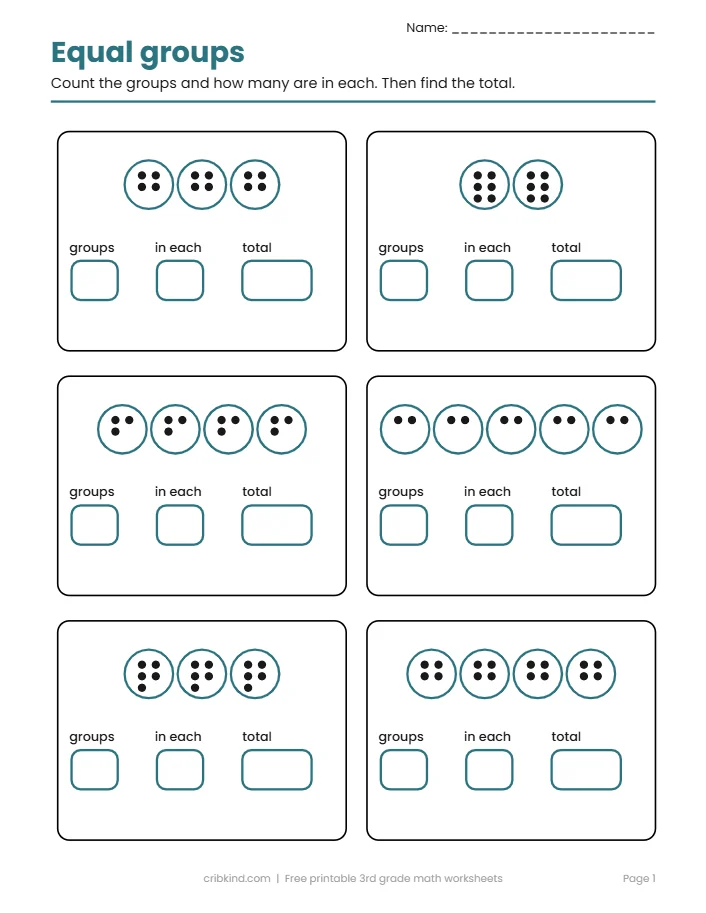
- Equal groups. Six boxes of circles with dots inside, where your child counts the groups, counts how many are in each and finds the total.
- Arrays. Four arrays of circles, from 3 rows of 6 to 5 rows of 5. Your child writes a multiplication sentence and then the same thing as repeated addition. It is the page that explains what an array is.
- Times tables 2, 5 and 10. Twelve problems with big answer boxes, and the friendliest facts of all.
- Times tables 3 and 4. Twelve problems from 3 times 4 to 4 times 9. They are mixed up so the order does not give the answer away. Skip counting out loud helps here.
- Times tables 6, 7, 8 and 9. Twelve of the harder facts, such as 7 times 8 and 9 times 6. Do these a few at a time over several days.
- Multiplication grid. A 6 by 6 table with sixteen squares left empty. Your child finds each missing product from its row and column, and you can see the pattern in the whole table at a glance.
- Find the missing number. Twelve sentences such as 4 times a blank box equals 32.
Division worksheets and fact families
I put division right after multiplication on purpose, since it is the same facts run backward. Page 8 has no numbers to divide at all. Your child draws cookies onto plates until each plate has the same amount, and then writes the share. Vihaan would probably want to eat a few cookies on the way, and I would let that become a conversation about remainders. Pages 9 and 10 move to plain division facts and fact families, where the three numbers of a family make two multiplication and two division sentences.
- Sharing equally. Six boxes, such as 12 cookies on 3 plates and 20 cookies on 4 plates. Every share comes out even. Your child draws the cookies first and then writes how many go on each plate.
- Division facts. Twelve problems like 35 divided by 5 and 24 divided by 6.
- Fact families. Four triangles, each with a product on top and two factors below. Your child writes two multiplication and two division sentences from them.
Three digit adding, subtracting and rounding
Third graders add and subtract within 1,000, which means carrying and trading can happen in two places in one problem. Page 11 has twelve adding problems and page 12 has twelve subtracting ones. Several subtraction problems start from a number with a zero in it, such as 700 minus 356, because zeros are where children most often trip. Page 13 covers rounding. The back to school season is a good time to check these skills, and our back to school checklist for parents has a few other things worth a look. Eeshan would probably get the first row right and then forget the carry in the second.
- Add three digit numbers. Twelve stacked problems such as 214 plus 325 and 618 plus 197.
- Subtract three digit numbers. Twelve problems such as 582 minus 247 and 904 minus 538. Your child trades from the next place whenever the top digit is too small.
- Rounding. Six numbers to round to the nearest 10 and six to round to the nearest 100. Halfway numbers such as 85 and 550 round up, which is the rule most classes teach.
Fraction and time worksheets
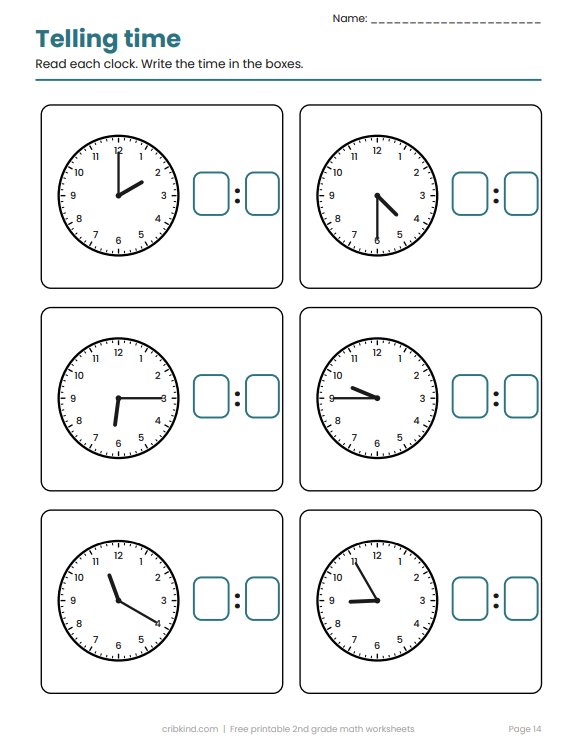
Fractions are the idea that surprises many third graders, so all three pages in this group lean on pictures. On page 14, your child writes the fraction for a shaded bar or circle in two boxes, with the top number over the bottom. Two bars sit side by side on page 15, and the question is which one is bigger. Clocks come back on page 16, now read to the exact minute instead of the quarter hour. If you ever need to talk through what the minute hand means, a real analog clock on the table helps more than a worksheet. Vihaan would probably tell me the minute hand is the long one, which is correct.
- Name the fraction. Six shaded shapes, from 1 out of 3 to 5 out of 8, where your child counts the shaded parts and then the total parts.
- Compare fractions. Six pairs of bars, such as 1 half against 1 fourth and 3 fourths against 3 eighths. Your child writes less than, greater than or equal to in each circle, and the pictures make the answer visible.
- Time to the minute. Six clocks showing times such as 2:47 and 7:09. Your child writes the hour and the minutes in separate boxes.
Area, perimeter and word problems
These last two pages bring the year together. Page 17 gives four rectangles on a grid. Your child counts the squares for the area, and then adds up the sides for the perimeter. Many children mix these two up, so the page keeps them in separate boxes, with different labels. Page 18 has six word problems that mix multiplication, division, adding and subtracting. The hard part is deciding which operation to use, and I would ask your child to say the problem in their own words first. Eeshan would probably underline the numbers and miss the question at the end.
- Area and perimeter. Four rectangles, from 3 by 3 to 6 by 3. Each has two boxes, one for the squares inside and one for the distance around.
- Word problems. Six problems, such as 4 boxes of 6 pencils and 24 apples put into bags of 4. A dotted box on each leaves room to show the work. Ask your child to explain the answer back to you.
How to print and use the answer key
Parents who search for math worksheets 3rd grade usually want pages they can print tonight, and nothing here needs a login. Print only the pages you plan to use that day, one or two at a time. Begin with the group that matches what the class is doing now, and go back a page if it feels too hard. Nobody is hurt by repeating the times tables three times, and free 3rd grade math worksheets like these cost nothing to reprint. Page 19 is the answer key, so print it once and keep it away from the table.
Keep each session short, about 10 to 15 minutes. A pencil with a good eraser helps, since a child who fears mistakes slows down. I would sit beside the child for the first page and then step back, answering questions instead of correcting answers. Check the work together with the key afterward, and let your child mark a wrong answer. If pencil control is still tiring for your child, our list of fine and gross motor skills examples has easy hand strength games. Vihaan would probably enjoy holding the key far more than doing the page.
Safe practice with pencils and younger siblings
A third grader can handle a regular pencil, but a short stub is hard to grip. Use a full length pencil with an eraser, and sharpen it before you start instead of in the middle of a page. Wash hands afterward, especially if crayons or counters were also out.
Free download: Get all 18 third grade math worksheets and the answer key as one PDF
Frequently asked questions about 3rd grade math worksheets
What math should a 3rd grader know?
Most third grade programs focus on multiplication and division within 100, fractions, adding and subtracting within 1,000, rounding, telling time to the minute, and area and perimeter. These worksheets follow that order, but your child’s school sets the exact goals.
What is an array in 3rd grade math?
An array is objects arranged in equal rows and columns, such as 3 rows of 6 circles. Counting the rows and columns gives the multiplication sentence, 3 times 6 equals 18. Page 2 is built around arrays.
Where can I find free 3rd grade math worksheets?
This post has 18 free printable pages plus an answer key. Use the download button near the top and print as many copies as you need for home or class.
Do these worksheets include answers?
Yes. Page 19 is an answer key for pages 1 to 18, so you can check your child’s work together. The answers were generated from the same numbers used to build the pages.
Do you have what’s my rule worksheets?
Not in this set. The missing number page (page 7) is the closest, since it asks for the unknown number in a multiplication sentence.
How many worksheets should a 3rd grader do in a day?
One or two is plenty for most children, at 10 to 15 minutes per page. Stop when your child is tired, because frustration teaches less than a short, easy page.
If I were setting up the first page for Eeshan or Vihaan, I would print page 3, hand over a sharp pencil, and tell them to start with the 10s. Then I would keep quiet until the last box was filled and ask which fact felt trickiest. My guess is it would be 7 times 8, and I would save that one for the next day. The rest of the pages can wait in the folder.